Saturday, November 28, 2020

The Art of Book Covers Before Dust Jackets

Like my friend, Michael Skeet, who pointed me towards this article, I'm not a collector of books as objects. I have hundreds of books on the large bookshelf beside me, but they were purchased because I wanted to read them, not because they were objects of art (although a few of them coincidentally are). 

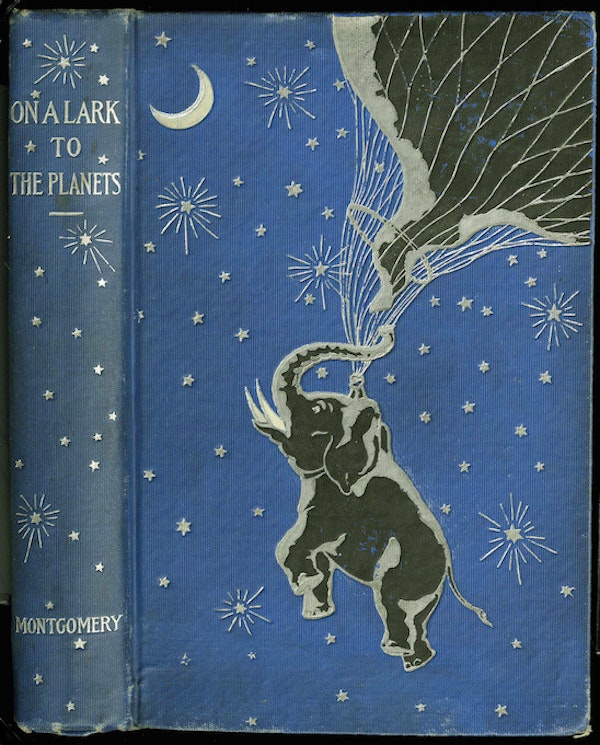
Back before printed and artistic dust jackets became prevalent, book covers were art objects. 

Inspired by rising literacy rates and advancing technologies, the nineteenth century saw the book transform from a largely hand-made object to a mass-produced product. In this new environment the book cover took on added importance: it was no longer merely a functional protection for the pages but instead became a key platform through which to communicate and sell the book. Prior to this covers had — bar a smattering of highly bespoke one-off creations (e.g. embroidered covers for personal libraries) — mostly been plain leather bound affairs. From the 1820s, with the rise of mechanical bookbinding, these leather covers of old gave way to new cloth coverings which, in addition to being inexpensive, were now also printable. A wide variety of cover printing techniques were employed over the decades: from embossing to gilt to multi-colour lithography. A totally new artistic space was opened up. As you can see in our highlights below it was one in which illustrators and designers flourished, producing a range of covers as eclectic in aesthetic approach as the myriad contents they fronted.

I think this one might be my favourite of the books shown in the article. It's from Frances Trego Montgomery's On a Lark to the Planets published in 1904.


Friday, November 27, 2020

The Long-Term Effects of Zoom Culture

A couple of years ago, I'd never heard of Zoom. At work, when we had a virtual meeting, we used Google's Meeting software (or whatever it's called this week). Since I retired, I've used a variety of platforms for virtual meetings with doctors, bankers, family, and friends, but Zoom now seems to be the default for many people. Workspaces are becoming virtual as are many entertainment events.

For one example, see this post about how businesses in Toronto's PATH network that rely on office workers are suffering because 95 percent of office workers are now working from home. Yes, people will go back to the office, eventually, but not all of them. On another from, we're now paying to watch concerts online. What happens to concert halls and theatres? 

We need to think about these effects, as this article points out. 

So, while we absolutely sh\ould be thankful for the way in which Zoom has helped us maintain some semblance of connection and productivity throughout 2020, we must also take a hard look at the many pressing needs this experience has uncovered. These issues will have to be dealt with — and soon.

Already a necessity, broadband access is going to become ever more crucial for participating in society. OpenVault, a company that provides broadband software and tracks Internet usage pointed out that an “average US home in September used 384 gigabytes of data, up slightly from 380 gigabytes in June, but up 40% from September 2019.” The growth — whether it is driven by people working from home, shopping online, getting on-demand delivery, or cord-cutting — indicated that the future got here in a hurry.

Earlier this month, Leichtman Research reported that “the largest cable and wireline phone providers in the U.S. — representing about 96% of the market — acquired about 1,530,000 net additional broadband Internet subscribers in 3Q 2020.” In the trailing twelve months, these companies added 4.56 million subscribers, which represents “the most broadband net adds in a year since 3Q 2008-2Q 2009.”

Shifts this significant have permanent ramifications. We should cast aside any belief that we will return to our previous understanding of normalcy. Many people have tasted the future, and despite its challenges, they seem to like what they have seen.


Spaceflight Does Weird Things to the Body

I recently watched and enjoyed a documentary on Netflix about astronaut Scott Kelly's almost-year-long mission to the International Space Station. Kelly, and his twin brother who stayed on Earth, were extensively studied to see how the extended period of zero gravity would affect his body.

The results are in and are quite interesting, and not necessarily in a good way.  

The researchers highlight six biological changes that occur in all astronauts during spaceflight: oxidative stress (an excessive accumulation of free radicals in the body’s cells), DNA damage, dysfunction of the mitochondria, changes in gene regulation, alterations in the length of telomeres (the ends of chromosomes, which shorten with age), and changes in the gut microbiome. 

Of these six changes, the biggest and most surprising one for scientists was mitochondrial dysfunction. Mitochondria play a critical role in producing the chemical energy necessary to keep cells—and by extension, tissue and organs—functional. Researchers found irregular mitochondrial performance in dozens of astronauts and were able to broadly characterize these changes thanks to new genomics and proteomics techniques. Afshin Beheshti, a bioinformatician at NASA and senior author of one study, says mitochondrial suppression helps explain how many of the problems astronauts experiment (like immune system deficiencies, disrupted circadian rhythm, and organ complications) are actually holistically related to each other, since they all rely on the same metabolic pathways.

“When you’re in space, it’s not just one are or organ that’s affected, it’s the whole body that’s affected,” says Beheshti. "We started connecting the dots."

Thursday, November 26, 2020

Iceland Does It Right

Iceland has done a good job of controlling COVID-19, despite keeping its borders open because of the country's heavy reliance on tourism. This article from Nature explains what Iceland has done and details some of the findings that researchers there have made about the disease.  

In a nutshell, they relied on extensive testing, contract tracking, and quarantines of people who tested positive. Some lockdowns were necessary, but are being relaxed as infections decline.

I found this especially interesting, and concerning.

In early spring, most of the world’s COVID-19 studies focused on individuals with moderate or severe disease. By testing the general population in Iceland, deCODE was able to track the virus in people with mild or no symptoms. Of 9,199 people recruited for population screening between 13 March and 4 April, 13.3% tested positive for coronavirus. Of that infected group, 43% reported no symptoms at the time of testing. “This study was the first to provide high-quality evidence that COVID-19 infections are frequently asymptomatic,” says Jade Benjamin-Chung, an epidemiologist at the University of California, Berkeley, who used the Iceland data to estimate rates of SARS-CoV-2 infection in the United States. “It was the only study we were aware of at the time that conducted population-based testing in a large sample.”

Two decades of pandemic war games failed to account for Donald Trump

A smaller population study, carried out in an Italian town, came to similar results on asymptomatic infection months later. When a 78-year-old man died in the northern Italian town of Vo’, Italy’s first COVID-19 death, the region’s governor locked the town down and ordered that its 3,300 citizens be tested. After the initial round of government testing, Andrea Crisanti, head of microbiology at the University of Padua in Italy, asked the local government whether his team could run a second round of testing. “Then we could measure the effect of the lockdown and the efficiency of contact tracing,” says Crisanti, who is currently on leave from Imperial College London. The local government agreed. On the basis of the results of the two rounds of testing, the researchers found that lockdown and isolation reduced transmission by 98%, and — in line with Iceland’s results — that 43% of the infections across the two tests were asymptomatic.

That would certainly explain why there is so much community spread and reinforces the message to "wear a mask". 

Some News About The Expanse

Amazon has announced that season 6 of The Expanse will be its last. Given that season 5, to start December 16, covers books 5 and 6 in the series, season 6 will need to cover the events of the final three books (the last of which hasn't yet been published). 

Also, Cas Anvar, who plays Alex, won't be returning in season 6. 

Amazon Studios announced in a press release that the streaming platform has given The Expanse an early renewal for season six, which Deadline first reported would be the final season. This comes a few weeks before the show is set to return on December 16 with season five, which sees the Belters rising up against Earth and Mars. However, Cas Anvar, who’s played Alex since the first season, will not be joining them for the final season—following a string of sexual misconduct allegations earlier this year. As of now, it’s unclear how much Anvar will be present in season five or how the series will address his departure in the final chapter.

Hopefully, the writers and producers will do a better job of concluding the series than those of Game of Thrones.

Wednesday, November 25, 2020

A Good Site for Vision Information

I'm always interested in information about vision problems and Vision Center is a good one. 

It has several major sections dealing with eye conditions, eye glasses, contact lenses, and LASIK surgery. Each section has subsections with more detailed information. For example, the section on eye conditions has topics ranging from the relatively benign, like eye twitching, to the serious, like macular degeneration. 

As far as I can tell from personal experience and my educated layman's perspective, the information seems accurate and clearly presented. The site's disclaimer does say that all topics are reviewed by a licensed optometrist. 

Vision Center appears to be associated with Zodiac, a "digital healthcare marketplace", whatever that means. There are links in the articles that encourage you to book appointments with their network. 

I would use this site as a first reference, as it's well organized and easy to understand. However, I'd also recommend backing it up with research on another site, like the Mayo Clinic.


Upgrading Old Movies

AI technology is making it possible to upgrade old movies to make them look remarkably good, much sharper and smoother than the originals. It even makes it possible to colorize black-and-white films, although the results here are somewhat less convincing.

If you're interested in how this technology works, Wired has an overview of the most common techniques. Several examples are linked in the article. 

ON APRIL 14, 1906, the Miles brothers left their studio on San Francisco’s Market Street, boarded a cable car, and began filming what would become an iconic short movie. Called A Trip Down Market Street, it’s a fascinating documentation of life at the time: As the cable car rolls slowly along, the brothers aim their camera straight ahead, capturing women in outrageous frilly Victorian hats as they hurry across the tracks. A policeman strolls by wielding a billy club. Newsboys peddle their wares. Early automobiles swerve in front of the cable car, some of them convertibles, so we can see their drivers bouncing inside. After nearly a dozen minutes, the filmmakers arrive at the turntable in front of the Ferry Building, whose towering clock stopped at 5:12 am just four days later when a massive earthquake and consequent fire virtually obliterated San Francisco.

Well over a century later, an artificial intelligence geek named Denis Shiryaev has transformed A Trip Down Market Street into something even more magical. Using a variety of publicly available algorithms, Shiryaev colorized and sharpened the film to 4K resolution (that’s 3,840 horizontal pixels by 2,160 vertical pixels) and bumped the choppy frame rate up to 60 frames per second, a process known as frame interpolation. The resulting movie is mesmerizing. We can finally see vibrant colors on those flamboyant Victorian hats. We can see the puckish looks on those newsboys’ faces. And perhaps most importantly, we can see in unprecedented detail the … byproducts that horses had left on the ground along the cable car’s tracks.

Tuesday, November 24, 2020

Forensic Examination of the Beirut Explosion

The explosion of stored ammonium nitrate that devastated the port of Beirut earlier this year was widely photographed and recorded on video. This has helped a team of forensic architects to model the explosion and determine exactly how it started and why it was so destructive.  

FA launched its probe with an invitation from the Egyptian independent online publication Mada Masr. The research group used publicly available images and videos of the blast, among other open-source materials and documents, to create a 3D model of the explosion and a timeline that reconstructs the events of August 4.

 Through spatial and architectural analysis of the images and videos, FA was able to locate the sources of the smoke plumes, fires, and explosions at the port, and to map the interior of the warehouse where 2,750 bags of ammonium nitrate were haphazardly stored.

The analysis found indications for the presence of flammable materials like fireworks and car tires in close proximity to the cache of ammonium nitrate. According to the investigation, these materials likely helped detonate about half of the 2,700 tonnes of ammonium nitrate inside the warehouse. The analysis also found that many of the warehouse’s doors and windows were shut, creating hot temperature areas that brought the ammonium nitrate to its combustion point.

Gareth Collett, an explosives expert for the UN who consulted FA in its investigation, said that the arrangement of goods within the building was “the spatial layout of a makeshift bomb on the scale of a warehouse, awaiting detonation.”

I highly recommend watching the video linked in the article. It is extremely well done and one of the best examples I have seen of integrating 3D modelling and photographs and videos as well as summarizing all the other information that was made available to the Forensic Architecture team. 


Some Short Video Reviews

Here are some short reviews of videos I enjoyed watching.

Monday, November 23, 2020

Best SF and Fantasy Books of 2020

Each year, the reviewers at Tor.com publish a list of their favorite books for the year, and the list for 2020 is now up. 

It’s been a long and strange year, but one comforting thing that kept us going were the consistently amazing book releases in the genres of science fiction, fantasy, young adult, and beyond. Our reviewers each picked their top contenders for the best books of the year—and they almost all chose different titles! This year’s highlights run the gamut from action-packed science fiction and genre-bending epic fantasy, to neo-gothic horror and powerful anthologies. We’ve got ghosts, we’ve got empresses, we’ve got revolutionaries and superheros and wormholes in retail stores!

From the list, these are the titles that I intend to read or that I think should be worth reading though they don't suit my tastes.

  • Hench by Natalie Zina Walschots
  • Machine by Elizabeth Bear (this is one that I bought)
  • The City We Became by N. K. Jemisin
  • Mexican Gothic by Noémi Taoboda
  • Quotients by Tracy O'Neill
  • Piranesi by Susanna Clarke
  • Unconquerable Sun by Kate Elliot
And I will add to the list a book that the Tor.com reviewers didn't include but I enjoyed, Robert J. Sawyer's The Oppenheimer Alternative. I will also add Kim Stanley Robinson's The Ministry for the Future, which based on reviews and a podcast interview that I've heard, has jumped to the top of to-be-read queue after I finish Peter F. Hamlton's Salvation trilogy. 

COVID-19 Can Cost You Your Sense of Smell

COVID-19 is often thought of as a respiratory disease like the flu, but it can affect other parts of the body and have many other symptoms. One of them is loss of the sense of smell and sometimes taste.

An estimated 80 percent of people with COVID-19 have smell disturbances, and many also have dysgeusia or ageusia (a disruption or loss of taste, respectively) or changes in chemesthesis (the ability to sense chemical irritants such as hot chilies). Smell loss is so common in people with the disease that some researchers have recommended its use as a diagnostic test because it may be a more reliable marker than fever or other symptoms.

One lingering mystery is how the novel coronavirus robs its victims of these senses. Early in the pandemic, physicians and researchers worried that COVID-related anosmia might signal that the virus makes its way into the brain through the nose, where it could do severe and lasting damage. A suspected route would be via the olfactory neurons that sense odors in the air and transmit these signals to the brain. But studies have shown that this is probably not the case, says Sandeep Robert Datta, a neuroscientist at Harvard Medical School. “My gestalt read of the data to date suggests that the primary source of insult is actually in the nose, in the nasal epithelium,” the skinlike layer of cells responsible for registering odors. “It looks like the virus attacks, predominantly, support cells and stem cells and not neurons directly,” Datta says. But that fact does not mean that neurons cannot be affected, he emphasizes.

Most people recover their sense of smell after a few weeks, but in others it can take months, and it may not come back at all or return with unpleasant effects, like everything smelling of drain cleaner. Yet another reason to social distance and wear that mask! 

Sunday, November 22, 2020

Featured Links - November 22, 2020

Links to things I found interesting but didn't want to do a full blog post about.

Saturday, November 21, 2020

Dueling Dinosaurs

Fossil hunters have found the first complete skeleton of a T-Rex. Not only is complete, and in good condition, but it's locked in combat with a triceratops, also a complete and well preserved skeleton.


It has been described as ‘one of the most important paleontological discoveries of our time’ – and is the only 100% complete T-rex ever found. Dr Lindsay Zanno, head of palaeontology at the museum, said: ‘We have not yet studied this specimen; it is a scientific frontier.

‘The preservation is phenomenal, and we plan to use every technological innovation available to reveal new information on the biology of the T. rex and Triceratops. ‘This fossil will forever change our view of the world’s two favourite dinosaurs.’

 The 10-year-old in me is jumping up and down and yelling: "I want to see this!"


Some Articles About COVID-19

Here are some recent articles about COVID-19 that I thought worth sharing.

Friday, November 20, 2020

Fifty Years Ago My Life Changed

November 1970. I was in my third year of studies at the University of Windsor, taking a major in English Literature, although in reality my major was working at the student radio station and going to as many concerts as I could afford. I'd heard the Grateful Dead, of course; their album, Workingman's Dead, had come out earlier that summer, and I had driven my parents crazy playing Uncle John's Band as loud as my cheap record player would permit (and getting told off for playing a song with "god damn" in the chorus). 

I wouldn't have called myself a Deadhead at the time. I was much more into the Jefferson Airplane, having seen them twice in Detroit by that point. Friends of mine asked me if I wanted to go to Rochester, where some of them were from, to see the Dead at the University of Rochester on November 20th. I wasn't too keen on the idea, but it turned out that the Airplane were playing in Rochester the same night, and they told me the Airplane would probably come over and jam after their show was over. That was enough to get me to drive 300 miles to Rochester with four other people crammed into a Volkwagon Beetle. 

The concert started with a set by the New Riders of the Purple Sage, a psychedelic country band, with Jerry Garcia sitting in on pedal steel. I remember little of their set, other than being blown away by Garcia's playing. 

The Dead were something else. I wasn't a Deadhead when I walked into the gym, but I was after about five minutes of Cold Rain and Snow, their first song. That's all it took. I've heard of people becoming heroin addicts on their first shot. The Dead's music was like that. It hit your mind, your body, and your soul, and filled them all with joy.

I don't remember a lot of the concert, due to the mists of time and various substances consumed that night. I do remember being able to get right up close to the band as they were playing in a gym on a low, makeshift stage. I remember dancing - you could not sit still during a Grateful Dead concert. I remember the third set (or maybe an extended second set) with Jorma Kaukonen from the Airplane. It finally ended sometime around 2:00 a.m. Word was that the Airplane wanted to do a set, but the university security people shut them down. Considering the concert had started around 7:30 the previous evening, I can't really blame them.


(I am pretty sure this picture is from the Palestra concert-note the basketball hoop. Jorma is just to Bob Weir's left).

The Dead became a part of my life that night, and never left. I'm listening to an episode of the Good Ol' Grateful Deadcast as I type this, an episode about the recording of American Beauty which had just been released in November 1970. And I become a tape trader and amassed a sizeable collection of concert recordings. Their music became the soundtrack to my life.

I saw them eight times. Each concert was different and each was magic in its own way. Their July 4, 1986 concert in Buffalo was probably responsible for my current marriage, as Nancy was one of the group I drove down to Buffalo with, and it was the first time I really got to know her. 

Thanks to the magic of Maxell (or maybe it was Ampex) and the bearded guy with the reel-to-reel tape deck in the middle of the floor, a tape of the concert survives and you can download or stream it from the Grateful Dead's section of the Internet Live Music Archive. By modern standards, it's not the greatest quality recording and there are cuts and dropouts, but it's good enough. There's a review of the show here that describes it as "raw and thrilling", which is pretty accurate. It probably won't change your life the way it changed mine, but you might get lucky.

 "Once in a while you get shown the light in the strangest of places if you look at it right." - Grateful Dead - Scarlet Begonias


How to Avoid Social Media Phishing Scams

I'm sure most of us are aware of how to avoid email phishing attacks (at least, those of us who still use email). But phishing also occurs on social media platforms. Here's a good article on what to watch out for on platforms like Facebook, Instagram, and LinkedIn. 

Facebook is the third most commonly impersonated brand for phishing attacks. With over 2.6 billion users worldwide, it’s easy to see why. The platform offers a plethora of profiles and messages teeming with personal information for phishers to exploit.

Attacks on Facebook are often targeted towards consumers and not as much on big organizations. Phishers use social engineering to lure unsuspecting victims into exposing their data.

They will pretend to be from Facebook and send emails to users about a security alert, for example. From there, users are instructed to log in to their Facebook profiles and change their password. They’re then sent to a fake Facebook login page where their credentials are harvested.

Thursday, November 19, 2020

Arecibo To Be Decommissioned

After 60 years of service, the giant Arecibo radio telescope in Puerto Rico will be decommissioned after a series of cable failures rendered it inoperable and unsafe to repair. The news was announced today, and from what I can see on my social media feeds, it has been met with a chorus of sadness.  

Also, after the incident engineers determined the weight it bore was only at 60% of its minimum breaking strength, and it was a calm day (no wind). Apparently the problems in the cable were deeper than suspected. This also raises concerns that the remaining 11 cables may be worn more than previously thought. No one knows if the other cables are damaged or not, or if they can carry the designed load for much longer.

After consideration and an investigation by an engineering team, the NSF concluded that there is no way to fix these problems while still maintaining the safety of any crew who would do the work. Stabilizing or replacing the cable may also accelerate the collapse. The NSF therefore decided to decommission the telescope.

It's not clear what might have damaged the cables. They were very old, and moisture seeping in over the years may have contributed to the problem. Also, Puerto Rico has been battered by hurricanes which strain the structure, and a series of earthquakes near the observatory struck late in 2019 as well. Any or all of these may have been part of the issue.

While it's possible that a new telescope could be built on the same site, there's currently no funding in place to do that. Given the anti-science mood that seems to be prevalent these days, I'm not holding my breath.  

How the Pandemic Has Changed Life In Toronto

The pandemic has had a huge effect on all of our lives. That's especially true in Toronto. Using statistics from Google, the folks at BlogTo.com have been able to quantify some of the effects. 

The ways in which we all get around, procure food and spend our leisure time in particular have all seen significant shifts since the pandemic first hit in March, according to newly-released data from Google Maps

"The world has changed in 2020, and so has the way that we navigate it. From where we spend our time to how we get there - and everything in between," wrote the tech company in a release announcing its findings.

"As we head into the final months of 2020, Google Maps dove into Popular Times, traffic and search data to see where and how Torontonians have changed their patterns during the pandemic (March 2020 - October 2020)."

First up, transportation: Google saw a 53 per cent uptick in people looking at "cycling directions" for map routes, year over year, compared to the same time period in 2019.

This is, perhaps, unsurprising to people who regularly hit the roads, as bike traffic has been increasing not only since the pandemic, but steadily for more than a decade alongside a booming population and worsening congestion.

I suspect that many of the changes outlined in the article would be common to most large cities, especially in Canada.  

Wednesday, November 18, 2020

Why COBOL Is Still Around

Although the most popular computer languages are relatively modern, like JavaScript, C#, C++, Go, and PHP, many of the world's largest financial systems run on COBOL, which has been around since the 1960s. There are good reasons for that, as this article points out. 

There are an estimated 240 billion lines of COBOL out there, and they're the backbone of your financial life — 95% of the time when you swipe your bank card, there's COBOL involved, and every night when the work-day is over, the massive mainframe farms of big banks leap into action, using COBOL to balance the day's books.

Why is COBOL — which debuted in 1969 — still so crucial to everyday life? The online finance magazine Wealthsimple asked me to write about that, so I talked to tons of COBOL folks, including some programmers who wrote bank routines in the 1980s that are still being used today — they're long retired, in their 70s, and their banks still call them up to ask them to maintain the stuff.

There are lots of reasons COBOL's still around, but one that's intriguing is that three-decade-old code is stable as hell. You have code in production that long, it's been debugged within an inch of its life; and they've had decades to tweak the compilers — which turn the COBOL into instructions for the machine — for massive efficiency.

This turns the new-new-thing hype of Silicon Valley on its head, of course. It's a sector obsessed with the hottest, latest thing — but as any programmer can tell you, the hottest, latest thing that just got shipped at 2 am is gonna be a rickety kluge of buggy code. That old COBOL, though? In service since the days of early MTV? It's tough as old boots.

During my time as a technical writer, I've been involved in several projects that aimed to either replace COBOL code, or bolt on a snazzy new front end written in the hot language of the day. Guess what. That legacy code is still running, although the mainframe may have been replaced by more modern hardware and the front-end software has been rewritten or replaced several times.

How The Atlantic Fact-Checks Articles

I've been reading The Atlantic on and off for a long time and this year I've read almost all of their excellent pandemic coverage (which they have generously put outside of their paywall). Recently, a friend gifted me a subscription, so I can now read more than a handful of other articles each month. 

Why do I read The Atlantic? One reason is that they hire great writers and their articles are almost always eminently readable. Another reason is their journalistic reputation. They have a well-deserved reputation for accuracy, and their articles are thoroughly fact-checked. 

And I do mean thoroughly. Here's an article that explains how one fact-checker worked on an article about ISIS in 2015. As a technical writer/editor, I'm used to checking that my work, or material that I edit, is accurate, but this is a whole other level of work.

  1. Get familiar with the material. I read the piece a few times and educate myself on the topic. Then the author either annotates the piece with sources in footnotes or simply walks me through it. This gives me a sense of how the piece was put together: What or who are the sources? Who might be difficult or sensitive to deal with? What did the author read? Then I ask the most important question: What is the author most worried about? Often it is the understandable fear that a highly sensitive source might not want to cooperate with the checking process. More on that soon.
  2. Break down the piece with a red pencil. Every checker has a different system but I’m old-fashioned and still work on paper. I format the piece with wide margins so I can clearly keep track of which source is responsible for which fact. Months later, I need to be able to see the backup for everything. I then underline all the facts that have to be checked in red pencil. Proper names are highlighted. Legal sections are noted in red marker with lots of circled stars to indicate a need for triple-checking. Anything that I have confirmed gets a check mark through it—and, oh, the lovely satisfaction of making a check mark! The checked text disappears into the background, allowing me to focus on the lingering unchecked text. If I’m worried about a detail and want to discuss with the author, I’ll highlight it in yellow, and list possible solutions on a sticky note. After Graeme and I agreed on a change, I circled it with a red pen.

It goes on through seven steps. 

I can't imagine how the author and other fact-checkers and editors at The Atlantic must feel when their magazine is described as "fake news".