Thursday, March 24, 2022

The Threat of Melting Permafrost and Methane

Over the last year or two, I've been seeing more articles about melting permafrost and how it releases methane into the atmosphere. Methane is a potent greenhouse gas that traps heat in the atmosphere about 20 times more than carbon dioxide. It isn't as persistent as CO2 but there is a lot of it trapped in permafrost in the arctic and antarctic. 

You may have seen pictures of arctic buildings that are leaning or have collapsed because the permafrost under their foundations has melted. But there's also permafrost under the seafloor (submarine permafrost) and that is beginning to thaw as the ocean warms. 

Yet submarine permafrost is largely unstudied, owing to its inaccessibility—renting out time on a research vessel is not cheap anywhere, much less in the Arctic, and it's much harder to reach for drilling samples. Now, in an alarming paper published last week in the Proceedings of the National Academy of Sciences, an international team of scientists give us a rare look at what’s going on down there. The team used oceanic robots, which look like torpedoes, off the coast of northern Canada and mapped the seafloor with sonar. The scientists repeated this several times over the course of nine years to get a sense of how the topology of the seafloor might be changing and found that it’s undergoing massive upheaval.

 The result is the worrisome image shown above—a massive sinkhole indicating that the subsea permafrost has thawed and collapsed. This sinkhole is a giant among dozens of pockmarks the researchers found on the seafloor. Scientists have already documented this violent phenomenon, called thermokarst, on land. Because permafrost is made of soil suspended in a matrix of frozen water, when it thaws the land shrinks, gouging massive holes across the Arctic landscape. And as these images of the seafloor show, it’s also happening underwater.

“I think it's just absolutely remarkable that there are places on the seafloor where changes of this scale are happening at this rate,” says Monterey Bay Aquarium Research Institute marine geologist Charlie Paull, a coauthor on the paper. The entire survey covered an area that’s half the size of Manhattan and tallied 40 holes. (You can see a portion of the area in the image below.) The giant one, he says, “is equivalent to a whole New York City block composed of six-story apartment buildings.”

If you want a more visual exploration of the problem of melting permafrost releasing methane, watch the PBS Nova episode "Arctic Sinkholes". 

Colossal explosions shake a remote corner of the Siberian tundra, leaving behind massive craters. In Alaska, a huge lake erupts with bubbles of inflammable gas. Scientists are discovering that these mystifying phenomena add up to a ticking time bomb, as long-frozen permafrost melts and releases vast amounts of methane, a potent greenhouse gas. What are the implications of these dramatic developments in the Arctic? Scientists and local communities alike are struggling to grasp the scale of the methane threat and what it means for our climate future.

I watched this last night and the implications, understated as they are in the show, are quite terrifying.  


Wednesday, March 23, 2022

Review: The Next Civil War by Stephen Marche

If you've been reading this blog for a while, you will know that I think the United States is in serious trouble. I was not surprised by the January 6th insurrection, and I would not surprised if there was more and more extreme political violence in 2022 and 2024. 

If you want an idea of how bad things could get, read The Next Civil War: Dispatches from the American Future by Stephen Marche. 

In it, he outlines, in detail, several scenarios that could lead to the collapse or break up of the United States. Along with those scenarios a (a Bundy-style alt-right protest that gets suppressed by the military, a presidential assassination, and more), he provides copious background information to explain how and why each scenario could come to pass. 

It makes for some pretty grim reading and Marche isn't much of an optimist. There may be a path forward that doesn't end up in widespread civil unrest or a breakup of the country, but he thinks it's going to be very hard to find. It is also a very well-written book and very hard to put down. I plowed my way through it in five days, and that wasn't entirely due to the fact it was a library loan and had to be returned in seven. 


Tuesday, March 22, 2022

SpaceX To Use New Booster, Ship for Orbital Test

In a tweet yesterday, Elon Musk announced that SpaceX will use a new booster and ship for their first orbital test flight. The current compo of Booster 4 and Ship 20 will be retired without a test flight. This means that the first orbital test flight will occur no earlier than sometime in May, and that is likely an optimistic target.  

Crucially, Musk revealed that the first Starship to attempt an orbital-class launch will now feature upgraded Raptor V2 engines – engines that require an entirely new thrust structure design. That already all but guaranteed that B4 and S20 had been overtaken but Musk also explicitly confirmed that they would be replaced with a new pair in a later tweet.

That new pair – widely assumed to be Super Heavy B7 and Starship S24 – feature a wide range of design changes, including substantially modified header tanks, an entirely new nosecone design, new layouts for secondary systems (pressurization, avionics, heat exchangers, etc.), and more. Most importantly, their thrust structures – giant ‘pucks’ machined out of steel – have been tweaked to support new Raptor V2 engines instead of the Raptor V1 and V1.5 engines that have been installed and tested on all Starship and Super Heavy prototypes to date.

Monday, March 21, 2022

Featured Links - March 21, 2022

Links to things I found interesting but didn't want to do a full blog post  about. 


Sunday, March 20, 2022

Photo of the Week - March 20, 2022

I bought a new lens for my Fujifilm X-S10, a 27 mm. F2.8. Here's the first picture I took with it. Meet Tea Sea, who we inherited when my mother-in-law died earlier this year.

Fujifilm X-S10 with 27 mm. F2.8 at F5.6, 1/34 second, ISO 3200, Velvia film simulation


Saturday, March 19, 2022

Saturday Sounds - The Firesign Theatre - I Think We're All Bozos On This Bus

The Firesign Theater were perhaps the premiere comedy troupe of the pyschedic era. Their best work was complex, funny, very twisted, and aimed squarely at the stoner counterculture of the late 1960s and early 1970s. 

The Firesign Theatre was the brainchild of Peter Bergman, and all of its material was conceived, written, and performed by its members Bergman, Philip Proctor, Phil Austin, and David Ossman. The group's name stems from astrology, because all four were born under the three "fire signs": Aries (Austin), Leo (Proctor), and Sagittarius (Bergman and Ossman). Their popularity peaked in the early 1970s and ebbed in the Reagan Era. They experienced a revival and second wave of popularity in the 1990s and continued to write, record and perform until Bergman's death in 2012.

In 1997, Entertainment Weekly ranked the Firesign Theatre among the "Thirty Greatest Comedy Acts of All Time". Their 1970 album Don't Crush That Dwarf, Hand Me the Pliers was nominated in 1971 for the Hugo Award for Best Dramatic Presentation by the World Science Fiction Society, and their next album I Think We're All Bozos on This Bus received the same nomination in 1972. Later, they received nominations for the Grammy Award for Best Comedy Album for three of their albums: The Three Faces of Al (1984), Give Me Immortality or Give Me Death (1998), and Bride of Firesign (2001). In 2005, the US Library of Congress added Don't Crush That Dwarf to the National Recording Registry and called the group "the Beatles of comedy."

I've not listened to their albums in a long time, but I still remember their earlier work with fondness. I'm linking here to I Think We're All Bozos On This Bus, which is probably the most accessible album to modern ears. 

Friday, March 18, 2022

The Latest Update to the OED

The Oxford English Dictionary, aka the OED, is the premiere dictionary of the English language. Given how fast the language changes, the lexicographers at the OED are constantly updating it. The March 2022 update has more than 700 new words and phrases.  

This update contains nearly 700 words, senses, and phrases which have been researched, defined, and included in OED for the first time, from absolute threshold to ydraw. Absolute threshold, the level or point at which a stimulus—such as sound, touch, or smell—reaches sufficient intensity to become consciously perceptible, is a loan translation of a German phrase, first used in English in 1892. Ydraw is a verb obsolete since the fifteenth century and first recorded in Old English with reference to the sweeping of the hem of a garment.

More recent linguistic developments covered in this update include burner phone, an inexpensive prepaid mobile phone, especially one used for a short time and then destroyed or discarded to protect the owner’s anonymity, first recorded in a 1996 song by rapper Kingpin Skinny Pimp, and the shortened burner in the same sense, first seen from 2002.

A trigger warning, a warning before a piece of writing or other content that may cause distress, especially by reviving upsetting memories in people who have experienced trauma, is first recorded in a 1993 Usenet newsgroup for survivors of abuse. Content warning, also added in this update, is now often used in the same sense, but its other current sense—denoting a notice accompanying a film, video game, or written publication, warning that it contains material potentially offensive to some audiences or unsuitable for children—is earlier, with evidence stretching back to 1977.

For more details, see the article linked above. 

Thursday, March 17, 2022

Weaponizing AI-Based Drug Development

Trigger warning: If you suffer from anxiety, you may want to skip this post. 

The trope of a mad-scientist or terrorist developing a bio-weapon has been around in science fiction for many years; see Frank Herbert's The White Plague for an early example. Now we have something else to worry about. 

Many companies and academic researchers use AI-based software to optimize drug development. Basically, the software helps them find chemicals that have low toxicity and high efficacy. But what happens if you instead, ask the software to optimize for high toxicity? You get a weapon. 

That's what a US-based company, Collaborative Pharmaceuticals Inc., found when they decided to tweak their software for toxicity as part of a presentation for a Swiss security conference. The results were, to put it mildly, troubling, as they describe in this article for Nature.

The Swiss Federal Institute for NBC (nuclear, biological and chemical) Protection —Spiez Laboratory— convenes the ‘convergence’ conference series1 set up by the Swiss government to identify developments in chemistry, biology and enabling technologies that may have implications for the Chemical and Biological Weapons Conventions. Meeting every two years, the conferences bring together an international group of scientific and disarmament experts to explore the current state of the art in the chemical and biological fields and their trajectories, to think through potential security implications and to consider how these implications can most effectively be managed internationally. The meeting convenes for three days of discussion on the possibilities of harm, should the intent be there, from cutting-edge chemical and biological technologies. Our drug discovery company received an invitation to contribute a presentation on how AI technologies for drug discovery could potentially be misused.

The thought had never previously struck us. We were vaguely aware of security concerns around work with pathogens or toxic chemicals, but that did not relate to us; we primarily operate in a virtual setting. Our work is rooted in building machine learning models for therapeutic and toxic targets to better assist in the design of new molecules for drug discovery. We have spent decades using computers and AI to improve human health—not to degrade it. We were naive in thinking about the potential misuse of our trade, as our aim had always been to avoid molecular features that could interfere with the many different classes of proteins essential to human life. Even our projects on Ebola and neurotoxins, which could have sparked thoughts about the potential negative implications of our machine learning models, had not set our alarm bells ringing.

Our company—Collaborations Pharmaceuticals, Inc.—had recently published computational machine learning models for toxicity prediction in different areas, and, in developing our presentation to the Spiez meeting, we opted to explore how AI could be used to design toxic molecules. It was a thought exercise we had not considered before that ultimately evolved into a computational proof of concept for making biochemical weapons.

This is the scariest article about potential misuse of technology that I've read in quite some time. It's the first time I've ever put a trigger warning on my blog. I rather wish I hadn't read it myself; my anxiety levels are high enough (COVID-19 and Ukraine) as they are. 


Wednesday, March 16, 2022

The Perils of Thought Scams

 Here's an interesting article about the perils of mis- and disinformation written from a Canadian perspective. The author uses the term "thought scams" which I haven't come across before but is a good descriptor. We Canadians have a tendency to be somewhat smug and dismissive about some of the political excesses that we seen in othe countries, especially  the United States. But as the recent "Freedom Convoy" and occupation of Ottawa have shown, we're not so different. 

In the face of an increasingly disastrous war in Ukraine, Russia is shutting down independent media outlets, and threatening massive punishments for anyone caught spreading “fake news.” But Russian citizens aren’t the only victims of that country’s propagandizing and disinformation campaigns: Russia, and other foreign regimes, have been pushing insidious thought scams on Canadians for years, robbing our institutions of trust and our citizens of informed thought.

Foreign bad actors have worked hard to sow conspiracy theories, distrust and division. They encouraged anger and disinformation to impact recent American elections, and they have become well-entrenched here in Canada too.

Researchers at Simon Fraser University found Russia and Iran have been “spreading disinformation around highly emotional and divisive issues to further their strategic interests” in Canada. 

But let’s be clear, the foreign, state-sponsored bad actors aren’t the only ones creating fake news. Often, their most effective attempts to amplify misinformation and lies begin with stories and claims that began right here at home. In a single week last month, as protesters descended on Ottawa and tensions around the country ran high, we saw a fake death by horse-trampling, a fake Governor General registry of 3.5 per cent of Canadians to secure a vote of no confidence, a fake frozen bank account, and a fake UN reinforcements story because a plane was getting maintenance in North Bay.

Tuesday, March 15, 2022

The Amazon Rainforest May Be in Trouble

News about climate change has been pushed into the background for a while because of the pandemic and the war in Ukraine. But it's not going away and some of the news is not good.

We've known for some time the Amazon rainforest is in serious trouble, with deforestation destroying more and more of the forest. Now a new study suggests that the rainforest is losing it's ability to recover from external stresses like drought, not to mention the impacts of human settlement.

A paper published today in the journal Nature Climate Change aims to provide more clarity on that tipping point, which may be rapidly approaching. While prior research used complicated modeling to predict how the decline might unfold, this new research is based on satellite data that shows 75 percent of the Amazon has become less resilient to disturbances like drought.

For a forest, one way to track resiliency is through a satellite measurement called vegetation optical depth, or VOD, which penetrates through the canopy and detects how much woody biomass there is. (Other satellite techniques just look at the tops of trees, but VOD gets a better picture of what’s hidden underneath.) These scientists also looked at a separate data set tracking changes in types of land cover—for instance, forest versus farms—which allowed them to pick out where urban areas and croplands have intruded on the rainforest. Because they had data going back to 1991, they could watch how long it took for a given plot of the Amazon to recover by growing its biomass back after a disturbance. This regrowth is resilience.

And the Amazon is losing it. The researchers broke the rainforest up into an imaginary grid, allowing them to keep track of vegetation within the cells and to correlate that with stressors like droughts or nearby land development. 

They found that the vegetation in over three-quarters of the Amazon has been losing resilience since the early 2000s—a slower rate of return to normal after disruptions. Because the researchers also had that land-cover data, they could further show that areas that receive less rainfall or are closer to human disturbances, like farmland, are losing resilience faster than wetter, unsullied land. 

Sunday, March 13, 2022

Featured Links - March 14, 2022

Links to things I found interesting but didn't want to do a full blog post about. No politics or COVID-19 this week. 

Photo of the Week - March 13, 2022

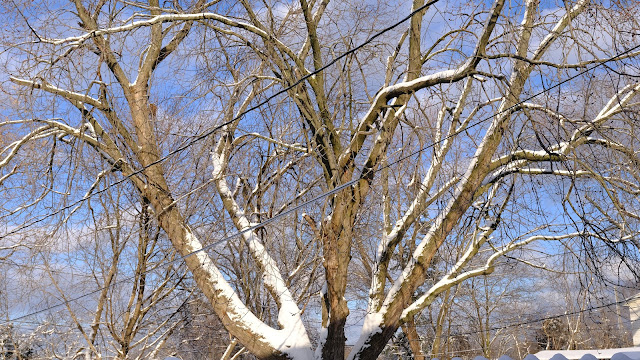
I love looking at the bare tree branches overhead at this time of year. This photo was a grab shot with my Pixel 4a. 


Saturday, March 12, 2022

Saturday Sounds - Rusty McCarthy - Great Lakes Nocturnes

Rusty McCarthy is a guitarist, songwriter, and producer living in Sault Ste. Marie, Ontario. When I was in high school he was in the biggest local band, the Polisi Bassoon, and went on to a successful musical career in Southern Ontario before moving back to the Sault. 

He has numerous solo albums and this week I'm featuring a collection of instrumentals called Great Lakes Nocturnes. With titles like "Harmony Bay", "St. Mary's River Fantasy" and "On Georgian Bay", the northern Ontario influences are obvious. This is a quieter album than some of his others and very pleasant. 

Friday, March 11, 2022

The Roots of Modern SF

It's a common belief that modern science fiction as a genre began with the publication of Hugo Gernsback's Amazing Stories in 1926 and came to maturity in Astounding in the 1940s under the editorship of John W. Campbell. That's true, at least as far as the commercial development of SF, but ignores the many literary predecessors going back at least as far as Mary Shelley's Frankenstein.

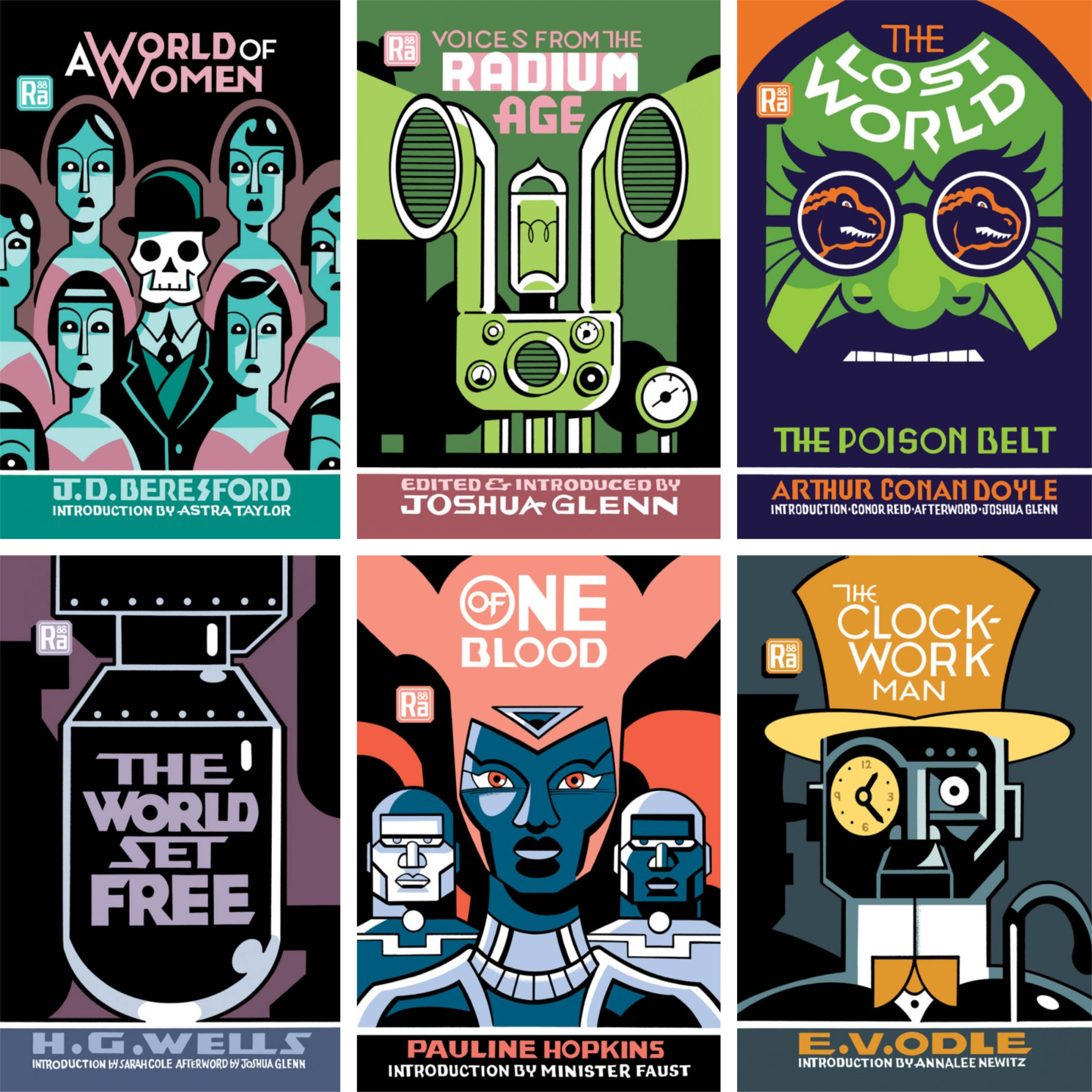
MIT Press is launching a series of books, published under the banner of The Radium Age that will shed some light on the early works that influenced modern authors. Although it includes works by Wells and Doyle, most of the title will be unfamiliar to modern readers. 

MIT Press is launching a new project today: it's publishing a new series, The Radium Age, which'll be edited by Joshua Glenn, which will examine the works that came before the Golden Age of science fiction — works that he believes held a great influence on the genre that followed, and which have largely been forgotten.

The first installment, Voices from the Radium Age, comes out today. Edited by Glenn, it's a collection of shorter works by authors like Rokeya Sakhawat Hossain, William Hope Hodgson, Arthur Conan Doyle, Jack London, W. E. B. Du Bois, and more, all published between 1905 and 1931. After that, the press will release J.D. Beresford's A World of Women, originally published in 1913.

Other installments will hit bookstores later in the year. May brings E.V. Odle's 1920 novel The Clockwork Man, and H.G. Wells' The World Set Free, August will see Of One Blood by Pauline Hopkins and Nordenholt's Million by J.J. Connington, and Rose Macaulay's What Not will debut in October. Other titles, like Theodore Savage by Cicely Hamilton, and Arthur Conan Doyle's The Lost World and The Poison Belt will come in 2023.

This is an interesting project. When I was in university studying English literature, I read a few books from that era but other than Wells, no works of science fiction and fantasy were on the curriculum. Maybe the series will help to change that.

And the covers are gorgeous. 


Thanks to Andrew Liptak and his Transfer Orbit newsletter for bringing this to my attention. I highly recommend subscribing.

Thursday, March 10, 2022

2021 Nebula Awards Ballot

The Science Fiction and Fantasy Writers of America (SFWA) have announced the nominees for the 2021 Nebula Awards. The winners will be announced on May 21, 2022 in a webcast, which will be part of the (virtual) Nebula Conference Online. 

These are the nominees for the Nebula Award for Novel:

  • The Unbroken, C.L. Clark (Orbit US; Orbit UK)
  • A Master of Djinn, P. DjèlĂ­ Clark (Tordotcom; Orbit UK)
  • Machinehood, S.B. Divya (Saga)
  • A Desolation Called Peace, Arkady Martine (Tor; Tor UK)
  • Plague Birds, Jason Sanford (Apex)

  • There are links to most of the short fiction nominees so you can read them online.  

    As usual, it's a diverse list. It will likely be somewhat different from the Hugu Award ballot though I expect that the books by P. Djeli Clark and Arkady Martine will make the Hugo ballot. Also as usual, I haven't yet read any of the nominees, though I will certainly read A Desolation Called Peace in due course.

    Tuesday, March 08, 2022

    When Is It Safe To Go Maskless?

    As the latest COVID-19 wave begins to recede, many jurisdictions are removing their mask mandates. That doesn't mean that you can't still wear a mask though, but you might wonder when it's safe to do.

    For some time, I've been following Dr. Wachter on Twitter. He's the chair of the department of medicine at UCSF (University of California San Francisco) and is both knowledgeable and a good communicator. In this article, he explains some of the factors you should think about when deciding whether or not to wear a mask in various situations.

    SFGATE: When and where are you still wearing a mask and why?

    Wachter: I am now comfortable eating indoors in restaurants. I also am fine getting together in small to mid-sized groups (up to 10 or so) of people who I’m pretty confident are vaccinated. (For example, I’ve resumed, maskless, my eight-person poker game.) I haven’t worn a mask outdoors since early in the pandemic. But in larger indoor groups or in places where it seems unnecessary to accept any risk of catching COVID, I’ll still wear a mask. So I wear one when I’m shopping, and would wear one if I went to a movie or indoor sporting event. I’m still required to wear one in the hospital. Flying: I keep it on for as much of the flight as I can, and try to remove it (briefly) to eat when others around me have their masks on.

    SFGATE: What factors should people consider when determining whether or not to wear a mask in certain situations?

    Wachter: How much COVID is there in your region, what is your own personal risk from COVID (have you had three shots or, if you’ve had a documented infection, at least one to two shots; and also are you older, immunosuppressed, have medical co-morbidities or live with people who meet any of these categories). It’s also worth understanding how risk-averse you are.

    As for myself, I have several boxes of KN95 masks and will continue to wear them indoors or crowded outdoor situations for some time to come. COVID-19 rates in Souther Ontario are coming down and I now feel comfortable enough to eat indoors in a restaurant. But I will still wear them shopping or going to a concert or movie, probably until the summer, depending on where we stand with infection rates. 


    Monday, March 07, 2022

    Featured Links - March 7, 2022

    Links to things I found interesting but didn't want to do a full blog post about.


    Sunday, March 06, 2022

    Photo of the Week - March 6. 2022

    My god, it's full of ... birds.

    Fujifilm X-S10 with 16-80 mm. F4 at 68 mm., F8, 1/3000 second, ISO 400, Velvia film simulatoin


    Saturday, March 05, 2022

    Saturday Sounds - Steve Kimock Band - Live in Colorado, Vol. 3

    Steve Kimock is one of those musicians who deserves to be a lot better known than he is. He's been playing around with various and sundry musicians in the San Francisco music scene since the 1980s, in bands like Zero, with his own groups, and as a hired guitarist with people like Bruce Hornsby and Bob Weir. He's a superb guitarist with a delicate touch and able to play in a wide variety of styles. 

    Here's a fine live concert recording from Colorado in 2003 that features some of his best material.  

    Friday, March 04, 2022

    It's Time to Cancel the SLS Program

    I've said here before that NASA's Space Launch System (SLS) is a giant boondoggle, a waste of money that could better be spent on other programs. Now, it's become even clearer on just how ridiculously expensive the SLS is and how little value for the money it offers.

    Earlier this week, NASA's inspector general revealed that an SLS launch will cost at least $4 billion, and that doesn't include amortization of the development costs. Factor those in, and you might be looking at more than double that cost. Compare that to the cost of SpaceX's SuperHeavy/Starship combo, which will be under $10 million per launch, and the booster and Starship will be reusable. 

    Appearing before a House Science Committee hearing on NASA's Artemis program, Martin revealed the operational costs of the big rocket and spacecraft for the first time. Moreover, he took aim at NASA and particularly its large aerospace contractors for their "very poor" performance in developing these vehicles.

    Martin said that the operational costs alone for a single Artemis launch—for just the rocket, Orion spacecraft, and ground systems—will total $4.1 billion. This is, he said, "a price tag that strikes us as unsustainable." With this comment, Martin essentially threw down his gauntlet and said NASA cannot have a meaningful exploration program based around SLS and Orion at this cost.

    There's no justification for spending this amount of money on the SLS. It should be cancelled immediately and the money reallocated to SpaceX, Blue Orgin, and the other private companies working on reusable space launch systems.  

    Thursday, March 03, 2022

    Help With Understanding Risk

    Risk can be a hard thing to understand and evaluate. What does it mean when someone says that the chance of dying from COVID-19 is about .1% (roughly the case for my age group)? How does that compare with other activities,  like taking a drive out of town to visit friends or having surgery under anesthetic?

    In Understanding Risk, Katelyn Jetelina looks at the risk of dying from COVID-19 and provides a framework for comparing it to other activities. It's one of the best articles I've read on the subject. To help explain things, she uses the concept of a MicroMort (MM), or one chance in a million of dying, originally developed in the book Norm Chronicles. For example, for people in my age group, contracting COVID-19, the "cost" is about 6,000 MM. That's roughly equivalent to the risk of a US baby dying during the first year of life. 

    Because “dying from COVID-19” is new in our risk repertoire, we can contextualize it by comparing it to other activities, which may help calibrate risk. For example:

    • The risk of a 0-4 year old dying from a COVID-19 infection (227 MM) is about the same as the risk of a mom dying from childbirth in the U.S. (210 MM).
    • For a vaccinated 18-49 year old, the risk of dying from an Omicron infection (90/48 MM) is less than the annual risk of dying on the road (100 MM).
    • For a boosted 50-64 year old, the risk of dying from an Omicron infection (516 MM) is about the same risk as driving for 5 years in the U.S. (500 MM).
    • For an unvaccinated 65+ year old, the risk of dying from an Omicron infection (28,978 MM) is about as risky as 1.5 years of heroin use (29,550 MM).
    • For a boosted 65+ year old, the risk of dying after an infection (6,023 MM) is about as risky as a baby’s first year of life (6,600 MM). Or, it’s a little more risky than one year of active service in Afghanistan in 2011 (5,000 MM).

    Wednesday, March 02, 2022

    The Dark Side of Space Disinformation

    I've been a space nerd since the launch of Sputnik in 1957. So I have a pretty good understanding of what's real in the space program and what's not (no, Stanley Kubrick did not film the Apollo moon landings on a backlot) and astronomy (no, Mars is not suddenly going to appear as big as the moon).  Generally, I haven't paid that much attention to space-related disinformation, writing it off as plain silliness. 

    But it does have a dark side, as this interview with cosmologist Katie Mack points out. 

    Q: On the face of it, this seems frustrating, but not necessarily as troubling as health misinformation.

    A: The way it goes is that you see something that’s false and you believe it. Right? Some physics or astronomy thing that is false, but for whatever reason you think it’s true. And then you discover that it’s not an accepted idea. All the experts say it’s wrong. And then at that point, either you accept what the experts say, or—if you still think that thing is true—then the experts are lying. And if the experts are lying, then that leads you directly to the conspiracies, right? Because you have to say, what else are they lying about? Why are they lying? Who are these people running the show?

    That’s what happens with things like the flat Earth conspiracy, which is not something you can believe in if you don’t believe that everybody involved in the space community is a liar. And if they’re lying, they must be coordinated by some high-up conspiracy, and then that leads into all of the other conspiracies that require some kind of global leader. Once you dig down into it, they all kind of look the same. They all get you to paranoid conspiracies, anti-Semitism, “the elites are holding us down” … that kind of thing. 

    Tuesday, March 01, 2022

    Movie and TV Reviews - February 2022

    Here are some short reviews of things I watched in February. Mostly it was TV shows this month as we worked our way through several series.

    Movies

    • Come From Away: This musical is based on what happened in Gander, Newfoundland on 9/11 when the small town was inundated with passengers from more than 30 airliners that had to make emergency landings. I am not a big fan of musicals but I really enjoyed this; it's one of the best theatrical productions of any sort that I've seen. (Apple TV+)

    TV Shows

    • Doom Patrol (Seasons 2 and 3): This show got stranger and more gonzo as it went along. It's a credit to the producers, writers, and actors that I enjoyed it as much as I did even though I often had trouble following what was going on (mostly due to my lack of knowledge of the DC comic universe and not paying enough attention). 
    • Doctor Who (Season 12): I didn't enjoy this season very much. There's too much time running around yelling, on both the part of Jodie Whittaker and her companions. She's a capable enough actor, but the writing isn't up to the level of some of the previous seasons, although it did get better towards the end of the season.(BBC)
    • Reacher (Season 1): I enjoyed this series though more for the quality of the supporting actors than Alan Ritchson. (He's a good actor, but the role didn't work for me). It was nice to see some local places show up at various points. (Amazon Prime)
    • Line of Duty (Season 6): This is one of the very best British crime dramas with superb acting and tight, engaging, and tense plots. The only series that comes close to matching it is the recent Manhunt with Martin Clunes. The ending of the season leaves it open as to whether it will continue, although if it does, it may be without some of the current actors. (BBC)
    • Grantchester (Season 1 and 2). Here's another British crime dramas, this with a vicar as the main character. I thought it would be lighter than it turned out to be. It's good, but would benefit from longer episodes as the one-hour format compresses too much into a show. (PBS Masterpiece)

    Monday, February 28, 2022

    Featured Links - February 28, 2022

    Links to things I found interesting but didn't want to do a full blog post about.

    We Canadians Are Hardy Sorts

    Sunday, February 27, 2022

    Photo of the Week - February 27, 2022

    Trees on the east spit silhouetted against the late afternoon sky. 

    Fujifilm X-S10 with 16-80 mm. F4 at  47 mm., F8, 1/480 second, ISO 400, Velvia film simulation


    Saturday, February 26, 2022

    Saturday Sounds - Aaron Copland - Appalachian Spring

    It's not quite spring yet here in the Great White North (we seem to be in the grip of a winter that doesn't want to end), but that doesn't mean we can't enjoy some spring-like music. Earlier in the month, the Royal Conservatory of Music in Toronto streamed a concert by the Royal Conservatory Orchestra, with the first item on the program being the symphonic version of Aaron Copland's Appalachian Spring. The other two pieces were Franz Liszt's Piano Concerto No. 2 in A Major, and AntonĂ­n Dvořák's Symphony No. 7 in D Minor

    I'm not familiar with the latter two pieces, but Appalachian Spring is one of my favourite pieces of classical music. Although I prefer the chamber orchestra version, which I've been able to see performed live a couple of times, the symphonic version does have its merits. I saw Copland conduct it in Hamilton in the 1970s along with his other well-known ballet scores, Billy the Kid and Rodeo.

    It doesn't seem possible to embed the video of the concert, so you will have to be content with this link. Program notes are here.

    Friday, February 25, 2022

    Photography Links - February 25, 2022

    Here are some articles about photography that I found interesting or useful.

    Fujifilm X-S10 with 16-80 mm. F4 at 34 mm., F8, 1/850 second, ISO 1600, Tri-X film simulation

    Wednesday, February 23, 2022

    Editing Footnotes and Endnotes in Microsoft Word

    I used Microsoft Word daily for much of my career as a technical writer. Fortunately, most of the documents I had to work with in Word were fairly straightforward, but occasionally I'd run into one where the author had used footnotes. Sometimes things went well, but just as often they didn't. 

    Here's a good article from the Editing in Word website that offers some good tips on using footnotes and endnotes in Word. It's worth reading if you use them, especially if you are using a more recent version of Word than the now ancient Word 2013 that I still use at home. 

    The footnote function is one of the great features of Word: it will automatically change numbering, place them in order at the bottom of the page, shift them as pages grow and shrink, and renumber when they are moved around. The endnote function is similarly great. And even better, you can use both in one document!

    However, editing footnotes and endnotes poses some challenges. Sure, Word will track changes you make to the words in the note, but it doesn’t handle other edits quite so smoothly, as shown in the demo video below.

    Free SF Stories from Analog and Asimov's

    Each year, Analog Science Fiction and Fact and Asimov's Science Fiction Magazine publish online the top stories from their monthly readers' polls so readers can pick the best of the year. This means that there are now about 30 stories online that you can read for free.

    I've had a quick skim through the entries and there are many stories that I want to read, including those by:

    • Elizabeth Bear
    • Greg Egan
    • Robert Reed
    • Will McIntosh
    • Kristine Kathryn Rusch
    • Adam Troy Castro
    • Harry Turtledove
    • Suzanne Palmer
    And if you really like what you've seen here, support the magazines and buy a copy (yes, you can still find them if you look in the right places) or subscribe.

    Tuesday, February 22, 2022

    A Look At Some Troubling Political Futures

    Recently, I've been seeing more articles proffering warnings about the possible collapse of democracy in the United States and what it might mean for Canada and the rest of the world. All of the articles below are worth reading and thinking about, and then working to make sure that the catastrophes described don't happen.

    Monday, February 21, 2022

    Why Are So Many Pedestrians Dying?

    Updated 2/21 - See the end of the post.

    The other day, I got out of our car next to a Dodge Ram and realized that the hood of pickup was as high as my chest. It was rather intimidating. And it would likely be fatal to any pedestrians it hit, even in a slow speed collision. 

    Pedestrian deaths have been increasing over the last several years. As this article points out, the cause is the increasing number of large vehicles on the road; in other words, SUVs and pickup trucks. Some North American car makers are no longer manufacturing sedans. People want big vehicles because it makes them feel safer, but they're killing more and more pedestrians.  

    The year that Daniels was injured was the beginning of an escalation in pedestrian deaths. Between 2009 and 2019, total driving miles increased by 10 percent while pedestrian deaths in the U.S. jumped by 50 percent. It’s since only grown worse, with more pedestrians dying in 2020 than 2019 despite a decline in vehicle miles driven. But even before the pandemic-related surge in reckless driving, American roads have been getting more dangerous for non-drivers in part because of the very vehicle type that struck Daniels down.

    Portland also saw an alarming spike in pedestrian deaths in 2021, disproportionately affecting homeless people.

    Numerous studies and investigations have shown that SUVs and other light trucks are far deadlier for those outside the vehicle than sedans. This isn’t a novel finding: Almost 20 years ago, researchers showed that SUVs were more than twice as likely to kill pedestrians as a normal sedan.

    For decades, American vehicles have been growing heavier and taller, but the trend has accelerated over the last decade. In 2016, Fiat Chrysler announced they would abandon the sedan market, while in 2020 Ford decided to no longer sell them in the U.S. either. SUVs and trucks have outsold normal passenger vehicles every year since 2018.

    As Vice News recently showed, American cars are getting almost as big as World War II tanks.

    Personally, I'd like to see larger vehicles heavily taxed. Pedestrian safety isn't the only problem with them; they use way more fuel than smaller vehicles, directly contributing to climate change.  

    Update: This Twitter thread shows the truly obscene size of some new pickup trucks and SUVs. These vehicles should be banned, or at the very least require a commercial license to own. Make sure you watch the video that shows the invisible Corvette in front of the truck.


    Featured Links - February 21, 2022

    Links to things I found interesting but didn't want to do a full blog post about.


    Sunday, February 20, 2022

    Photo of the Week - February 20, 2022

    One of our neighbour's trees covered in snow and lit by the late afternoon sun. 

    Fujifilm X-S10 with 16-80 mm. F4 at 26 mm., F8, 1/640 second, ISO 400, Velvia film simulation


    Saturday, February 19, 2022

    Saturday Sounds - The Genius of Thelonious Monk

    Today's post celebrates Thelonious Monk, the great and eccentric jazz pianist, who died 40 years ago yesterday. 

    In The Genius of Monk, David Katznelson contacted several musicians, producers, and journalists to get their picks for their favourite of Monk's recordings. Like the musician himself, it's an eclectic list. Most of the picks are linked to Spotify so you can listen and judge for yourself. 

    Just at random, I picked this one which is a pretty representative sample of Monk's genius.

    Friday, February 18, 2022

    Some Articles About COVID-19

    Here are links to some articles I've read recently about COVID-19 that I thought were worth sharing.

    Thursday, February 17, 2022

    Articles About the Canadian Truck Protests

    I've been watching the Canadian truck protests with more than a little disquiet. I'm not directly affected (although I did notice some bare shelves in the supermarket earlier this week), I think there are some wider implications that make them more important than might be evident on the surface. 

    For my US and overseas readers, you should be aware that these protests have been noticed by many and various groups who are likely to use the same tactics to promote their causes. Even if you haven't seen much about them in your media, you should be paying attention. 

    Here are a few articles about the protests that are worth reading.  


    Tuesday, February 15, 2022

    Some Useful Android Tips

    Here are a few articles I came across recently that have some useful tips and advice for Android users. Some, but not all, are specific to Google's Pixel phones. 

    Monday, February 14, 2022

    Featured Links - February 14. 2022

    Links to things I found interesting but didn't want to do a full blog post about. 


    Sunday, February 13, 2022

    Photo of the Week - February 13, 2022

    We've had some very pretty sunsets this winter, and this was one of the best. 

    Fujifilm X-S10 with 16-80 mm. F4 at 31 mm., F4, 1/100 second, ISO 400, Velvia film simulation


    Saturday, February 12, 2022

    Saturday Sounds - Phil and Phriends - April 17, 1999

    There have been many incarnations of Phil and Friends over the years, but his one, featuring Trey Anastasio and Page McConnell from Phish (informally known as Phil and Phriends) is my favourite of all the Dead's bassist's bands. With Trey Anastasio riffing off of Steve Kimock's brilliant leads and the band powered by the rhythm section of Lesh and John Molo, there's a lot of musical magic here.

    This show is the last of a three-night run at San Francisco's The Warfield. It was professionally recorded with, I have read, the intent to release a live album, but that never came to be. The video quality is OK for 1999, but that hardly matters here. The other two nights are also available on YouTube if you want more, and why wouldn't you?


    Friday, February 11, 2022

    Tor's 2021 Anthology Is Out Now

    Every year, Tor.com, the pre-eminent publisher of science fiction and fantasy releases an anthology of the best of the stories originally published on their website. Some of the Best from Tor.com 2021 is now available as a free ebook download.

    This year's anthology contains 22 stories from both new and established writers. These are a few of the people that I'm familiar with.

    • Elizabeth Bear
    • Sam J. Miller
    • Annalee Newitz
    • Sarah Pinsker
    • Lavie Tidhar
    • Catherynne M. Valente
    • E. Lily Yu
    Even if you only like a couple of stories, the book is free, and you may find a few new authors to follow. 

    Wednesday, February 09, 2022

    In Appreciation of Colin Linden

    You may not be familiar with the music of Colin Linden, but you should be. He's a Canadian guitarist, songwriter, and producer now living in Nashville. If you listen to much blues or folk music, you've probably heard him playing, especially if you've heard anything by Blackie and Rodeo Kings, a band that he founded with Stephen Fearing and Tom Wilson as a tribute to the music of the late Canadian singer-songwriter, Willie P. Bennett; and which went on to become Canadian superstars and record 11 albums. 

    I first met Colin in 1971 when I hitched a ride to Toronto with his brother Jay (a singer-songwriter in his own right). Even at the age of 11, it was obvious that he was born to be a musician and was going to be a good one. Since then, I've lost track of the number of times I've seen him perform, either solo, with his band, with Blackie and the Rodeo Kings, or backing up other musicians like Bruce Cockburn. 

    The last time I saw Colin perform was with Blackie and the Rodeo Kings and they finished with the Everly Brothers song, The Price of Love. It was one of the most energetic performances I've seen. Here's a video of them doing Willie P.'s Driftin' Snow into The Price of Love. 


    What prompted me to write this post was a long article about him in Premier Guitar. It covers his entire career, both as a musician and producer, and has a lot of tasty info for the gearheads out there. 
    Some guitar heroes explode across the stage or erupt from recordings. Think Hendrix or Jimmy Page. Others, like Colin Linden, have a quieter brilliance. They play to support fellow musicians and their own songs with a perfection that extends beyond service into art, dancing a characterful line between the sacred and the profane, the beguiling and the dramatic. They have a visionary approach, distilled from years of surveying their craft and shaping what they’ve learned into diamonds. And with those jewels they can refract complex emotions or simply cut like the patient, intuitive, and exacting badasses they are.

    Linden, who has a wonderfully raucous and spacious new album called Blow, is a crucial ingredient in the glue of Nashville’s—and, therefore, the world’s—roots music scene. And while the ability to write songs that turn life into an open book, create sounds that wallow in the dirt or glide toward heaven, or illuminate the wisdom and heart in the work of those he supports or produces seems part of his DNA, it all traces back to a magical encounter with a giant.
    Finally, here's his latest album, bLOW.

    Tuesday, February 08, 2022

    The Atkinson Hyperlegible Font

    The choice of font can make a big difference in legibility, especially for readers like myself with low vision. I recently discovered a new font that's specifically designed to improve readability for people with low vision. It's called Atkinson Hyperlegible and it's free to download and install. 

    Atkinson Hyperlegible font is named after Braille Institute founder, J. Robert Atkinson.  What makes it different from traditional typography design is that it focuses on letterform distinction to increase character recognition, ultimately improving readability.  We are making it free for anyone to use!

    I've installed it as the default font in Chrome and I do find it much easier to read than any other font that I've seen. I've also installed it on my Kindle. I had been using Amazon Ember, which is a very readable font, but Atkinson Hyperlegible is better. Note that to install it on your Kindle, you should remove the "-102" suffix in the font name before copying it to your Kindle. 

    If you're interested in finding out more about the font, there will be a free webinar with the designer on February 24th. 


    Monday, February 07, 2022

    Featured Links - February 7, 2022

    Links to things I found interesting but didn't want to do a full blog post about.


    Sunday, February 06, 2022

    Photo of the Week - February 6, 2022

    This has been a more severe winter than normal here, but it's still possible to find beauty in the cold. We haven't taken down our Christmas lights and the slight thaw we had a couple of days ago has left us with some pretty icicles.
     
    Fujifilm X-S10 with 16-80 mm. F4 at 63 mm., F4, 1/340 second, ISO 400, Provia film simulation


    Saturday, February 05, 2022

    Saturday Sounds - Dream Master by Bill Hughes

    Today's Saturday Sounds is an album that I am sure that very few readers of this blog have heard of: Dream Master by Bill Hughes, released in 1979. Hughes was originally a member of the Christian folk group, Lazarus, who recorded two very pleasant albums in the early 1970s and had a couple of minor hits before breaking up. He went on to a solo career and I saw him perform several times in Hamilton later in the 70s. 

    After getting a major label contract, he recorded Dream Master. I have never understood why he was not a huge star on the order of Chris Cross, but it never happened, and his musical career took other paths. He died, if memory serves, sometime in the 1990s, much too young. 

    Dream Master is a very listenable album and still has a place in my heart after more than 40 years. I particularly recommend "Only Your Heart Can Say" and "Only Love", which I guarantee you be humming a week after hearing it. 

    Friday, February 04, 2022

    How Hospitals Are Coping With COVID-19

    The pandemic has been going on for more than two years now, and hospitals are stretched to the limit. Here are a couple of articles, one from the United States and one from Canada, that describe the experiences of two hospitals. 

    First up is Ed Yong's article from The Atlantic about Advocate Trinity Hospital in Chicago.  

    To see as many patients as quickly as possible, the hospital’s exhausted staff brought intensive care into the emergency room, using portable oxygen tanks sourced from a local company. They brought emergency services into the waiting room, installing catheters and ordering medical tests for people who couldn’t yet be given a bed. They resuscitated a patient who had had a heart attack while still in an ambulance, because there wasn’t anywhere for them to be off-loaded. But between staff shortages that had been getting steadily worse throughout the pandemic and the sheer deluge of sick people, the team simply couldn’t see everyone quickly enough.

    The second article, from the Globe and Mail, describes what things are like in the emergency room at Humber River Hospital, one of the busiest in Ontario.

    The Omicron variant has led to more complex medical cases, which in turn leads to longer hospital stays, Casey says.

    “If you come in with COVID and all these other concerns and you need to be admitted upstairs, you just stay longer,” Casey says. “You’re often here longer just because it takes longer to care for you.”

    Despite the ER being full, the overall number of patients they’re seeing during the fifth wave is actually down, Casey says.

    Lavagueur says that is due to fewer patients coming into the emergency department with minor injuries like cut and sprains.

    “I think we’ve seen a lot less of those patients because people are afraid to go to emergency, and rightfully so,” he says. “There’s lots of patients with COVID – the present variant is very contagious.”

    It’s not just beds that are hard to come by, it’s people to staff them, too.

    I am more worried about developing a condition or having an injury that requires a hospital visit than I am about getting COVID-19.  

    Thursday, February 03, 2022

    Still Fighting About Fluoride

    Fluoride started being introduced into drinking water when I was a child, and the number of children with cavities began dropping almost immediately. But it's still a controversial subject, as evidenced by the recent vote by Calgary, Alberta city council to reintroduce fluoride into the city's water system. 

    Now in California there's an attempt to sue the Environmental Protection Agency to have fluoride removed immediately. Nature has a good article about the subject and why fluoride is still controversial. It seems like the evidence for the benefits of water fluoridation isn't as clear-cut as many people assumed, myself included.

    It is difficult to ignore the importance of equity in these arguments. On the one hand, dentists think that fluoridated water most benefits those who lack access to dental services, oral-health education, or a steady supply of fluoridated toothpaste — the very people who are most susceptible to poor oral health and who experience the greatest financial hardship when dental problems strike. On the other hand, toxicologists worry about any impact of fluoridated water on IQ, especially in populations that are already vulnerable because of exposure to high rates of air pollution and elevated poverty rates, for example. And even if such populations are aware of the potential risks of fluoridation, they are least likely to be able to afford bottled water to use when formula-feeding infants, for instance.

    “A couple of cavities and a couple of IQ points are both serious when you think about a population. If you’re in a place of privilege, and luck and environment is with you, and you have a child testing in the high percentile, a few IQ points may not be of great impact. But for others, in different conditions, it can be.” And, she says, “At a population level, it’s a big shift. Being in a disadvantaged position cuts across domains — health, economics, education, exposure. The most vulnerable populations are most vulnerable to a lot of things, not just dental caries and neurotoxicants.”

    Wednesday, February 02, 2022

    Locus 2021 Recommended Reading List and Poll

    Every year Locus, the newsmagazine of the science fiction and fantasy field, publishes a recommended reading list for the previous year's publications. The 2021 list is now out and there's a lot of there to peruse. 

    Here are a few books from the science fiction novels section that I've either bought or plan to read based on reviews and my previous experience with the authors.

    • Leviathan Falls, James S.A. Corey (Orbit US; Orbit UK)
    • Cloud Cuckoo Land, Anthony Doerr (Scribner; Fourth Estate)
    • A Desolation Called Peace, Arkady Martine (Tor; Tor UK)
    • Inhibitor Phase, Alastair Reynolds (Gollancz; Orbit US)
    • Purgatory Mount, Adam Roberts (Gollancz)
    • Invisible Sun, Charles Stross (Tor; Tor UK) - I am reading this now.
    • Shards of Earth, Adrian Tchaikovsky (Tor UK; Orbit US)
    Note that the list includes novels in several categories as well as short fiction and non-fiction. Most entries are linked to online bookstores or the original online publication in the case of some of the short fiction.

    Locus has also opened its annual poll for voting on the annual Locus Awards.

    Tuesday, February 01, 2022

    Movie and TV Reviews - January 2022

    Here are some short reviews of things I watched in January. 

    Movies

    • Ghostbusters: Afterlife. Not a reboot but a direct sequel set about 35 years after the original. I liked it, although it did get a bit mawkish at the end. The young actors are very good. 
    • Don't Look Up: See my review
    • The Eternals: Another flashy, pointless, Marvel epic. I fell asleep halfway through. 
    • The ProtegĂ©: A good Saturday night flick with decent performances by Samuel L. Jackson, Michael Keaton, and Maggie Q. Good pacing and enough action help to keep you from thinking about how silly it is. 

    TV Shows

    • Inspector Lewis: This is a sequel to Endeavour and Inspector Morse, following Morse's sergeant, Lewis, who is now an inspector. It's very well done with good acting, twisty plots, and deep characterization. Who knew that there was so much crime and depravity in the quiet university town of Oxford? (PBS Masterpiece)
    • War of the Worlds (Season 2): The first season did little for me and the second season isn't much better. (CBC Gem)
    • A Discovery of Witches (Season 2-3): I liked this show more as it developed. I think they could have done more with the premise of witches, vampires, and demons living among us, but what's there is good.
    • The Expanse (Season 6): The "final" season (scare quotes because there are rumours it will continue after all) continues straight on from the end of season 5, but begins to introduce the Laconia plot from the last three books in the trilogy. This is about as good as SF TV shows get. (Amazon Prime)
    • Doom Patrol (Season 1): I ratefy like superhero movies or TV shows, but I am enjoying this one, primarily because it is so twisted and strange. There is enough going on in any one episode to fill a season of the average show. It's a credit to the producers that I am often lost as far as following the plot but still enjoying it.
    • Queens of Mystery (Season 2): Another light, frothy mystery show. The only reason I watch it is because my wife likes it.