Friday, June 14, 2019

Astounding: A Review

When I was a teenager, the science fiction magazines, especially Analog Science Fact Science Fiction, were my gateway drug into the worlds of science fiction. I was lucky that there was a used bookstore in the Sault that sold back issues and I was able to grab dozens of copies of Analog and its earlier incarnation of Astounding for a nickel apiece. Through them, I discovered Poul Anderson, Mack Reynolds, Anne McCaffery, Randall Garrett, Christopher Anvil, and many other authors.


For about twenty years, Astounding was the leading magazine in the SF field. Under the editorship of John W. Campbell, Jr. it published stories by Robert A. Heinlein, Arthur C. Clarke, L. Ron Hubbard, Isaac Asimov, and A. E. Van Vogt, in an era that became known as the golden age of science fiction.

Astounding:  John W. Campbell, Isaac Asimov, Robert A Heinlein, L. Ron Hubbard, and the Golden Age of Science Fiction by Alec Nevala-Lee is the history of that period and a biography of Campbell and his three major authors.
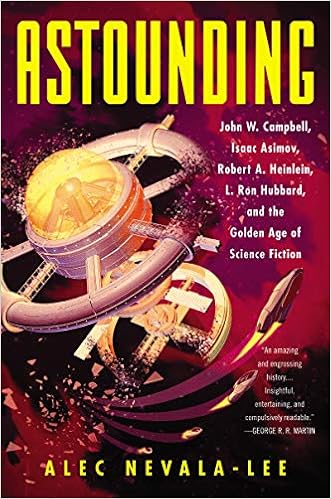


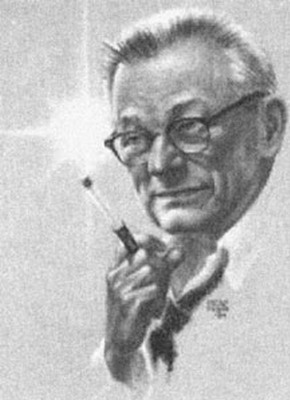
Although there have been biographies and critical studies of the authors before this, it's the first major biography of Campbell, who was arguably the most influential editor in the history of science fiction.
As an editor, he wanted good writing, accurate science, believable characters, and stories that logically accounted for multiple variables: "The future doesn't happen one at a time."
Campbell was controversial. His political views put him well to the right of the political spectrum, something that probably didn't help his career during the 1950s and 60s when SF made a distinct swing to the left. He was also seriously into what we'd now call fringe ideas and championed dianetics with L. Ron Hubbard, ESP and parapsychology, and the Dean drive (a purported reactionless drive that didn't work).

I am well read in both science fiction and historical and critical work aobut it, and there were things in this book that I had never heard about, for example, Campbell's correspondence with Gene Roddenberry and his influence on the original Star Trek series.

The book isn't just about Campbell; as the subtitle indicates it's also about Heinlein, Asimov, and Hubbard, and especially about Campbell's influence on their careers, which was extensive. Unfortunately, it's clear that while Campbell was instrumental in developing their careers, he couldn't grow with them and maintain the relationship that he'd established.

I would have liked to see more details on the history and operation of the magazine itself and the role of the magazines in fostering the development of the genre. It's there, but I wanted more. Still, I enjoyed this book immensely, and I recommend it highly if you have any interest in classic science ficiton.

Thursday, June 13, 2019

More On the Cost of Running a Tesla

Here's an interesting tweet about the cost of running a Tesla. It cost the poster $129.09 (US dollars) to run his Tesla for 5,000 miles. Converting to metric and Canadian dollars, that's about $172.00 Canadian dollars for 8,047 kilometers or 2.1 cents a kilometer at 13 cents US per KWh. I think our rates would be comparable.

Comparing it to gas costs, our car uses about 9 litres per 100 km. At a cost of $1.20 per litre, that's $10.80 per 100 km. or 10.8 cents a kilomtre, about five times more expensive than for the Tesla.

And that doesn't include maintenance costs, which were essentially zero for the Tesla. Our first oil change, at 6,000 km. was about $50. That adds up, fast.

Wednesday, June 12, 2019

Google Docs Gets Compare Feature

Users of Google's G Suite platform will finally get a compare feature in Google Docs.
The newly added feature lets you compare two documents directly from the web interface. To do so, you need to open the first document in Docs, then click on Tools -> Compare Documents and fetch the version to compare it against. This will create a new file highlighting changes as suggested edits. To make it easier to recognize, you'll be asked who the differences should be attributed to, which will make the changes appear as if they were made by a particular user directly in Docs.
That's a second major feature added to Docs recently; the other being the addition of section breaks. It's nice to see Docs finally getting some (much needed) love.

Introductory Sentence Diagramming

I remember learning sentence diagramming when I was in grade school and hating it. Later, when I was in university, I found it was occasionally useful in trying to parse and understand some complex academic prose, but I never used it much after that.

It can be a useful skill for editors, and this article is a good introduction to the technique.
Now it’s important to understand that there are ten sentences patterns in the English language.
Yes, you heard that right.
THERE ARE ONLY TEN WAYS TO SAY SOMETHING IN THE ENTIRE ENGLISH LANGUAGE!
I’m sorry for the caps, I’m just always shocked by that fact.
There are only ten kinds of sentences that we can speak daily, and although it feels like we should have more (as English is usually thought of as complex), this one fact about the language is it can be simplified into just ten sentences.
Just ten sentence patterns!
There are four different kinds of verbs, and all ten sentence patterns use at least one kind of verb.

Tuesday, June 11, 2019

Grateful Dead Guide

I have been a Deadhead all of my adult life and was lucky enough to see them eight times. Trust me, there was nothing like a Grateful Dead concert. Over the years, I've read many of the books and articles published about them, but somehow I've managed to miss the Grateful Dead Guide.

It's a collection of essays and articles about the early years (mostly before 1975) of the Grateful Dead. It's a large site with many detailed articles about the history of the Dead. And I do mean detailed. Here's a more or less random sample.

Monday, June 10, 2019

How San Francisco Broke America's Heart

San Francisco has always been a special place for me. I grew up a fan of the city's psychedelic bands like the Grateful Dead and the Jefferson Airplane and the countercultural movement that was centred there in the late 1960s. I finally got to visit the city in 2006, but by then it had lost much of its lustre.

Now the city seems to be falling victim to the same sort of pressures that have been bedeviling Toronto over the last decade: crazy high real estate prices, high commercial and residential rents, and income inequality driven by the tech boom.
What residents resent now is the shift to one industry, a monoculture.
“What I wanted was this flow of humanity and culture,” says editor and former nonprofit executive Julie Levak-Madding, who manages the VanishingSF page on Facebook, documenting the “hyper-gentrification” of her city. “It’s so devastating to a huge amount of the population.”
To many inhabitants, San Francisco has become unrecognizable in a decade, as though it had gone on a cosmetic surgery bender.
“I can’t tell you the number of friends who tell me how much they hate San Francisco,” says former city supervisor Jane Kim. Which is something given that she ran for mayor in the 2018 special election. (Kim came in third.) “They say it’s too homogenous.”
Too homogeneous. Too expensive. Too tech. Too millennial. Too white. Too elite. Too bro.
Toronto, by comparison, despite facing many of the same economic pressures has embraced its diversity and is now one of the most multicultural cities in the world. If you want to see what its future looks like, see pictures of crowds celebrating Toronto's Raptors as they seek an NBA championship.

Putting Ebola in Perspective

If you follow news of disease outbreaks, you'll know about the outbreak of Ebola in the Democratic Republic of the Congo. So far there have been more than 2,000 cases and more than 1,000 people have died.

Now the outbreak has infected the political discourse in the United States, as right-wing "news" sources are claiming that there have been cases on the southern US border with Mexico. This is, of course, completely untrue, as Crawford Killian points out. Ebolanoia has returned.
As if this kind of mendacity weren't bad enough, I'm reading Mark Honigsbaum's excellent new book The Pandemic Century, whose subtitle is "One Hundred Years of Panic, Hysteria, and Hubris." One chapter describes an outbreak of plague that hit the Mexican quarter of Los Angeles in 1924. The response of the politicians was cover-up, and the media obliged. When the news eventually got out, it also triggered alarms about imaginary hordes of diseased Mexicans sneaking across the border to infect upstanding Anglo-Saxons. 
Ninety-five God-damn years later, InfoWars and Gateway Pundit have driven spikes through the heart of any belief we might still have in progress. Yes, we've advanced scientifically and technologically and medically in countless way, but we've also dragged millions of people with us who have never abandoned their medieval view of the world ("Black plague? Burn the Jews!"). Whether they're in hostile North Kivu villages, or sitting behind keyboards anywhere in the world, they—not Ebola—are the biggest threat to global health we now face.


Sunday, June 09, 2019

Featured Links - June 9, 2019

Links to things that I found interesting but didn't want to do a full post about.

Saturday, June 08, 2019

An Appreciation of Terry Pratchett

The recent broadcast of the TV adaptation of Good Omens has drawn a lot of attention to its authors, Neil Gaiman and Sir Terry Pratchett. Gaiman has been getting the spotlight, because unfortunately Pratchett died four years ago. In this Syfy article, Brian Silliman throws the spotlight back on Pratchett, who deserves it.
Personally, I had no experience with the work of Sir Terry Pratchett until I read Good Omens many years ago. After falling in love with it, I rectified that. Good Omens was my Pratchett gateway book, and after downing many of his novels, I realized there was so very much more to not only the man's work but the man himself.
Pratchett's biggest contribution to literature has been a large series of books that all take place in a realm called Discworld. It's called that because the enormous land is on a giant disc, placed on top of four huge elephants, and they stand on the back of the great turtle A'Tuin, who floats through space.
When I heard about this book series upon completion of Good Omens, I knew I had to dive in immediately. How had I never heard of these books? If I'd lived in Britain, I would have — the series routinely appeared at the top of bestseller lists until J.K. Rowling and Harry Potter came flying in to bump them down a little bit. In America, they are nowhere near as prevalent. It's a shame, because they are extraordinary.
I will admit to not having read much Pratchett. I have not read Good Omens (something I will rectify soon) and only got part way through The Color of Magic before putting it aside. I had a mistaken idea that the Discworld books were light, frothy fantasy and missed all of the depth and subtlety of Pratchett's work - something that I only came to appreciate when reading about him after his death. But if the TV adaptation of Good Omens is any indication, I have some reading to catch up on.

Friday, June 07, 2019

Designing an Acceible App

App designers could learn a lot from Moovit, a leading transit app whose designers have focused on improving accessibility features. By doing so, they've made it more usable for all users.
For users with hand motor disabilities, Moovit redesigned menus and buttons for easier use with one hand, especially on larger phones. For people who are colorblind and use color-coded transit systems, such as “the green line,” Moovit includes the name of the line, instead of just a colored dot or symbol, a space-saving practice in many maps.
The company also ensures no broken or overlapped text when a user needs to magnify the font. It partnered with Be My Eyes, an app that connects sighted volunteers with people who are blind or low-vision. It’s studying how to use a phone’s vibration and flashlight to serve users with hearing loss. And it continually works with people with a disability to improve or customize the app.
I wish more companies would do this. I use a large system font on my phone and many apps have problems with that. And some (like the RB Digital app for reading magazines), have issues with dark themes (button labels are illegible). 


Major Disease Outbreak Killing Pigs

An outbreak of Asian Swine Flu is spreading through China and south-east Asia, forcing farmers to kill millions of pigs.
The implications of the outbreak are already being felt beyond Asia. Global pork prices have risen by almost 40%, and long term it is likely to lead to more pork imports from Europe and America to meet demand, which will also push up global meat prices. Market analyst Rabobank said global pork supplies could fall by 8%.
I thought bacon prices were high when we were shopping yesterday; I wonder if it's already having an effect here. 

Thursday, June 06, 2019

Google Docs Gets Sections

In May, Google started rolling out an update for Google Docs that adds section breaks to its formatting choices. You'll be able to change margins between sections. Reading their update doc, I haven't been able to figure out if it will allow a change from portrait to landscape orientation.
Insert section breaks and view section breaks in your doc
You can now insert a next page or continuous section break in Google Docs by going to Insert > Break. From here, you can select next or continuous. Note both types of breaks will start at the place of your cursor location.
To easily view where section breaks are located in your document, you can use the new show section breaks tool by going to View > Show section breaks. When Show selection breaks is enabled, you’ll see a blue dotted line where each section break is located.
Adjust margins per section
It’s now possible to use the ruler to adjust the left and right margins by section. Previously, it was only possible to adjust the margins for the entire document.
These updates are for G Suite customers. If you are using the free version of Google Docs, you'll probably have to wait a while for it to roll out.

More Testing for the EmDrive

Over the last few years, there has been some interest in something called the EmDrive – what could, if it is for real, be a true reactionless drive that could at minimum be used as a thruster on satellites and space probes. It's been tested in several countries, and some experiments seem to generate a small (micro-Newton level) thrust, but given the difficulties of measurement, the results have been inconclusive.

Now a team of German engineers has conducted a new series of tests and should be announcing their results soon.
The resolution lies in designing a tool that can measure these minuscule amounts of thrust. So a team of physicists at Germany’s Technische Universität Dresden set out to create a device that would fill this need. Led by physicist Martin Tajmar, the SpaceDrive project aims to create an instrument so sensitive and immune to interference that it would put an end to the debate once and for all. In October, Tajmar and his team presented their second set of experimental EmDrive measurements at the International Astronautical Congress, and their results will be published in Acta Astronautica this August. Based on the results of these experiments, Tajmar says a resolution to the EmDrive saga may only be a few months away.
I will be waiting with bated breath to see the results.

Wednesday, June 05, 2019

The Beauties Hidden in Pi

In The Beauties Hidden In Pi, mathematician Al Kayaspor gives us a tour of some of the complexities and elegance of this most interesting number. You don't need an advanced degree in math to understand the article or appreciate the beauty of π.
It was finally the weekend! After my long mathematics presentation, I came home to watch my favorite tv show, Person of Interest, to de-stress. Surprisingly, the episode was about the most famous mathematical constant, pi (π) which is equal to the ratio of a circle’s circumference to its diameter, commonly approximated as 3.14159. Mr. Finch (the main character) was acting as a substitute teacher and wrote on the chalkboard 3.1415926535. Then he asked the students, “What does this mean?”. I answered the question in my mind, thinking, “If I have a bicycle tire with a diameter of 1, then one full revolution of the bicycle tire would travel distance pi.” However, in the movie, nobody answered. Then Mr. Finch answered the question himself, saying
Pi, the ratio of the circumference of a circle to its diameter — 3.1415926535 — is just the beginning. It keeps going forever without ever repeating, which means that contained within this string of decimals is every other number; your birth date, the combination to your locker, your social security number, etc. It’s all in there somewhere. And if you convert these decimals into letters you would have every word that ever existed in every possible combination; the first syllable you spoke as a baby, the name of your latest crush, your entire life story from beginning to end, and everything we ever say or do. All of the world’s infinite possibilities rest within this one simple circle. Now what will you do with that information; what it’s good for? Well, that would be up to you…
Although that scene was actually inaccurate, I loved it. This scene is beautiful because most teachers in the world struggle to be as good and as interesting of a teacher as Mr. Finch is here. His knowledge about the subject expands the discussion beyond the textbooks and keeps the students focused throughout the lecture.

A Few Articles About Good Omens

I watched Good Omens over the weekend. For those of you who aren't SF fans, or have had your head in the sand and have missed Amazon's massive publicity campaign, Good Omens is a six-part TV show based on the comic fantasy novel by Neil Gaiman and the late Terry Pratchett.  I enjoyed it more than any TV show I've seen in quite some time and can't recommend it highly enough.

Here are some articles about the show. If you're spoiler averse, you may not want to read them until after you've seen it.

Tuesday, June 04, 2019

Avoiding an Online Job Scam

On Ars Technica, Lee H. Goldberg, an unemployed writer and editor, writes about how he almost got caught in an online job hiring scam. Fortunately, he realized that something was amiss before the scammers could do him any damage. But it's obvious that someone more desperate or less careful than he was could easily have become a victim.

This is how it started:
Like most successful cons, this one involved gaining the willing consent of its victim through some combination of greed, fear, or desperation. Having been laid off several months earlier, I fell into the latter category and was ripe for the picking. When I lost the unfulfilling but steady editorial job I'd held down for the past few years, I was confident that my strong credentials and deep collection of contacts I'd made over the years would help me land a better gig within a month or two.
To my surprise, the job hunting skills I'd honed over my 20+ year career were outdated and almost useless at penetrating the layers of digital screening agents that stood between me and a potential employer. I found myself in unfamiliar territory, struggling to learn the complex Kabuki dance that today's job seekers must master in order to slip past Corporate HR's silicon sentinels and gain an audience with a carbon-based life form.
Even engaging a resume coach to help me finetune my credentials failed to break the deafening silence until an email arrived from ZipRecruiter, one of several job hunting sites I was registered with. The recruiter was responding to the application I had submitted a day earlier for a remote-work tech writer position at a biotech firm.
The article is worth reading if you're involved in the online job market and there are links to resources that offer advice on avoiding scams. It's certainly opened my eyes. 

The Levels of Edit

I first encountered the concept of levels of edit early in my technical  writing career when I came across a copy of the JPL Style Manual. The section on levels of edit has been republished as a PDF file). I found it quite helpful in organizing my work and explaining what I was doing to managers and SMEs.

Since then, there have been externsions of the original concept. The best explanation I've seen so far is the article The Levels of Edit, by Odile Sullivan-Tarazi.
Conceptions of how many “levels” of edit there are, and just what each comprises, differ across editing environments.
In general, the levels move from broader to successively finer concerns —
On up to the finer-grained, more superficial issues (hyphenation, spelling, surface-level grammar) often related to the look on the page . . .
To characteristics of the writing itself (tone, style, clarity, cohesion, coherence, parallelism, etc.) . . .
To issues of structure and organization (both inherent logic and as applicable to context and audience) . . .
The larger, foundational issues of the piece (concept, tone, purpose, audience, conceived content) . . .
She goes on to explain each level in detail as well as describing how the levels relate to each other. It's a useful article for anyone pursuing an editing career or for technical writers faced with editing as part of their workflow.


Monday, June 03, 2019

House Style and the Zombie Apocalypse

Despite the title, I don't think a house style guide will help you much in the zombie apocalypse. But this article makes a good case that it may make your job a lot easier.
Specifying a preference for one of several equally valid options helps establish your editorial authority and helps your editorial team work together. Nobody has to make the initial decision and communicate that to the rest of the team. You reap the most benefits if you use the same editors over and over—they’ll quickly adapt to your house style and use it automatically for your projects.
When I started at the TSX (now TMX Group), our marketing department had a reasonably complete style guide. That went by the wayside after corporate mergers and reorganizations and platform changes on our intranet. I used parts of it to create my own style guide, but never had the politcal clout to get it established as a departmental standard, much less a corporate one. That was unfortunate, and made my life more difficult on several occasions when I had to edit documents from other departments or had to incorporate their content in mine.

Sunday, June 02, 2019

2019 Aurora Award Finalists Announced

The finalists for the 2019 Aurora Awards for the best English-language Canadian science fiction and fantasy have been announced. The winners will be announced at Can-Con 2019 in Ottawa, October 18-20.
  • Armed in Her Fashion by Kate Heartfield, ChiZine Publications
  • Graveyard Mind by Chadwick Ginther, ChiZine Publications
  • One of Us by Craig DiLouie, Orbit
  • The Quantum Magician by Derek Künsken, Solaris Books and Analog Science Fiction and Fact
  • They Promised Me The Gun Wasn’t Loaded by James Alan Gardner, Tor
  • Witchmark by C. L. Polk, Tor.com Publications
It's worth noting that several of the Aurora finalists have also been nominated for the Nebula and Hugo awards.

Restoring Vision in Blind Mice

Scientists have discovered a technique that apparently restores a significant degree of vision in mice that were blind. 
It was surprisingly simple. University of California, Berkeley, scientists inserted a gene for a green-light receptor into the eyes of blind mice and, a month later, they were navigating around obstacles as easily as mice with no vision problems. They were able to see motion, brightness changes over a thousandfold range and fine detail on an iPad sufficient to distinguish letters.
Being very nearsighted, I'm quite aware of the possibility of developing macular degeneration or other serious eye problems. This gives me some hope that there will be a cure, or at least a mitigation, within the next few years.

Say What You Mean

Accuracy is important when writing documentation, but it's even more important in scientific papers. This article provides advice on making sure wording in scientific papers is as accurate as possible. It should also be directly relevant to most technical writers.

Here's an example from the article.
‘These’ and ‘this’ can be vague. Make sure it is clear what these pronouns refer to. Take a look at this example:
The cytoskeleton consists of microtubules, actin filaments, and intermediate filaments. In neurons, these are called neurofilaments.
Here, it is not clear whether ‘these’ refers to all or just one component of the cytoskeleton. In fact, neurofilaments are intermediate filaments and do not contain microtubules or actin. To be perfectly clear, the sentence should read:
The cytoskeleton consists of microtubules, actin filaments, and intermediate filaments. In neurons, intermediate filaments are called neurofilaments.

Saturday, June 01, 2019

Featured Links - June 1,2019

Links to things that I found interesting but didn't want to do a full post about.

Friday, May 31, 2019

How Modern Design Fails Older Consumers

Don Norman is the author of one of the classic works on design, Design of Everyday Things, and a former Apple VP. He's also 83 and finding that modern design is failing him and a whole generation of consumers.

In a Fast Company article, he rails against what he sees. Don't be mislead by the title of the article. What he describes is a problem that affects more than just the elderly.
Do not think that thoughtful design is just for the elderly, or the sick, or the disabled. In the field of design, this is called “inclusive design” for a reason: It helps everyone. Curb cuts were meant to help people who had trouble walking, but it helps anyone wheeling things: carts, baby carriages, suitcases. Closed captions are used in noisy bars. As Kat Holmes points out in her book Mismatch, all of us are disabled now and then. Some of us have permanent disabilities, but all of us have suffered from situational and temporary problems. When outside in the sun, the text message that just arrived is unreadable: wouldn’t it be nice if the display, whether cellphone, watch, or tablet, could switch to large, higher contrast lettering? Are elderly people handicapped? Maybe, but so is a young, athletic parent while carrying a baby on one arm and a bag of groceries in the other (and perhaps trying to open their car door). Ride-share bicycles and scooters cannot be used by people who need to carry bulky packages. Everyone has difficulty hearing people in noisy environments. Noise-canceling headphones are for everyone, not just the elderly. Almost anything that will help the elderly population will end up helping everyone.
I couldn't agree with him more. I constantly find myself running up against bad design that makes my life more difficult. I've reccently unsubscribed from a couple of interesting looking email newsletters because the publishers formatted them in small, light grey type on a white background, thus making them virtually impossible for me to read. It's a small thing, but it's symptomatic of the problem that Norman discusses in the article.

Putting Comments in Code

During my career as a technical writer, I've had to document several APIs in a variety of languages. At Daleen Technologies, we sold the API as part of the product, and I had to learn Java so I could add and edit comments directly in the code. I learned a lot about what to do, and more importantly, what not to do, thanks to some helpful (and occasionally exasperated) developers.

This article by Bill Sourour would have been extremely helpful when I was starting out.
Stop me if you’ve heard this one before…
“Good code is self-documenting.”
In 20+ years of writing code for a living, this is the one phrase I’ve heard the most.
It’s cliché.
And like many clichés, it has a kernel of truth to it. But this truth has been so abused that most people who utter the phrase have no idea what it really means.
Is it true? Yes.
Does it mean you should never comment your code? No.
In this article we’ll look at the good, the bad, and the ugly when it comes to commenting your code.
For starters, there are really two different types of code comments. I call them documentation comments and clarification comments.

Thursday, May 30, 2019

Microsoft Working To Help People with Disabilities

Microsoft has announced seven new projects aimed at helping people with different disabilities. Out of the seven, I'm particularly interested in two that should help people with visual problems.
  • Massachusetts Eye and Ear, located in Boston, is developing a vision assistance app to aid individuals who are blind or have decreased vision. The app will provide the users with heightened location and navigation assistance.
  • Researchers at University of California Berkley are also creating an app for the visually impaired. The app will provide users with audio descriptions regarding their surroundings.
I'm curious about the first item, considering that Microsoft no longer has a mobile platform for apps. Presumably it will run on Android and possibly IOS.

Solving the Cat and Mouse Problem

Here's a simple puzzle that I came across on Boing Boing the other day.
A swimming mouse is in a circular pond. A non-swimming cat on the perimeter of the pond can run four times as fast as the mouse can swim and will always run in the most optimal way around the pond to catch the mouse. The mouse can run faster than the cat. The question: can the mouse get away from the cat? Mathematician Ben Sparks explores different methods the mouse can try.
Give it some thought. It requires only the application of logic and some simple, middle school math. No algebra or calculus is required. 


Wednesday, May 29, 2019

Some Free SF from the Magazines

Two of the major science fiction magazines have a readers' poll each year for the best stories and articles. The winning authors get some egoboo and a bonus payment.

As a bonus for you, they publish the winning stories online so you can read them for free.  File 770 has the links.


I am looking forward to reading stories by David Brin and Ctein, Wil McCarthy, and Rich Larson, among others.

Can CBD Really Do All That?

Now that cannabis is legal in Canada and many US states, there's increased interest in its theraputic properties. It's been used as a medicine for many years, but now there's both commercial and scientific research going on into what it does and what chemicals in the plant are effective.

So far it seems that the most medically useful component of cannabis is cannabidiol, or CBD. It's not psychoactive, unlike THC, so it doesn't get a person high, but it may have many uses.

The New York Times has published a long article about CBD, its history, its uses, and its likely future. Its the best article I've seen on the subject so far, completely free from hype or fear mongering.
Seven years later, cannabidiol is everywhere. We are bombarded by a dizzying variety of CBD-infused products: beers, gummies, chocolates and marshmallows; lotions to rub on aching joints; oils to swallow; vaginal suppositories for “soothing,” in one company’s words, “the area that needs it most.” CVS and Walgreens each recently announced plans to sell CBD products in certain states. Jason David now sells a cannabis extract called Jayden’s Juice, named for his son — one of several extracts on the market, including Haleigh’s Hope and Charlotte’s Web, that are named after children who are said to have benefited from being treated with CBD.
Many of these products are vague about what exactly CBD can do. (The F.D.A. prohibits unproven health claims.) Yet promises abound on the internet, where numerous articles and testimonials suggest that CBD can effectively treat not just epilepsy but also anxiety, pain, sleeplessness, Crohn’s disease, arthritis and even anger. A confluence of factors has led to this strange moment. Plenty of legitimate, if still inconclusive, research is being done on CBD. Many scientists are truly excited about it. The laws governing cannabis and its chemical components have loosened up. And the anecdotes that have emerged from what Elizabeth Thiele, an epileptologist at Harvard, calls the “vernacular” cannabis movement have lent emotional force to the claims made for CBD.

Tuesday, May 28, 2019

The Best New Features In the Windows 10 May 2019 Update

Microsoft has started rolling out the May 2019 Windows 10 update, so if you're running Windows 10 it may be showing up on your computer one of these days. This article has a summary of the key new features in the update.

My own experience with Windows 10 has been fairly positive, especially after last spring's update, which fixed an issue I had with my PC sometimes taking forever to reboot. As far as the new update, I like the ability to uninstall some of Microsoft's crappy apps (Groove Music, for example), and the new emoji selection dialog. What would be the most useful feature, the Windows Sandbox, isn't available to me because I'm running Windows Home. I may have to upgrade one of these days.

Book Circulation Is Declining In College Libraries

Book circulation is declining at college and university libraries, but it may not be because students are reading less. That's the gist of this article from the Atlantic.
But there is a difference between preservation and access, and a significant difference, often unacknowledged, in the way we read books for research instead of pleasure. As the historian Michael O’Malley humorously summarized the nature of much scholarly reading and writing, “We learn to read books and articles quickly, under pressure, for the key points or for what we can use. But we write as if a learned gentleman of leisure sits in a paneled study, savoring every word.” Or as he more vividly described the research process, academics often approach books like “sous-chefs gutting a fish.”
With the rapidly growing number of books available online, that mode of slicing and dicing has largely become digital. Where students or faculty once pulled volumes off the shelf to scan a table of contents or index, grasp a thesis by reading an introduction, check a reference, or trace a footnote, today they consult the library’s swiftly expanding ebook collection (our library’s ebook collection has multiplied tenfold over the past decade), Google Books, or Amazon’s Look Inside. With each of these clicks, a print circulation or in-house use of a book is lost. UVA’s ebook downloads totaled 1.7 million in 2016, an order of magnitude larger than e-circulations a decade ago. Our numbers at Northeastern are almost identical, as scholars have become comfortable with the use of digital books for many purposes.
I am pretty sure the same trend is happening in public libraries based on the changes I've seen in our local libraries. 

Monday, May 27, 2019

Before Netscape

Some of you reading this blog may never have used an Internet browser other than Google Chrome or Firefox. But the World Wide Web goes back well before those browsers, to 1991 when Tim Berners-Lee released the code libraries that made Internet browsers possible. This article from Ars Technica looks at the very first browsers, including the first one I used, Mosaic. (On second thought, I may have used a text-mode browser before Mosaic, but the memory is dim).
Some years later Berners-Lee returned to CERN. This time he relaunched his "World Wide Web" project in a way that would more likely secure its success. On August 6, 1991, he published an explanation of WWW on the alt.hypertext usegroup. He also released a code library, libWWW, which he wrote with his assistant Jean-François Groff. The library allowed participants to create their own Web browsers.
"Their efforts—over half a dozen browsers within 18 months—saved the poorly funded Web project and kicked off the Web development community," notes a commemoration of this project by the Computer History Museum in Mountain View, California. The best known early browser was Mosaic, produced by Marc Andreesen and Eric Bina at the National Center for Supercomputing Applications (NCSA).
Mosaic was soon spun into Netscape, but it was not the first browser. A map assembled by the Museum offers a sense of the global scope of the early project. What's striking about these early applications is that they had already worked out many of the features we associate with later browsers. Here is a tour of World Wide Web viewing applications, before they became famous.

The Cost of Owning a Tesla After 200,000 Miles

It seems that there are more advantages to owning a Tesla (and presumably any fully electric vehicle) than just saving money on gasoline. The author of this article calculated his costs after driving his Tesla for 200,000, and he's done pretty well. 
In total, here’s what the Tesla cost to “use and abuse” it vs. keeping it to myself and only driving 50,000 miles:
$79,000 — My purchase price for my used P85 with 35,000 miles (purchased in August of 2014).
−$25,000 — Turo Earnings
−$17,000 — Uber/Lyft Earnings
−$20,000 — Tax Savings
−$25,000 — Current Resale Value (Private Party)
$8,000 — Amount I was paid to own and drive the hell out of a Tesla. Keep in mind, I could have made a lot more as I only averaged 1 Uber ride a day over 4.5 years, and I only rented it seriously starting in 2016. I was having too much fun doing massive 48 state road trips and running my Flagstaff Vacation Rental business to really focus on maximizing the earnings.
Even assuming that you aren't going to try making money with Uber or Lyft, the savings on fuel and maintenance are substantial.

Sunday, May 26, 2019

Featured Links - May 26, 2019

Links to things that I found interesting but didn't want to do a full post about.

Saturday, May 25, 2019

Dead Sound

I saw the Grateful Dead eight times between 1970 and 1992 and one thing was common to all their concerts – they had great sound systems. It was possible, sitting near the back of an arena like Copps Coliseum, to distinguish the sound of individual drums, in stereo, and when Phil Lesh "dropped the bomb", you could feel it in your gut.

It's not well known outside of the sound reinforcement industry, but the Dead were responsible for many of the amplification techniques that we now take for granted – mixing hall sound in stereo, analyzing hall sound to tune the mix, using phase cancellation microphones, using the PA instead of the bands amplifiers for instrumental sound, and more.

CBS has an audio documentary about the sound of the Dead with an accompanying article.
"I mean very early on they got a reputation for having the best sound of any band that was out there touring," Jackson said. "A lot of the other sound engineers copied what they were doing or talked to them about what they were doing and how they were able to isolate instruments, and how they were able to combine instruments in interesting ways in the PA, and give a faithful reproduction of what was actually being played."
The Dead's innovation culminated in the Wall of Sound: more than 600 speakers, 40 feet high and 70 feet wide across the stage.
McNally said it could create perfectly acceptable sound at a quarter mile away.
Unfortunately, I never saw the Dead while they were touring with it. I have heard audience recordings from that period that sound better than some soundboards, so I will attest to its quality. 

Friday, May 24, 2019

Getting Started With CSS Layout

Cascading Style Sheets (CSS) have gotten a lot more complicated since they were introduced in the latter part of the 1990s. You can now use them to do animation, complex formatting, and layouts that respond to different screen sizes and formats.

Getting Started wtih CSS Layouts is a guide to the many properties of CSS layouts. It should be helpful to anyone creating a CSS layout from scratch or modifying the generated CSS code from a tool like RoboHelp or WebWorks ePublisher.

Thursday, May 23, 2019

Why Google+ Failed

Google is notorious for killing off services that it perceives as not performing well. Earlier this year, they shut down Google+, their attempt at establishing a social network. (It will still be available under different branding to commercial GSuite customers).

A software engineer who worked on Google+, identified only as Talin, has written an article about why Google+ failed. His reasons include some basic architectural choices made at the beginning of the project as well as some that were specifically internal to Google and the way it runs projects.

I used Google+ at the TMX and hated it. The interface was clunky, wasteful of screen space, and lacked basic features (being able to see the date of posts and sort them by criteria like date or user) that would have made managing large volumes of posts much easier. I used bulletin board services in the early 1990s that were easier to use and more sophisticated.

I'm not surprised it failed and this article gives some insight into why it was doomed from the start.

NASA's Full Artemis Plan Revealed

NASA has revealed more details about it's Artemis project to return US astronauts to the moon by 2024. It's an ambitious plan that will require many launches of both NASA's Space Launch System (SLS) and commercial rockets.

And it's going to be expensive.
One thing missing is its cost. NASA administrator Jim Bridenstine has asked for an additional $1.6 billion in fiscal year 2020 as a down payment to jump-start lander development. But all of the missions in this chart would cost much, much more. Sources continue to tell Ars that the internal projected cost is $6 billion to $8 billion per year on top of NASA's existing budget of about $20 billion.
It's a reasonably good plan but it will likely never happen. Given the political climate in the US, I can't imagine either a Republican or Democratic administration allocating the necessary funding. 
NASA is in danger of becoming a political football. Democrats are unlikely to support Pell Grants as a source of funding, and some space industry sources have speculated that this may have been a "poison pill" from the White House's Office of Management and Budget to undermine a long-term, costly program. If Democrats wanted to push back in a political way, they could tell President Trump they will only support NASA's lunar landing with Department of Defense funds earmarked for the "Space Force." Under such a scenario, the politicization of NASA would be bad for an agency that has mostly flown above the partisan fray.

Wednesday, May 22, 2019

Constructing a Hertzsprung-Russell Diagram for a Globular Cluser

Back when I was in high school, I created a Hertzsprung-Russell diagram from a set of data pulled from a star catalog. It was a painful exercise and I think I used several pieces of Bristol board before I got it right.

Now, with the aid of high-resolution telescope images and powerful graphics software, it's much easier, as this video shows.
If you aren't into astronomy, this may not mean much to you, but it's seriously cool.

We're Toast 7

This post is a collection of links that support my increasingly strong feeling that the human race (or at least our technological civilization) is doomed. It is part of an ongoing series of posts.

Climate Change and Environment

    Politics

      Technology

      Tuesday, May 21, 2019

      How the Boeing 737 Max Disaster Looks to a Software Developer

      There have been many articles about the Boeing 737 Max disaster published in the last few months, but this one in the IEEE Spectrum magazine, written by a software developer who is also a pilot, is the best that I've seen. It focuses on the critical process and design flaws that led to the disaster, and there were many. But this is probably the most critical.
      So Boeing produced a dynamically unstable airframe, the 737 Max. That is big strike No. 1. Boeing then tried to mask the 737’s dynamic instability with a software system. Big strike No. 2. Finally, the software relied on systems known for their propensity to fail (angle-of-attack indicators) and did not appear to include even rudimentary provisions to cross-check the outputs of the angle-of-attack sensor against other sensors, or even the other angle-of-attack sensor. Big strike No. 3.
      I've had quite a bit of experience documenting failure modes of complex software and hardware systems and have been directly involved in their design. It is beyond belief that Boeing could produce a control system that did not have multiple sanity checks for its control inputs. It makes me reluctant to ever fly on a Boeing aircraft again. 

      WebWorks ePublisher 2019.1 Released

      Quadralay has announced the release of WebWorks ePublisher 2019.1. The release notes and documentation are online.

      This release includes support for 32-bit FrameMaker 2019, improved performance (definitely noticeable when viewing the online docs) and several enhancements to the Reverb 2.0 format.

      I was a happy user of Quadralay's WebWorks products for many years and recommend them highly for their stability and excellent technical support.

      2018 Nebula Awards Announced

      The winners of the 2018 Nebula Awards have been announced. They are voted on by members of the Science Fiction and Fantasy Writers of America.

      To no one's surprise (I haven't seen so much buzz about a novel in years), Mary Robinette Kowal won the Best Novel award for The Calculating Stars. I expect her to win a Hugo for it later this year. 

      Locus Magazine has the full list of awards. 

      Friday, May 17, 2019

      Off for the Weekend

      Monday is Victoria Day in Canada, which means it's a long weekend for most people. It's known informally as the May 24 weekend, because that's Queen Victoria's birthday. It's traditionally the first weekend of gardening season, depending on the weather of course, which finally seems to be turning into something akin to summer (it's been a terrible spring here so far).

      So I'm taking the weekend off. Posts will resume on Tuesday.

      Featured Links - May 17, 2019

      Links to things that I found interesting but didn't want to do a full post about.

      Thursday, May 16, 2019

      12 Things I Learned In Type School

      I didn't realize that you could go to school to study typography, although it makes sense. Peter Cho did and has written an article about twelve things he learned in type school. Some of them are what anyone would expect to learn about themselves after an intensive study program; others are about some of the finer points of typography. I found it fascinating.
      [ 8 ] The importance of counter shapes
      Counters are the shapes inside letters, both closed shapes like e and o, but also the concave regions in m and n. It follows from what we learned about positive and negative space that counters are important, but their importance in establishing a visual system extends beyond a single font style. In a workshop in June, Andy Clymer explained how punch cuts were tapered, and the same punch could be used for a larger size by cutting deeper into the lead. When designing different weights of a family, you should think like a punchcutter and preserve the counter shapes so the letterforms feel related.
      Sasha Tochilovsky also brought up a related idea in his workshop in March. When you’re pairing different fonts to use in a design, you can compare the counter shapes in the letter a to be a signal of whether the faces will work well together.

      How to Automate Google Sheets with Macros

      I've been using Google Sheets in preference to Microsoft Excel for some personal files. For what I need, the simplicity of Google Sheets compared to Excel makes it the better choice. But I have one spreadsheet that I was considering using Excel for. I want hide a bunch of columns in an export file from LibraryThing and I would have to do it every time I create a new export file. So I was going to try to write an Excel macro, which I have not done before. (I know how to write Word macros, but have never done it in Excel).

      However, it turns out that Google Sheets has a macro recorder, which I didn't know before reading this article.
      When you record a macro in Google Sheets, it automatically creates an Apps Script with all the code to replicate your actions for you. This means you can create complex macros without knowing how to write code. The next time you run it, Sheets will do everything you did when you recorded the macro. Essentially, you’re teaching Google Sheets how to manipulate a document to your liking with a single command.
      If I needed to do anything complex with a spreadsheet macro, I probably would use Excel. I'm much more comfortable with Microsoft's VBA than Google's AppScript. But it's nice to have the recording capability in Sheets to automate simple tasks.

      Now, if Google would give us that capability in Docs, I'd be much more inclined to use Docs instead of Word.

      Wednesday, May 15, 2019

      Useful Chrome Extensions for Web Developers

      Google Chrome's extensions are one of its most useful features. If you are doing web development, there are a plethora of extensions that can make your life easier. Hongkiat.com has compiled a list of more than 30 extensions that you might want to take a look at.

      More than a few of these should be useful to any technical writers producing online documentation with tools like RoboHelp or WebWorks ePublisher. I would look at Web Developer and CSS Viewer to start.

      Evil Clippy Is Bad News For Word Users

      Word macros have been a security problem ever since the days of Melissa, one of the first widespread computer viruses. Since then, Microsoft has made Word more secure and many organizations lock down the macro capabilities of Word so that users either can't use them or explicitly have to enable macros.

      However (Isn't there always a however?), security researchers have developed a new tool, Evil Clippy, that's capable of bypassing all of Word's current security controls to insert malicious code. Here's the TL;DR from BoingBoing:
      Evil Clippy comes from Dutch security researchers Outflank: "a tool which assists red teamers and security testers in creating malicious MS Office documents. Amongst others, Evil Clippy can hide VBA macros, stomp VBA code (via p-code) and confuse popular macro analysis tools. It runs on Linux, OSX and Windows." Evil Clippy's magic depends in part on some awesomely terrible undocumented Office features, including "VBA Stomping": "if we know the version of MS Office of a target system (e.g. Office 2016, 32 bit), we can replace our malicious VBA source code with fake code, while the malicious code will still get executed via p-code. In the meantime, any tool analyzing the VBA source code (such as antivirus) is completely fooled."
      It's notable that Evil Clippy relies on undocumented VBA features. From the authors' post:
      Evil Clippy only scratches the surface of issues resulting from the gap between official Microsoft specifications on VBA macros (MS-OVBA) and its actual implementation in MS Office. Since malicious macros are one of the most common methods for initial compromise by threat actors, proper defense against such macros is crucial. We believe that the lack of adequate specifications of how macros actually work in MS Office severely hinders the work of antivirus vendors and security analysts. This blog post serves as a call to Microsoft to change this for the better.
      As far as I can tell from reading the post, the techniques that Evil Clippy uses can bypass most current security tools. That may change as vendors update their products. In the meantime, the authors suggest several techniques for mitigating the danger. One of them is disabling macros in documents downloaded from the Internet. I am not sure how this would affect users of web-based tools like Sharepoint and Google Drive.

      In any case, it's a dangerous world out there, and it just got more dangerous. And maybe harder for technical writers using Word macros.

      Tuesday, May 14, 2019

      New Words Added to Merriam-Webster in April 2019

      The English language is constantly changing and dictionaries need to be updated to keep up. Merriam-Webster has published an additional list of words that were added to the dictionary in April 2019.  Some words are new to the dictionary; some are new meanings for existing entries, like snowflake and purple.
      It all begins, in each case, with evidence of words in use. Each word follows its own path at its own pace before its use is widespread enough to be included in a dictionary. We watch as words move from specialized contexts to more general use and we make citations for each word in order to draft our definitions. This means, in other words, that we have the receipts (in a manner of speaking).

      History of the Capital AI & Market Failures in the Attention Economy

      The article that this post is about came to me as a Twitter recommendation from both Tim O'Reilly and Charles Stross. That was more than enough to pique my interest. O'Reilly said: "This is far and away the best summary of the argument for capitalism as an #AI with a flawed objective function  that I’ve ever read. I love it."

      He's right. 

      History of the Capital AI & Market Failures in the Attention Economy is one of those articles that will likely be read and discussed for at least the rest of this year. It's long, opinionated, and well researched.
      This is a lengthy discussion, so I’ll begin with a summary.
      The basic idea in this post is to consider capitalism as a highly efficient objective function (or “AI”) with its parameters optimized for the satisfaction of our short term desires rather than our long term interests.
      Paranoia about runaway feedback loops – in consumer capitalism, artificial intelligence, mass media, ‘Wrestlemania politics,’ etc – ultimately stems from the inscrutability of the emergent behavior of these complex systems to the individual actors and observers operating within them.
      Rather than responding with Luddite / anarchist nihilism, we should remember that technological and social systems like these have dramatically reduced our exposure to the unpredictability of the natural world and greatly improved living conditions on a number of dimensions over the past few centuries.
      At the same time, we should not ignore warning signs of a dystopian future, nor should we hope that a ‘personnel change’ of institutional leaders will solve our problems.
      It's a long article. If you don't have time to read the whole thing, skip directly the author's Practical Recommendations. This is one of them:
      (5) Set boundary parameters around economic growth and disparity. Instead of incessantly bickering about the dystopias that result from either raw economic growth without redistribution (which inevitably leads to extreme disparity) or the state enforcement of absolute equality (which leads to either stagnation or totalitarianism), we should define policies that moderate between these extremes and land us in explicit, acceptable ranges. We could, for example, set parameters such that whenever the economy is growing as a whole, we have a redistribution slider which ensures inequality decreases at the same time (see the 𝜏 parameter in this post).
      But it's better to take the time and read the whole thing. It's worth it.

      Monday, May 13, 2019

      Thirteen Mintues to the Moon

      As has been noted here and many places elsewhere, this year is the 50th anniversary of the Apollo 11 moon landing. To mark the occasion, the BBC has created a new podcast series, 13 Minutes to the Moon that features interviews with many of the people who helped to send the astronauts to the moon and some of the astronauts themselves.
      In total, no fewer than 400,000 people were involved in Project Apollo. Nearly all of them felt deeply connected to the mission and, although only a handful of people finally flew to the Moon, in a very real sense the factory workers, engineers, technicians and scientists that worked as part of the Apollo programme felt that, on 20 July 1969, part of them landed on the Moon, too.
      We wanted to tell all of those stories, framed by the drama of the last 13 minutes of descent before touchdown on the lunar surface.
      That period of the mission was rife with crisis and, as Armstrong would later testify, "rampant with unknowns".
      I've subscribed to the podcast and will be listening for new episodes each Monday.

      A Tribute to John Brunner

      John who? I suspect that's what most people reading this blog will be thinking when they see the post title.

      John Brunner was a British science fiction writer who had a fairly successful career that probably peaked in the late 1960s with the publication of the Hugo-winning novel, Stand on Zanzibar. I was an avid Brunner fan at the time it was published, having discovered his work as a teenager, and have read and re-read many of his novels. 

      The BBC has published an appreciation of Brunner and his work as part of a new series about books that predicted the future.
      He fed his powerful imagination – of which vivid nightmares seem to have been a lifelong manifestation – with journals such as New Society and The New Scientist, and if some of his predictions now read like wacky sci-fi clichés, others have proven spot on. For instance, in his 1962 novella Listen! The Stars! he conjured up the ‘stardropper’, an addictive portable-media-player-like gizmo. In 1972, he published one of his most pessimistic novels, The Sheep Look Up, which prophesies a future blighted by extreme pollution and environmental catastrophe. And his 1975 novel, The Shockwave Rider, created a computer hacker hero before the world knew what one was. It also envisaged the emergence of computer viruses, something that early computer scientists dismissed as impossible. He even coined the use of the word ‘worm’ to describe them.
      Brunner is a good choice for that; while he may have got the technological details wrong (the "internet" of The Shockwave Rider is based on touch-tone phone codes), he nailed the social and cultural aspects (hackers, for example). 

      Stand on Zanzibar remains his crowning achievement and is still readable and relevant today. 
      Though it divided critics on publication, Zanzibar has come to be regarded as a classic of New Wave sci-fi, better known for its style than its content. This seems a pity. When an excerpt appeared in New Worlds magazine in November 1967, an editorial claimed that it was the first novel in its field to create, in every detail, “a possible society of the future”.
      There’s irony in some of what Brunner got wrong. He assumed, for instance, that the US would have at last figured out how to provide adequate, inexpensive medical care for all by 2010. Other inaccuracies are sci-fi staples – guns that fire lightning bolts; deep-sea mining camps; a Moon base. And yet, in ways minor and major, that ‘future society’ nevertheless seems rather familiar today. For example, it features an organisation very similar to the European Union; it casts China as America’s greatest rival; its phones have connections to a Wikipedia-style encyclopaedia; people casually pop Xanax-style ‘tranks’; documents are run off on laser printers; and Detroit has become a shuttered ghost town and incubator of a new kind of music oddly similar to the actual Detroit techno movement of the 1990s.
      The ebook of Stand on Zanzibar is on sale now, and I cannot recommend it highly enough. I guarantee that you will never forget Shalmaneser, the intelligent and possibly self-aware computer: "Every now and again there passes through his circuits a pulse which carries the cybernetic equivalent of the phrase, “Christ, what an imagination I’ve got.“

      Sunday, May 12, 2019

      Featured Links - May 12, 2019

      Links to things that I found interesting but didn't want to do a full post about.

      Saturday, May 11, 2019

      Unbuilt Cities: What Might Have Been

      I've always liked alternate history stories.  Modern digital technology has made it possible to create realistic views of what might have been, and The Guardian has created some of the best that I've seen.

      The Guardian has a series of articles called Unbuilt Cities. I was impressed by two that use a clickable overlay on the pictures: click on the left and you get the original or current view, click on the right and you see the alternate rendering. It works extremely well.

      Have a look at Trafalgar pyramid? A look at an alternative London and A totem in Times Square: New York as it might have looked – in pictures. (I would link to one of the images but it doesn't seem possible to create a direct link).

      The rest of the articles on the Unbuilt Cities page are also fascinating and worth a look, but the two I've linked to are outstanding.

      Friday, May 10, 2019

      Jeff Bezos Unveils Lunar Plans for Blue Origin

      SpaceX isn't the only private company with ambitious plans for space exploration. Blue Origin, funded by Amazon's founder, Jeff Bezos, may have gotten off to a slower start than SpaceX, but their plans are at least as ambitious.

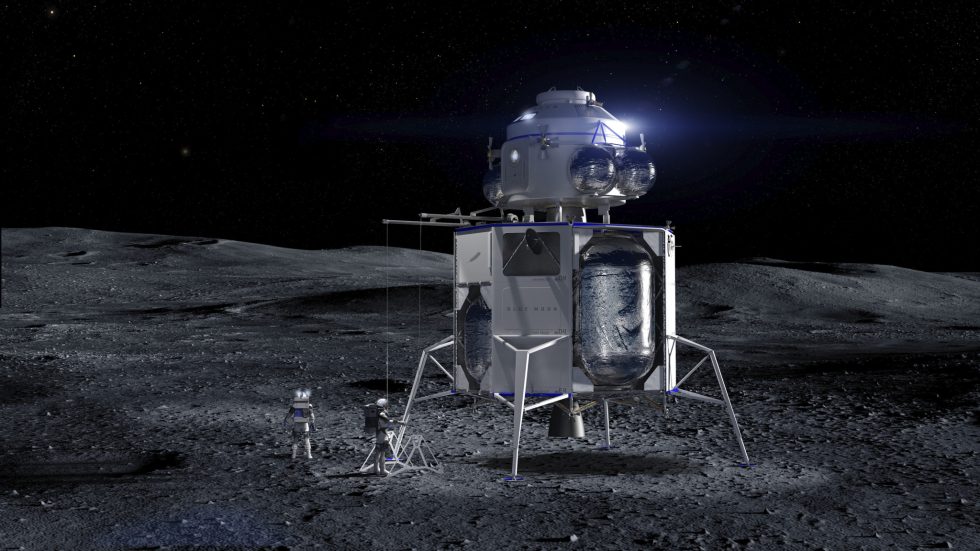
      Yesterday Jeff Bezos unveiled plans for a lunar lander and eventually colonies on the moon and in space.


      Near the end of his speech, Bezos praised the goal set by Vice President Mike Pence of landing humans on the Moon by 2024. "I love this," Bezos said. "It's the right thing to do. We can help meet that timeline but only because we started three years ago. It's time to go back to the Moon—this time to stay."
      In a configuration with "stretch tanks," Bezos said Blue Moon could carry up to 6.5 tons to the lunar surface, and this would be large enough for a crewed ascent vehicle. This aligns with NASA's vision for a multi-stage lunar lander that involves both a descent vehicle and then a different spacecraft for humans—the ascent vehicle—that will launch back from the surface of the Moon and return the crew to low lunar orbit. Blue Origin will bid on the descent vehicle portion of NASA's lunar lander contract.
      Based on their progress so far, I think that Bezos' plans for Blue Origin are ambitious but doable. His long-term goals might be another matter, involving building O'Neill colonies in space.


      I don't see that idea being any more possible than Elon Musk's plan for Mars colonies. If had the resources of Musk or Bezos, I'd be loooking at lunar colonies instead.

      5 Things to Consider When Creating Your CSS Style Guide

      During my career as a technical writer, I've worked on several style guides for my groups and had some input into coding standards for developers. It has never occurred to me that a style guide might be required for CSS, but I can understand the need, although I'd consider referring to one as a coding standards guide rather than a style guide.

      In any case, this article from LogRocket has some solid advice for creating such a guide. I can see that it would be especially useful for larger groups where writers might have to work with tools that are heavily CSS-based like Flare or WebWorks ePublisher.
      A CSS style guide is a set of standards and rules on how to use and write CSS code. It often contains global branding definitions like colors and typography and a set of reusable components for building a more consistent and maintainable project.
      CSS style guides should be considered an equal citizen of every project requirement.

      Thursday, May 09, 2019

      Designing a New Mobile Experience for the Guardian

      The Guardian is one of the best British newspapers, and they have a strong online presence. They're also turning a profit, without a paywall, which is a rarity in the newspaper business. Clearly they're doing something right.

      This article describes the process that The Guardian went through in updating its mobile website. While much of the article is specific to the newspaper business in the UK, there's quite a bit that would apply to any technical communication group planning on developing or redesigning their mobile presence.

      The recommendations from the article are particularly relevant to technical communication:
      • Make sure the website looks and feels like a digital product and not a print newspaper;
      • Innovate not only by investing in technology and new products, but also by providing training and continuous support to journalists;
      • Rethink the newsroom structure: hire as many developers, data scientists and designers as possible;
      • Do not be afraid to experiment: Build, Measure, Learn (Ries, 2011);
      • Be humble and open: the world has changed, business has changed — you should change, too;
      • Always involve the end-user in product decisions. Talk and, more importantly, listen to customers on a regular basis.

      2019 Locus Award Finalists

      Locus, the news magazine of the science fiction field, has published the list of finalists for its annual Locus Awards. They are voted on by readers and subscribers to the magazine and are always a good source of quality reading material.

      Here are the finalists for Science Fiction Novel.
      • Record of a Spaceborn Few, Becky Chambers (Harper Voyager US; Hodder & Stoughton)
      • The Calculating Stars, Mary Robinette Kowal (Tor)
      • If Tomorrow Comes, Nancy Kress (Tor)
      • Revenant Gun, Yoon Ha Lee (Solaris US; Solaris UK)
      • Blackfish City, Sam J. Miller (Ecco; Orbit UK)
      • Embers of War, Gareth L. Powell (Titan US; Titan UK)
      • Elysium Fire, Alastair Reynolds (Gollancz; Orbit US)
      • Red Moon, Kim Stanley Robinson (Orbit US; Orbit UK)
      • Unholy Land, Lavie Tidhar (Tachyon)
      • Space Opera, Catherynne M. Valente (Saga)
      Out of those, I've read two, The Calculating Stars and Elysium Fire, both of which were excellent. I was glad to see that Ian McDonald's superb Time Was on the novella list. Winners will be announced at the end of June.

      Wednesday, May 08, 2019

      Featured Links - May 8, 2019

      Links to things that I found interesting but didn't want to do a full post about.

      Microsoft Word to Get AI-Like Grammar Checker

      Microsoft will be adding AI-based grammar checking features to Word 365. 
      The functionality aims to take on similar platforms like Grammarly and Google Docs. The Ideas feature outlines simple errors, and highlights sentences that can be rephrased to improve clarity. Ideas will also be beneficial when reading, according to Microsoft. The feature can explain acronyms, outline the main points of what you’re reading and also estimate reading time. These features will give readers the ability to effectively skim through pieces of text.
      I'm not sure how I feel about that. I do use the grammar checker in Word, but I have turned off many of the things that it looks for.

      Another upcoming feature makes me very twitchy.
       Microsoft also announced a Word Designer feature that will allow users to style their documents and tables.
      Given how Microsoft has managed to make using paragraph and character styles more difficult with each release,  I can't imagine what they're going to do now.

      Tuesday, May 07, 2019

      Science Fiction Doesn't Have To Be Dystopian

      The publication of a new story by Ted Chiang is always an event in the science fiction field; the publication of a new collection of his stories is a major event. He has won four Nebula awards, four Hugo awards, and his story, The Story of Your Life was made into the movie, Arrival. And for a bonus, he's a technical writer.

      The New Yorker has a review of his new collection, Exhalation, written by none other than Joyce Carol Oates.
      In his new collection, “Exhalation” (Knopf), his second, Chiang again presents elaborate thought experiments in narrative modes that initially seem familiar. Contemporary issues relating to bioethics, virtual reality, free will and determinism, time travel, and the uses of robotic forms of A.I. are addressed in plain, forthright prose. If Chiang’s stories can strike us as riddles, concerned with asking rather than with answering difficult questions, there is little ambiguity about his language. When an entire story is metaphorical, focussed on a single surreal image, it’s helpful that individual sentences possess the windowpane transparency that George Orwell advocated as a prose ideal.
      I've read several of the stories in the collection and I cannot recommend it highly enough. I completely agree with Oates' assessment: "The stories in “Exhalation” are mostly not so magically inventive as those in Chiang’s first collection, but each is still likely to linger in the memory the way riddles may linger—teasing, tormenting, illuminating, thrilling."

      Free CSS Handbook

      Developer Flavio Copes has made his CSS Handbook freely available. It's written for developers and at 173 pages is a good reference for brushing up on some of the new CSS features.
      I wrote this article to help you quickly learn CSS and get familiar with the advanced CSS topics.
      CSS is often quickly dismissed as an easy thing to learn by developers, or one thing you just pick up when you need to quickly style a page or app. Due to this reason, it’s often learned on-the-fly, or we learn things in isolation right when we have to use them. This can be a huge source of frustration when we find that the tool does not simply do what we want.
      This article will help you get up to speed with CSS and get an overview of the main modern features you can use to style your pages and apps.
      You can download it in PDF, EPUB, and MOBI formats by subscribing to his free newsletter. He also has a series of handbooks on JavaScript and related tools.

      Monday, May 06, 2019

      Apollo 11 Manual for Sale

      The manual that the Apollo 11 astronauts used during their lunar landing is up for sale this summer. I was tempted to title this post "If I had a million dollars", but a million wouldn't be enough.
      This lunar module timeline book was used by the two U.S. astronauts to land Eagle, the lunar module that allowed for exploration of the moon’s surface. This rare cardstock-covered manual contains 44 three-hole-punched pages of detailed instructions for the launch and descent of Eagle.
      The time period that the book covers is the entire Lunar Module Eagle portion of the Apollo 11 mission, says Christina Geiger, head of books and manuscripts at Christie’s America.
      his step-by-step manual offers rare insight into the process of conducting the first moon landing, particularly the fact that the NASA astronauts weren’t completely certain their mission could be completed. In the book, there’s a section that gives details based on whether they decide to stay or not stay on the moon. “It’s almost like a choose your own adventure,” Geiger says. “They have a box with steps to abort the mission [if necessary].”
      I hope that whoever has deep enough pockets to purchase this significant piece of space history will put it on public display.

      Some Design and Typography Articles

      Here are some interesting articles about design and typography.

      Sunday, May 05, 2019

      Featured Links - May 5, 2019

      Links to things that I found interesting but didn't want to do a full post about.

      Saturday, May 04, 2019

      Surfing the Web Without CSS

      Cascading Style Sheets (CSS) are one of the best features of the web. CSS lets you (mostly) separate your presentation format from your content's code. I've been uisng CSS almost since it was developed in the mid-1990s, and I can't imagine doing anything on the web without it.

      Still, there are good reasons for wanting to see what a site looks like without CSS; the main one being to check accessibility features. So it's probably a good idea to test your website without CSS.

      Jon Kantner of CSS-Tricks wondered what would happen if he browsed to several major sites with CSS disabled. The results were interesting, to say the least.
      CSS is a key component to the modern web. As we’ve seen up to this point, there are a number of sites that become next to un-unusable without it — and we’re counting some of the most recognizable and used sites in that mix. What we’ve seen is that, at best, the primary purpose for a site can still be accomplished, but there are hurdles along the way. Things like:
      • missing or semantically incorrect skip links
      • links that run together
      • oversized images that require additional scrolling
      • empty elements, like list items and button labels
      He then goes on to provide best practices to follow to make sure your site works when CSS is disabled or not available. 

      This is a good article and I learned a lot from reading it.