
Friday, June 28, 2019
Off for the Canada Day Weekend
Monday is Canada Day, a big holiday up here in the temporarily warm and green Great White North. So I am taking the weekend off from blogging to indulge in traditional long weekend activities like drinking beer, eating barbecued food, watching the grass grow in my back yard, and maybe listening to some free live music. See you Tuesday.

Featured Links - June 28, 2019
Links to things that I found interesting but didn't want to do a full post about.
- How Historians Can Now See Invisible Text On Ancient Manuscripts.
- Seeing Is Believing: The Fact Checker's Guide to manipulated video. From the Washington Post.
- Gym bunnies and junkyard dogs: new words in the June 2019 update. I'm surprised at how long it takes some words to make it into the OED.
- New Video Shows How Humanity Could Spread Throughout the Galaxy. It would only take a few million years.
- The Sham of Sharehold Capitalism. It's not working.
- Amazon Canada launches 'Prime Reading', giving members free unlimited access to books. The article title isn't quite accurate - it should be 'some books'.
Thursday, June 27, 2019
In Praise of the NFB
I in my post about streaming services yesterday, I mentioned some free video streaming services. But I missed one – Canada's National Film Board. There you'll find thousands of short films, documentaries, and feature films produced by Canadian film makers going back more than half a century.
Chris Morgan of The Outline likes it too.
Chris Morgan of The Outline likes it too.
The experience of binging the NFB can be vertiginous. One film will leapfrog me to another, often within my interest of Canadian social and political history, of which the NFB has plenty to offer. Indeed, it is filled with documentaries that have matched and even surpassed the fly-on-the-wall style of Primary and The War Room. Flora: Scenes from a Leadership Convention (1977) follows Canada’s first female foreign minister Flora MacDonald as she and her staff try (and fail) to make her the first female Leader of the Progressive Conservative Party and therefore the opposition. Sophie Wollock’s Newspaper (1979) is a short history of The Suburban, a sort of Breitbart for anglophone Quebec. Acadia Acadia?!? (1971) depicts student radicals of New Brunswick’s francophone minority as they demonstrate for language recognition. My personal favorite is Donald Brittain’s The Champions, a three-part saga released between 1978 and 1986 covering the rise and rivalry of Prime Minister Pierre Trudeau and Quebec Premier and separatist icon René Lévesque. It combines talking heads, archival footage, droll narration, and a clear arc from brilliant promise to disappointment and corruption.
Wednesday, June 26, 2019
Facebook Is Getting Formatting
Facebook has some new tricks. I just did a post in a group I'm in and saw a pilcrow (backwards paragraph mark) beside my text. I hovered over it and got a submenu that offered H1, H2, bullet and numbered list, and quote formatting. Selecting text gives a bold and italic menu.
It only worked in the group, not in my newsfeed. Perhaps that will be rolling out later.
It only worked in the group, not in my newsfeed. Perhaps that will be rolling out later.
Back to the Bobbsey Twins?
For those of you too young to catch the reference in the title, the Bobbsey Twins were a series of novels for young readers popular when I was growing up. They were popular with librarians because they promoted the highly sanitized family values of the 1940s and 50s, not so popular with young readers who found them deadly dull.
If this article from the Guardian is correct, we may be moving back in that direction. The culture wars have hit the young adult publishing field.
If this article from the Guardian is correct, we may be moving back in that direction. The culture wars have hit the young adult publishing field.
These are just the latest battles in a war that seems to be escalating over who should control the way that people from marginalised communities appear in YA fiction. In August 2016, the Mexican-American author EE Charlton-Trujillo’s verse novel When We Was Fierce was delayed after several bloggers criticised its attempt to capture the voice of a black teenager. It has still not been published, and is not mentioned on Charlton-Trujillo’s website. In the months that followed, three speculative fiction novels, The Black Witch by Laurie Forest, American Heart by Laura Moriarty and The Continent by Keira Drake, attracted protests for their allegedly racist content. Forest published regardless, and with great success, despite a campaign of one-star reviews and emails to her publisher. Moriarty published, too, although Kirkus magazine, which had defended The Black Witch, downgraded and revised its review of American Heart, because it said the article “fell short of meeting our standards for clarity and sensitivity”. Drake, however, was convinced by her critics, 455 of whom signed a petition demanding that The Continent, “a racist garbage fire” according to one fellow author, be delayed to allow “additional editorial focus”. A substantially revised version appeared in March 2018.
Tuesday, June 25, 2019
The New Service Wars
My credit card expiry date rolled over recently, so I got sent a new card with a new expiry date. As a consequence, I had to go through my banking records and track down all my recurring subscriptions so I could update my payment information. I ended up having to create a spreadsheet for the task.
So it's worth tracking all of these in detail. You might be surprised at just how much you're spending.
As an alternative to paid services, you could check out some of the networks listed in this article from Wired. If your library has it, Kanopy is especially good, with much of the Criterion Collection available.
I was surprised at how much it added up to. And it will probably only get worse, as Sam Rutherford points out in this Gizmodo article.
In my case, I don't have any music subscriptions (unless you count the music part of Amazon Prime), but I have three online newspaper accounts (which will become two at some point), three online data storage accounts (again, which will be whittled down two), and three online video subscriptions (again, probably down to two as I think Netflix will be going).The beauty for companies is that once you sign you up, they’ve got you. It’s one thing not to buy another product from a specific company, but it’s another thing entirely to cancel one of your countless subscriptions, delete your account (and maybe migrate your data), and switch to another platform (assuming that’s even an option). After all, it’s just $10 or $15 a month, right? That’s nothing.This evolution has spawned an endless variety of monthly subscription services looking to sell you crates filled with your favorite nerdy swag, foreign confections from around the world, dental hygiene supplies, and basically anything else you can imagine. It’s a subscription service feeding frenzy out there. But it’s the tech companies that have perfected this model, as they have transformed things that once seemed like everyday pleasures into services that feel more like a tax on your paycheck. It sucks. When you combine these services with monthly bills for important things like housing, utilities, and internet, suddenly, a big chunk of the disposable income you think you have vanishes into the ether at the beginning of the month.
So it's worth tracking all of these in detail. You might be surprised at just how much you're spending.
As an alternative to paid services, you could check out some of the networks listed in this article from Wired. If your library has it, Kanopy is especially good, with much of the Criterion Collection available.
Monday, June 24, 2019
Meet Daniel Dale
I've been following the career of reporter, Daniel Dale, since his days covering the late mayor of Toronto, Rob Ford. He's spent the last few years as the Toronto Star's Washington correspondent, where he started fact checking Donald Trump and recently turned what started out as a sideline into a full-time position fact checking Trump for CNN.
I can't imagine how he does it, but this profile in the LA Times gives some insight into how and why.
I can't imagine how he does it, but this profile in the LA Times gives some insight into how and why.
I have been trying to cut down on the amount of political reporting that I read (especially from the US and the UK) to preserve my sanity, but I will keep following Daniel Dale for as long as he keeps writing.When you started this in September 2016, during the presidential race, you could have had no idea what this would end up involving, the tracking of every single lie that the man who would become President Trump would tell.No. I did not know. At first I did not think I was going to do every single claim or every single lie. I thought I would just do it occasionally, on days where it seemed like he was being especially dishonest.And then Michael Moore, of all people, the filmmaker, tweeted maybe five days into me doing it, saying something like, “Every single day, this Canadian journalist shames the U.S. media by pointing out every lie Trump tells.”And I got thousands of followers from that, and I seriously thought, “Oh gosh, I have to do it every day now to satisfy these people.”And then I thought I would probably be done with Trump, because I thought he was going to lose the election. Then, one of my first thoughts sitting there at Hillary Clinton’s so-called victory party in November 2016, election night, was, “Oh my gosh, I’m going to have to keep doing it for years now.”
15 LinkedIn Profile Tips
LinkedIn has become the primary social network for professional job hunting. So it's important to have a profile that reflects your skills and sells what you can contribute to a company.
I've been putting off reorganizing my profile (it's on my to-do list, honest), but when I do, I'll be using some of the tips in this article as a guideline. I recently attended a seminar on using LinkedIn as part of my retirement package and almost all of the advice I was given is covered in more detail in the article, and more.
I've read several articles recently on tweaking LinkedIn, and this is the best and most detailed one I've found.
I've been putting off reorganizing my profile (it's on my to-do list, honest), but when I do, I'll be using some of the tips in this article as a guideline. I recently attended a seminar on using LinkedIn as part of my retirement package and almost all of the advice I was given is covered in more detail in the article, and more.
I've read several articles recently on tweaking LinkedIn, and this is the best and most detailed one I've found.
Sunday, June 23, 2019
Featured Links - June 23, 2019
Links to things that I found interesting but didn't want to do a full post about.
- 2019 Sunburst Awards Longlist, for excellence in Canadian speculative fiction.
- A new AI tool from Adobe can detect Photoshopped faces. I'm sure we will be seeing more tools like this.
- Rocket Lab: The small firm that launched the 3D-printed space revolution. They get better performance than with conventional machining and it's cheaper.
- An Ambitious Search for Aliens Came Up Short–so Astrobiologists Are Thinking Bigger.
- Rebuilding the Solar System with CSS. It is remarkable what you can do now with CSS.
- Everything I Learned While Getting Kicked out of America's Biggest Anti-Vaccine Conference. Think of it as evolution in action.
- Game Changing Direct Drive Fusion Propulsion Progress. It's not the Expanse's Epstein drive, but it's better than anything we have now.
Saturday, June 22, 2019
Sugarmegs
I like listenning to recordings of live music. Over the years, I've listenned to a substantial portion of the Grateful Dead's concerts, along with other jam bands like Phish. It's probably because I don't get to go out to any near the number of live concerts that I'd like to attend.
Way back in the beginning days of the Internet, I used to frequent a site called Sugarmegs.org which collected live concert recordings. At some point, I think they went down and I stopped visiting. But a chance remark by a Facebook friend led me back there and to my great pleasure I found they're still up and running.
Sugarmegs isn't the prettiest site around; in fact it's layout is loud and pretty dated by modern standards. But what it lacks in visual flair, it makes up in content. You can browse recent uploads, an alphabetical list, or search for your favourite band. In the last few days, I've found several recordings of the Jefferson Airplane that I had not heard before, a wonderful performance from Fairport Convention at the end of May, a Richard Thompson show from his last tour, and a couple of recent Phil Lesh and Friends shows with Jorma Kaukonen.
These aren't always the highest quality recordings. Many of the shows are of taper-friendly bands and these will generally be quite listenable. Stealth recordings and older shows, not so much. But there's enough there that you're bound to find something good.
Friday, June 21, 2019
Say No to the Lunar Gateway
For reasons I cannot begin to understand (other than the usual political ones), NASA has come up with a plan to return to the moon by building what they call the Lunar Gateway, a space station in orbit around the moon. Herewith, some articles showing why it's a bad idea and waste of money and time.
Some months ago, I read an article that had a comparison of the delta-v (the change in velocity) required for NASA's Lunar Gateway (which is planned to orbit in one of the Lagrange points between the Earth and the Moon, and a standard lunar orbit. The Gateway required a higher delta-v, hence more fuel. Unfortunately, my Google skills have failed me, and I can't find the article.
Thursday, June 20, 2019
Some Links About Security
I've come across a few articles recently about Internet security that I thought were worth sharing.
- Tricky Scam Plants Phishing Links In Your Google Calendar
- Fake Office 365/OneDrive file deletion alerts, for Windows users.
- Cautionary tale: Hijackers hijack phone number, break into man's Google account, try to steal $25K. This is truly terrifying.
Stay safe. It's a nasty world out there.
Wednesday, June 19, 2019
Minivac 601 Replica
The Minivac 601 was an educational toy designed to teach digitial circuit design. It was developed by information science pioneer, Claude Shannon.

Now, courtesy of Michael Gardi (who happens to be my awesomely talent cousin), you can build your own replica.
Now, courtesy of Michael Gardi (who happens to be my awesomely talent cousin), you can build your own replica.
The Instructable presented here is for a full size replica of that Minivac 601 from 1961. I have tried to remain as true to the original as possible given the technologies and resources available to me. I don't have a "vintage" unit so this replica has been constructed based on photos and from the original manuals that were available online. I have included these manuals in PDF format as part of this project. I brought these files to a local copy center and had them printed as the spiral bound booklets you can see above. I'm really happy with the results.
ClickHelp - A New To Me Help Authoring Tool
I'm familiar with the industry-leading help authoring tools like RoboHelp and Flare, but I had not heard of ClickHelp until seeing a blog post from Tom Johnson.
ClickHelp is a browser-based tool that can create documentation or online help in a variety of formats. Source content is stored on a documentation portal hosted by ClickHelp and you can also publish to their portal.
From a quick scan of their online documentation (in ClickHelp format), it appears to have most of the features that you'd expect for a modern authoring tool (reusable content, flexible import and export of several formats), conditional text, and so on).
Of course, the devil is in the details, and without experimenting with the free trial (which I would love to do but don't have the time), I can't say much more than it looks interesting. For more, read Tom's review and browse the docs online.
ClickHelp is a browser-based tool that can create documentation or online help in a variety of formats. Source content is stored on a documentation portal hosted by ClickHelp and you can also publish to their portal.
From a quick scan of their online documentation (in ClickHelp format), it appears to have most of the features that you'd expect for a modern authoring tool (reusable content, flexible import and export of several formats), conditional text, and so on).
Of course, the devil is in the details, and without experimenting with the free trial (which I would love to do but don't have the time), I can't say much more than it looks interesting. For more, read Tom's review and browse the docs online.
Tuesday, June 18, 2019
Accessibility Improvements In Windows 10 Build 1903
Microsoft is making some significant improvements to the accessibility features in Windows 10, Build 1903 which is rolling out to users now.
From my point of view, the biggest improvement is with the mouse cursor. As well as being able to change size, you will be able to have a coloured pointer. I generally use dark mode as much as possible, and being able to have a bright yellow cursor would be good.
What I would really like is to have a guide circle around the pointer in a light contrasting colour. I use an application called CursorAttention to do this, bu it has issues with keeping the circle and the pointer in sync with some applications.
They've also made improvements to the Magnifier and Narrator applications.
These are all good reasons to look forward to the new build. And I'm glad to see Microsoft paying attention to accessibility.
Monday, June 17, 2019
Android Security: 5 Ways to Keep Your Android Phone Secure

Image from pixabay.com
Guest post: This is a guest post provided by techwarn.com. techwarn.com showcases the latest tech news, reviews, and downloads with coverage of entertainment, gadgets, security, enthusiast gaming, hardware, software and consumer electronics.
Mobile security is generally considered to be a boring subject, but neglect it and you might pay the price of data loss, being hacked, and worst of all, e-banking theft.
Huawei has been booted off the Android OS platform because of alleged spying activities through unauthorized ‘backdoors’. Elsewhere, other data breaches, such as phishing attacks happen every day, threatening the privacy and security of Android users.
With Android devices making up the bulk of smartphones in the market today, it becomes very important to ensure the safety of your device at all times – both online and offline.
Here are several ways to beef up your basic defenses.
1 Embrace 2FA for Google accounts
Android devices have been fashioned so that everything in them is tied back to the Google accounts they are registered with. This means anyone looking to go after your data would be very interested in hacking your Google account.Thus, it is not surprising that the first place we are starting from is the Google account.
Enabling two-factor authentication (2FA) on your accounts means that someone with only your password doesn’t get access to the account if they don’t have the other factor. Many people prefer to receive text messages (which is the most convenient but can also be the least secure) as compared to the Google Titan Bundle Key or the Authenticator app.
You can activate 2FA on your account by following this step-by-step guide.
2 Using a Strong Password
Android phones come with two form of biometric authentication. The phone comes with a fingerprint scanner or bundles a facial unlocking system.While those are great, they could make you pass setting a strong password.
What you might not have considered is that anyone with access to your phone does not need your biometric details when they can simply crack your password. Their chances of doing that increase with how weak the password is in the first place – emphasizing why you should make it something that is not easy to guess or crack.
3 Disable App ‘Sideloading’
Google made the Play Store available so they could regulate all the apps that go onto your phone. By doing so, they take on the task of ensuring those apps are safe, secure, and do not contain any malicious code that could hurt you.To keep the platform transparent, though, Google also kept a feature that allows you to install apps from unknown sources.
If you have enabled this feature in the past, now is the time turn it off again.
Called ‘sideloading’, installing apps from sources other than the Play Store means you don’t have any proof of the app being what it says it is. In other words, the app could contain malicious code to spy on you, steal your information, alter your device’s settings, and so much more.
If the app is not on the Play Store, you might be better off without it.
4 Enable ‘Find My Device’
It is never a good feeling when you lose your phone. You have put a lot of time and energy into setting up that phone to meet your tastes and your needs. Besides that, you have also put a lot of files and information on that phone that makes it worth more than what you paid at the store.With ‘Find My Device’, you might have a shot at locating the unit. If that doesn’t work, though, this feature could be the only saving grace in ensuring your data doesn’t get into the wrong hands.
Google has made it possible to remotely wipe all files on the unit when you lose it. This is important for those who keep sensitive information on their devices. Because you can get most of your files from backups (we’re assuming you have backups enabled on your device), it won’t really be a loss.
Just get another device and resume your Android lifestyle as if nothing happened.
5 Get a VPN
While keeping yourself safe offline, keeping your devices safe while connected to the internet is also as important.There are different measures by which hackers and unauthorized individuals might get access to your Android phone. Some of these tactics are, but not limited to, browser fingerprinting, man-in-the-middle attacks, rogue Wi-Fi network attacks, and so much more.
There are also companies that will track, monitor, and record your data for either personal use or sale to other companies/bodies. The Facebook and Cambridge Analytica scandal is a prime example.
Fortunately, you can use an Android VPN to encrypt your internet traffic. Coming with a slew of servers which will obfuscate your data anytime you are online, you can always get out of the ever-monitoring eyes of whoever is looking in on your internet traffic.
Wrap Up
Securing your phone doesn’t have to be an expensive or time-consuming project. With the simple tips above, you can keep your Android device safe from the prying eyes of anyone who shouldn’t be looking at your data in the first place.Sunday, June 16, 2019
Featured Links - June 16, 2019
Links to things that I found interesting but didn't want to do a full post about.
- Physicists See a Quantum Leap, Halt It, and Reverse It. A significant piece of research into quantum physics.
- The Most Beautiful Theorem in Mathematics: Euler's Identity. Some beautiful and elegant math for you.
- Why Are Ebooks More Expensive Than Paperbacks? This is something I've often wondered.
- Why Boeing May Never Recover From Its 737 Debacle. It put profit over safety.
- Native American Women Have Are Being Sold into the Sex Trade on Ships Along Lake Superior. This has been going along for years; hopefully now it can be stopped.
- Unbuilt Tokyo: 'depthscrapers' and a million-person pyramid. More from the Guardian's wonderful Unbuilt Cities series.
- A Few Fuel for Satellites Is So Safe It Won't Blow Up Humans. Say good riddance to hydrazine.
Saturday, June 15, 2019
We're Toast 8
This post is a collection of links that support my increasingly strong feeling that the human race (or at least our technological civilization) is doomed. It is part of an ongoing series of posts.
Climate Change and Environment
- Worlds rivers 'awash with dangerous levels of antibiotics'. This is helping to spread antibiotic resistance.
- For the Midwest, Epic Flooding Is the Face of Climate Change. America's breadbasket is underwater.
- New Report Suggests ‘High Likelihood of Human Civilization Coming to an End’ Starting in 2050. I think we will see major distruptions sooner than that.
- If Climate Goals Aren’t Met, Extreme Heat Will Kill Thousands in U.S. Cities, even northern ones.
- Groundbreaking Report Gives Us a Glimpse of the US Military’s Gigantic Carbon Footprint
Politics
- The Growing Danger of Trump's Trade War with China. Global recession is not the worst outcome.
- They Know That America Isn't Great. So they want to rig the census.
- How America could become a dictatorship in 10 years, according to Jared Diamond.
- Trump's Misguided Ban on Federal Fetal-Tissue Research Will Only Hurt Science.
Technology
- China Telecom Swallows Huge Amount of European Mobile Traffic For Over Two Hours. Is it live or is it China Telecom?
- 'I wash all my food like crazy': scientists voice concern about nanoparticles
- Satellite Constellations Like SpaceX's Starlink Could Cause Major Problems, Astronomy Group Warns. There goes the night sky.
Friday, June 14, 2019

Astounding: A Review
When I was a teenager, the science fiction magazines, especially Analog Science Fact Science Fiction, were my gateway drug into the worlds of science fiction. I was lucky that there was a used bookstore in the Sault that sold back issues and I was able to grab dozens of copies of Analog and its earlier incarnation of Astounding for a nickel apiece. Through them, I discovered Poul Anderson, Mack Reynolds, Anne McCaffery, Randall Garrett, Christopher Anvil, and many other authors.

For about twenty years, Astounding was the leading magazine in the SF field. Under the editorship of John W. Campbell, Jr. it published stories by Robert A. Heinlein, Arthur C. Clarke, L. Ron Hubbard, Isaac Asimov, and A. E. Van Vogt, in an era that became known as the golden age of science fiction.
Astounding: John W. Campbell, Isaac Asimov, Robert A Heinlein, L. Ron Hubbard, and the Golden Age of Science Fiction by Alec Nevala-Lee is the history of that period and a biography of Campbell and his three major authors.
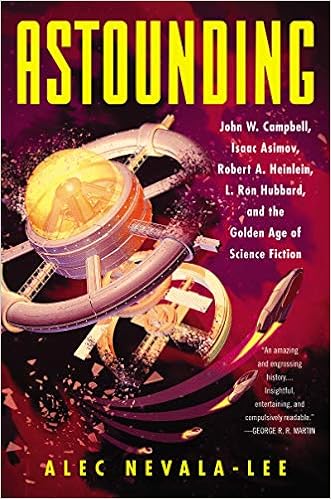
Although there have been biographies and critical studies of the authors before this, it's the first major biography of Campbell, who was arguably the most influential editor in the history of science fiction.

I am well read in both science fiction and historical and critical work aobut it, and there were things in this book that I had never heard about, for example, Campbell's correspondence with Gene Roddenberry and his influence on the original Star Trek series.
The book isn't just about Campbell; as the subtitle indicates it's also about Heinlein, Asimov, and Hubbard, and especially about Campbell's influence on their careers, which was extensive. Unfortunately, it's clear that while Campbell was instrumental in developing their careers, he couldn't grow with them and maintain the relationship that he'd established.
I would have liked to see more details on the history and operation of the magazine itself and the role of the magazines in fostering the development of the genre. It's there, but I wanted more. Still, I enjoyed this book immensely, and I recommend it highly if you have any interest in classic science ficiton.
For about twenty years, Astounding was the leading magazine in the SF field. Under the editorship of John W. Campbell, Jr. it published stories by Robert A. Heinlein, Arthur C. Clarke, L. Ron Hubbard, Isaac Asimov, and A. E. Van Vogt, in an era that became known as the golden age of science fiction.
Astounding: John W. Campbell, Isaac Asimov, Robert A Heinlein, L. Ron Hubbard, and the Golden Age of Science Fiction by Alec Nevala-Lee is the history of that period and a biography of Campbell and his three major authors.
Although there have been biographies and critical studies of the authors before this, it's the first major biography of Campbell, who was arguably the most influential editor in the history of science fiction.
As an editor, he wanted good writing, accurate science, believable characters, and stories that logically accounted for multiple variables: "The future doesn't happen one at a time."Campbell was controversial. His political views put him well to the right of the political spectrum, something that probably didn't help his career during the 1950s and 60s when SF made a distinct swing to the left. He was also seriously into what we'd now call fringe ideas and championed dianetics with L. Ron Hubbard, ESP and parapsychology, and the Dean drive (a purported reactionless drive that didn't work).
I am well read in both science fiction and historical and critical work aobut it, and there were things in this book that I had never heard about, for example, Campbell's correspondence with Gene Roddenberry and his influence on the original Star Trek series.
The book isn't just about Campbell; as the subtitle indicates it's also about Heinlein, Asimov, and Hubbard, and especially about Campbell's influence on their careers, which was extensive. Unfortunately, it's clear that while Campbell was instrumental in developing their careers, he couldn't grow with them and maintain the relationship that he'd established.
I would have liked to see more details on the history and operation of the magazine itself and the role of the magazines in fostering the development of the genre. It's there, but I wanted more. Still, I enjoyed this book immensely, and I recommend it highly if you have any interest in classic science ficiton.
Subscribe to:
Posts (Atom)