Tuesday, November 30, 2021

Posts May Be Sparse in December

It's coming up to December and the holiday season. So the blog will be going on vacation sometime just before Christmas until after New Year's Day. In the meantime, I probably won't be doing a lot of posts, other than the usual link posts. 

Partly that's because of the holidays and partly various family-related things that are eating up a lot of time and energy.  

I hope things will quiet down in the new year. 

Monday, November 29, 2021

Featured Links - November 29, 2021

Links to things I found interesting but didn't want to do a full blog post about.


Sunday, November 28, 2021

Photo of the Week - November 28, 2021

Here's a picture of the Portal, part of the Home Place in the Alex Robertson Park near us.  

Fujifilm X-S10 with 16-80 mm. F4, 16 mm. @ F14, 1/100 second, ISO 400, Velvia film simulation


Saturday, November 27, 2021

Saturday Sounds - Gimme Shelter - The Rolling Stones - 23rd November 2021

The Rolling Stones wrapped up their latest US tour recently. Here's a very good audience recording of Gimme Shelter from their final performance on November 23rd. 


See this Rolling Stone article for more details.  

Friday, November 26, 2021

Dublin 2019 Worldcon Makes Videos Available

The Dublin 2019 World Science Fiction Convention (aka Worldcon) has made videos of some of its programming available for viewing. They include the Hugo Awards ceremony and several panels, including ones with Joceyln Bell, Steve Jackson, Mary Robinette Kowal, and George R. R. Martin, among others. 

Videos are available on the convention's YouTube Channel

Thursday, November 25, 2021

Accessible Payment Terminals

Being visually impaired, I sometimes have trouble using payment terminals. Some of the new models are OK, but older ones with low-contrast LCD screens are very difficult for me to read.

Moneris has introduced a new line of Moneris Core terminals with accessibility features designed to make it easier for people like me to use them. Users can touch the accessibility icon (a circled A) or the 5 key to turn on the features, which include a high-contrast screen and voice prompts. 

Here's a short YouTube video explaining how to use the accessibility features. 


I'm very glad to see that at least one terminal vendor is thinking about accessibility and I hope to see more include these features if they haven't already. 


Tuesday, November 23, 2021

The Biggest Bomb

In 1961, at the height of the Cold War, the Soviet Union detonated the largest hydrogen bomb ever tested. At 50 megatons, it was thousands of times larger than the bombs that destroyed Hiroshima and Nagasaki. And it could have been larger, but concerns over the spread of fallout caused the designers to scale back the size of the explosion. 

The Bulletin of the Atomic Scientists has published a well-documented (with footnotes) history of the development of the bomb, often known as the Tsar Bomba. It's a rather unnerving story that highlights the craziness of those years.

In the early hours of October 30, 1961, a bomber took off from an airstrip in northern Russia and began its flight through cloudy skies over the frigid Arctic island of Novaya Zemlya. Slung below the plane’s belly was a nuclear bomb the size of a small school bus—the largest and most powerful bomb ever created.

At 11:32 a.m., the bombardier released the weapon. As the bomb fell, an enormous parachute unfurled to slow its descent, giving the pilot time to retreat to a safe distance. A minute or so later, the bomb detonated. A cameraman watching from the island recalled:

A fire-red ball of enormous size rose and grew. It grew larger and larger, and when it reached enormous size, it went up. Behind it, like a funnel, the whole earth seemed to be drawn in. The sight was fantastic, unreal, and the fireball looked like some other planet. It was an unearthly spectacle! [1]

The flash alone lasted more than a minute. The fireball expanded to nearly six miles in diameter—large enough to include the entire urban core of Washington or San Francisco, or all of midtown and downtown Manhattan. Over several minutes it rose and mushroomed into a massive cloud. Within ten minutes, it had reached a height of 42 miles and a diameter of some 60 miles. One civilian witness remarked that it was “as if the Earth was killed.” Decades later, the weapon would be given the name it is most commonly known by today: Tsar Bomba, meaning “emperor bomb.”

Monday, November 22, 2021

Featured Links - November 22, 2021

Links to things I found interesting but didn't want to do a full blog post about:

Sunday, November 21, 2021

Photo of the Week - November 21, 2021

Here's a photo taken between Echo Bay and Bruce Mines, Ontario on Thanksgiving weekend, taken with my Fujifilm X-S10. I cropped and edited the original JPEG in Photoshop Express to reduce the haze and bring up the colour. (My post of last Sunday shows what the weather was like). I'm not posting details because they're not really relevant after all the editing.


Saturday, November 20, 2021

Saturday Sounds - Grateful Dead, April 27, 1977

1977 was a good year for the Grateful Dead and many Deadheads consider it their best. I don't agree but it was certainly one of their best periods.

Here's a previously unreleased show from the Capitol Theater recorded on April 27, 1977. It's a very good recording made from the original tapes for an FM broadcast and it includes video footage. Given 1977 video technology, it's not great video, but it's been cleaned up and upscaled to 1080p, so it's watchable. 

I haven't listened to the whole show yet, but the parts I've heard are typical 1977 Dead, which means it's melodic, tight, and rocks like crazy when it's called for.


Friday, November 19, 2021

Tracking the History of Climate Vocabulary

Here's an interesting post from the Oxford English Dictionary blog about the OED's history of climate-related words. You might think that "climate change" is fairly recent usage, but it goes back to 1854. Other terms are also discussed in the article.  

In 2021, the OED embarked on a project to broaden and review its coverage of vocabulary relating to climate change and sustainability. I’d been feeding my own eco-anxiety by learning more about these topics for some years before I proposed that the OED conduct a review of its coverage. I knew that our New Words team had, over the course of the last 30 years or so, researched and covered a lot of the best-known terms, such as global warming and carbon offsetting, but this is a rapidly changing area of vocabulary. With the world spotlight coming to rest on the UK later this year at the UN climate summit in Glasgow (COP26), it is important to continue to monitor developments in this epoch-defining nexus of problems.

When OED editors are investigating the way a word or sense has been used over time, we look for examples of contextual and dateable evidence in our internal files and databases, as well as in external databases, websites, libraries, and archives.

We tend to think of climate change and sustainability as very contemporary issues, but what was interesting about researching some of the terms in this year’s update (as well as revisiting those we had already covered) was being able to put them into a historical perspective and seeing just how far back some ideas could be traced though the vocabulary, as a few examples will show.

Thursday, November 18, 2021

Disaster in BC Will Have Long-Term Effects

The rains have let up, at least for now, in British Columbia, but the unprecedented rainfall of the last few days will have long-term effects. Vancouver, the 4th largest port in North America, is cut off from the rest of Canada as highways and railways are washed out. 

From the Eye on the Storm blog

The heavy rains fell on mountainous areas that, in many cases, had been denuded of vegetation by the destructive wildfires that ravaged the region in late June and early July. These wildfires had been fueled by a record heat wave that brought an insane temperature of 49.6 degrees Celsius (121°F) to Lytton, British Columbia – the hottest temperature ever recorded in Canada. A rapid-response study from the World Weather Attribution program found that this heat wave would have been “virtually impossible without human-caused climate change.” The study estimated that the event was roughly a 1-in-1000-year event in today’s climate, but added, “the observed temperatures were so extreme that they lie far outside the range of historically observed temperatures. This makes it hard to quantify with confidence how rare the event was.”

The atmospheric river also swept into western Washington, which has been doused throughout the autumn by periods of unusually heavy rain. Rainfall from September 1 through November 15 at Seattle’s Sea-Tac International Airport was 15.87″, the most ever measured for that two-and-a-half-month period in data going back to 1945. The airport’s wettest full autumn (Sep-Nov) was in 2006, with 18.61″; that record could certainly fall before month’s end.

The Vancouver Sun reports on the effects on the provinces's infrastructure, already substantially damaged by this summer's heat wave and wildfires.

Owing to several washouts and mudslides, the old southerly route — Highway 3, snaking through the Cascades, Monashees and Selkirk mountains to the Crowsnest Pass in the Rockies — is impassable. The Fraser Canyon route, northward from Hope, about 130 kilometres east of Vancouver, has been smashed by rockslides and waterfalls that burst out of nowhere from the Coast mountains over the weekend.

CP Rail is looking to divert shipping traffic via Portland, Oregon, but restoring east-west overland connections by American routes won’t be easy. Washington State is a mess, too. Floodwaters from the Nooksack River have poured across the Canada-U.S. border into the Fraser Valley. Sumas Lake, an ancient waterbody drained to create farmland back in the 1920s, is a lake again today. Thousands of people have been evacuated.

About 280 kilometres east of Vancouver by a now non-functioning road, the Tulameen and Similkameen Rivers broke their dykes and burst their banks on Monday, and the rivers are now flowing through much of the town of Princeton. The temperature is dropping below freezing, the natural gas line that heats local homes is broken, the town’s water systems are wrecked, and nobody knows when things will be “normal” again.

While Princeton was drowning, the Coldwater River was venting its rage on the town of Merritt, 90 kilometres north of Princeton, and the entire community has been shut down because of the “immediate danger to public health and safety.” Roughly 7,000 people have been ordered to make their way to emergency centres in Kamloops and Kelowna.

A post in Gizmodo looks at how the effects of the wildfires contributed to the disaster.

Wildfires burn off an important layer of vegetation that, Brent Ward, a professor of earth sciences at Simon Fraser University and co-director of the Center for Natural Hazards Research, said “captures some of the rain and can slow it down before it gets into soil.”

Wildfires can also change how the soil interacts with rainfall. “When the organic layer in the upper part of the soil burns, it creates these organic compounds that travel into the upper part of the mineral soil and kind of precipitate,” Ward said. “It’s this waxy substance, and it makes that impervious to water—we call that hydrophobic. The water, instead of kind of centering down into the soil, it can’t go anywhere. It runs off, and runs down the slope, and hits a sort of steeper slope, and it erodes a lot. The sediment that’s eroding is often enough to generate a debris flow.”

And winter is coming. 


Wednesday, November 17, 2021

Amazon Best Books of 2021: Science Fiction and Fantasy

The editors at Amazon have announced their list of the best science fiction and fantasy books of 2021. The list has a wide range and includes several books by new authors. Out of the twenty books on the list, these are the ones I plan to read.

  • Project Hail Mary: A Novel by Andy Weir
  • Leviathan Falls (The Expanse Book 9) by James S. A. Corey
  • The Extinction Trials by A.G. Riddle
  • A Desolation Called Peace (Teixcalaan Book 2) by Arkady Martine

Twitter Cracking Down On Bots

I use Twitter a lot. I know it has a reputation for being full of garbage, but if you curate who you follow and use the right app, it can be extremely useful. Over time, I've noticed fewer garbage posts and that may be due to the work Twitter is doing to eliminate bots.

The Twitter blog has a long post about bots and Twitter that's worth reading if you're a Twitter user. 

“There are many bots on Twitter that do good things and that are helpful to people,” said Stewart. “We wanted to understand more about what those look like so we could help people identify them and feel more comfortable in their understanding of the space they’re in.”  

Stewart’s team revealed that people found content more trustworthy if they know more about who’s sharing it—starting with whether that account is human or automated. To help address the issue of bots, Twitter recently rolled out new labels that identify bots with an “automated” designation in their profile, an icon of a robot, and a link to the Twitter handle of the person who created the bot. “Not only are we just labeling these bots, we're also saying: this is the owner, and this is why they're here,” said Stewart. “Based on the preliminary research that we have, we hypothesize that that's going to create an environment where you can trust those bots a lot more.”  

So why go to the trouble of labeling bots, instead of banning them all from Twitter?

“It's not inherently wrong to have an automated account on Twitter; obviously automated accounts don't have to be terrible. There was a vaccine bot that was really popular in New York,” said Dante Clemons, the senior product manager tasked with creating and testing these labels. She was referring to the Turbovax bot that Tweeted vaccine appointments to its 160,000 followers. “I focused on those accounts because these are the ones that can help us all reframe how we think about bots.” 

You might also want to take a look at this thread from the Twitter Safety account that has some good tips about how to tell bots from real accounts.  

Tuesday, November 16, 2021

A Classic Grateful Dead Show

I was listening to the Grateful Dead channel on SiriusXM on the weekend and they played an excerpt from a 1972 show that I hadn't heard before, namely November 13, 1972 in Kansas City. This one struck me immediately because of the sound quality. The show is a mix of two audience recordings; the better of the two was recorded by the Dead's genius sound tech, Owsley Stanley (aka Bear). This is EXACTLY what the Dead sounded like if you were on the floor close to the stage.

The whole show is good, but if you're a sound purist, start with the Playin' in the Band, and listen on a good pair of headphones. The Dark Star > Playin' in the Band is especially wonderful. Turn down the lights, light up, and enjoy.

Monday, November 15, 2021

Featured Links - November 15, 2021

Links to things I found interesting but didn't want to do a full blog post about. 

Sunday, November 14, 2021

Photo of the Week - November 14, 2021

A very misty scene from Sylvan Valley about a month ago. I may try to dehaze this a bit in Photoshop, but I like the moody feel as it is.
 
Fujifilm X-S10 with 16-80 mm F4, 80 mm. at F5.6, 1/240 second, ISO 800, Velvia film simulation (probably) 


Friday, November 12, 2021

Useful Tips for Creating Charts

It's easy to lie with a chart. Not setting the axis at 0 is one thing I sometimes see. There are other mistakes that you can make that will confuse readers. 

Here's a list of tips for creating charts that was posted on the  Worthwhile Canadian Initiative, a mainly Canadian economics blog. It's a good list and I wish I had it when I was working at the TSX.

It's also a good list of things to look for in charts that you may see in news articles. If the chart makes some of the mistakes outlined in the article, it may be that the authors are trying to mislead you.

Thursday, November 11, 2021

A Slingshot To Space

Rockets aren't the only way of getting payloads into space. Other methods that have been tried are balloons and giant guns. Some day maybe we'll have a space elevator. Now there's another method – a giant slingshot. 

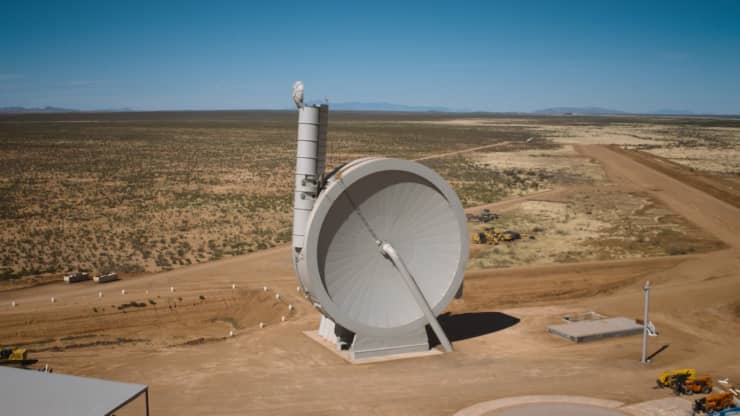
A US company, SpinLaunch, has built a giant centrifuge that can fire a payload at more than the speed of sound. Their first test in October was successful. The idea is to give a small rocket enough velocity that a booster stage isn't required. 

SpinLaunch, a start-up that is building an alternative method of launching spacecraft to orbit, conducted last month a successful first test flight of a prototype in New Mexico.

The Long Beach, California-based company is developing a launch system that uses kinetic energy as its primary method to get off the ground – with a vacuum-sealed centrifuge spinning the rocket at several times the speed of sound before releasing.

“It’s a radically different way to accelerate projectiles and launch vehicles to hypersonic speeds using a ground-based system,” SpinLaunch CEO Jonathan Yaney told CNBC. “This is about building a company and a space launch system that is going to enter into the commercial markets with a very high cadence and launch at the lowest cost in the industry.”


It seems like a crazy idea - that centrifuge is 33 metres in diameter and spins at hundreds of revolutions per minute - but it looks like it might be a viable way of launching small payloads. Do look at the video below - it's quite amazing. 


Wednesday, November 10, 2021

Technical Communication Links - November 2021

Despite being retired for almost three years now, I still follow what's going on in the technical communication field. Here are some useful links that I've come across recently.

Tuesday, November 09, 2021

2021 World Fantasy Awards

The winners of the 2021 World Fantasy Awards were announced last weekend at this year's World Fantasy Convention in Montreal. These are the fiction awards.  

  • NOVEL: Trouble the Saints by Alaya Dawn Johnson (Tor Books)
  • NOVELLA: "Riot Baby" by Tochi Onyebuchi (Tordotcom)
  • SHORT FICTION: “Glass Bottle Dancer” by Celeste Rita Baker (Lightspeed, April 2020)
  • ANTHOLOGY: The Big Book of Modern Fantasy, edited by Ann and Jeff VanderMeer (Vintage Books)
  •  COLLECTION: Where the Wild Ladies Are by Aoka Matsuda, translated by Polly Barton (Soft Skull Press US/Tilted Axis UK)

Monday, November 08, 2021

Featured Links - November 8, 2021

Links to things I found interesting but didn't want to do a full blog post about.

Sunday, November 07, 2021

Photo of the Week - November 7, 2021

Fall colours earlier this week. 

Fujifilm X-S10 with 16-80 mm. F4, F16 @ 20 mm., 1/100 second, ISO 1250, Velvia film simulation


Friday, November 05, 2021

30 Days of Dead Is Back

For the last several years, the Dead.net has been celebrating the legacy of the Grateful Dead with 30 Days of Dead. Each day, they release a soundboard track from the vast archives of the Grateful Dead that you can download for free. 

 As the young folks like to say, it’s time to flex your Grateful Dead knowledge and take home a high-quality MP3 download every day in November while you are at it. 30 days of unreleased Grateful Dead tracks from the vault, selected by Dead archivist and producer David Lemieux? Yes, please! The tracks are yours, no strings attached, but we hope you’ll stick around for the chance to win some sweet swag from the Dead.

If you don’t know what we’re on about, here’s the deal:

You know your Ables from your Bakers from your C's, but can your finely tuned ears differentiate the cosmic "comeback" tour from a spacey 70's show? Each day we'll post a free download from one of the Dead's coveted shows. Will it be from that magical night at Madison Square Garden in '93 or from way back when they were just starting to warm it up at Winterland? Is that Pigpen's harmonica we hear? Brent on keys? Step right up and try your hand all November long and win prizes to boot.

Free Grateful Dead music. It doesn't get much better than that. 

Thursday, November 04, 2021

The Pandemic Will Have Long-Term Impacts

I don't think there's anyone reading who isn't looking forward to the end of the pandemic. I know I am. But even if the pandemic subsides, and likely becomes just another endemic disease we have to worry about occasionally, it is going to have long-term impacts. These impacts will last for years and possibly decades, as this article from Talking Points Memo suggests. 

 These all suggest that the impact of the COVID Pandemic will not only be long-lasting but likely show most in ways now only barely visible to us. The so-called ‘great resignation’ is a key example. There are all sorts of theories about why so many people are quitting their jobs. There’s at least some evidence that it’s concentrated in a relatively small number of states. But we don’t really know. All we know is that fate picked up the world like it was one of those Christmas Snow Globes, shook it hard and that afterwards things weren’t at all the same. What about inflation? Well, we know we had a global shipping system that was engineered to have very little slack or resiliency in it (just in time production and shipping) and it’s struggled to bounce back from the shock. But people are also buying more stuff. Do they have more money because of forced delays in consumption (lockdowns) or COVID relief checks? Probably. But much of this also seem tied to different consumer desires based on radically different life experiences.

Today we’re talking about inflation, ‘labor shortages’ which really seem to be code for people unwilling to work for pre-Pandemic wages and other issues that are immediate and often viewed through a short-term electoral prism. But we should have in the backs of our minds that we’re seeing shifts in mass behavior that at present we don’t really understand or understand only in the most limited ways. Social cataclysms of such duration that reach so deeply into everyone’s lives never fail to have transformative consequences that reach far into the future. This must be even more the case when they hit a society already in the midst of great social stress and instability.

Consider the following impacts:

  • Deaths and illness of healthcare workers, and workers leaving the system because of stress and burnout. It takes years to train new nurses and doctors.
  • The education system has the same problem.
  • What are the long-term effects on children who have had their schooling interrupted for more than a year.
  • Commercial real estate, which has been hit hard by the trend of office workers working remotely. 
  • Social impacts of millions of people suffering from long COVID.
I could go on but I'm sure you get the idea. 

Wednesday, November 03, 2021

Some Thoughts on Dune: Part 1

I saw Dune: Part 1 last night at a nearby IMAX theatre. I did not think that I would ever see a film adaptation that would do the book justice but Villeneuve mostly has. 

Dune was one of the formative books for me as a teenager. I read it when it was serialized in Analog in the early 1960s and several times since and went on to read all of the Herbert-authored stories as well as several of the prequels written by Brian Herbert and Kevin J. Anderson. I've also read the recent graphic novel adaptation, which covered about the same part of the novel as the movie. 

Villeneuve's version is better than I expected and probably about as good as we can realistically expect for a modern big-budget movie. It is epic in scope, with outstanding effects (although much of the movie's impact comes from its physical sets) and a first-rate cast. The cinematography is gorgeous, reminiscent of David Lean's Lawrence of Arabia, which I'm sure must have been an influence. I did find the interior scenes of the movie very dark, which I suspect was a conscious choice on Villeneuve's part, but it's not one that fits my vision of story. 

The movie covers roughly the first half of the novel. It moves quickly, especially after the first half-hour, and didn't feel like it was 2-1/2 hours long. I think it could have been half an hour longer, as there were some plot points that were dropped or given short shrift. But I'm picking nits here. 

Dune: Part 1 is the best cinematic adaptation of a major science fiction or fantasy novel since Lord of the Rings. It should appeal both to fans of the book and to filmgoers who are just looking for an entertaining evening out.

Do not miss it, and go to a cinema with a big screen (preferably IMAX). TV will not do it justice.


Tuesday, November 02, 2021

Movie and TV Reviews - October 2021

Here are some short reviews of things I watched in October.

Movies

  • The Velvet Underground. This is a wonderful documentary about the career of seminal New York band. It also is about the New York scene of the 60s and 70s, including Andy Warhol. Definitely one of the best rock documentaries I've seen. (Apple TV+)
  • Jack Irish: The Movies. Three prequel made-for-TV films that cover the career (such as it is) of Jack Irish before the events of the TV series. We should have watched these before the series. Very enjoyable, gritty Aussie crime procedurals. (Acorn TV)

TV Shows

  • Jack Irish (season 3). The final season and probably the best of the three. (Acorn TV)
  • Midsommer Murders (season 22). Yes it's formulaic, but the plots are twisty and we love the setting and minor characters. Nothing too heavy and goes well with crackers and cheese and wine. (Acorn TV)
  • Nova: Arctic Drift. Excellent documentary about a 2019-2020 expedition that spent 10 months drifting across the Artic on an ice flow. (PBS)
  • Locke and Key, season 2. We've watched about half the season so far and I'm enjoying it more than the first season. If you like Stranger Things, you'll enjoy this. (Netflix)
  • Star Trek: Prodigy. A new Star Trek animated series. It seems to be aimed at a young audience, but it's worth watching for the gorgeous animation if nothing else. (CTV)

Monday, November 01, 2021

Featured Links - November 1, 2021

Links to things I found interesting but didn't want to do a full blog post about.


Sunday, October 31, 2021

Photo of the Week - October 31, 2021

Here's a new addition to the Liverpool Road boatyard.

Fujifilm X-S10 with 16-80 mm. F4, F8 at18 mm., 1/450 second, ISO 400, Astia film simulation

Saturday, October 30, 2021

Watch the Skies!

Keep an eye on the sky tonight and tomorrow night. There may be a major auroral display, i.e., the Northern Lights, visible as far south as the Great Lakes. Lots more details are at the SolarHam site and SpaceWeather.com.

NOAA forecasters say there is an 85% chance of geomagnetic storms on Oct. 30th when a CME (described below) is expected to hit Earth's magnetic field. It could be a strong storm, category G3, which means auroras could descend to mid-latitudes--places like Kansas, Nebraska, Oregon, Virginia. The CME's arrival time is uncertain; estimates range from midday on Oct. 30th to the early hours of Oct. 31st. 

It's going to be cloudy and rainy tonight, but hopefully it will clear up for Halloween. A good display of the Northern Lights on Halloween would be cool. 

48 New Science Fiction and Fantasy Books Coming in November

November looks to be a good month for science fiction and fantasy releases. Gizmodo has assembled a list of 48 books coming out next month. Big books for the month are likely to be Leviathan Wakes by James. S. A. Corey, the final novel in the Expanse series, and Termination Shock, a cli-fi novel by Neal Stephenson. I'll definitely be buying the Corey novel so I can finish the series (after I finish Charles Stross' Merchant Princes and Empire Games series). I might buy Stephenson's book, but I'll wait to see some reviews (his novels have been very hit and miss for me). 

There are several other books that look interesting.

  • Marvellous Light by Freya Warske
  • Perhaps the Stars by Ada Palmer
  • Noor by Nnedi Okorafor
  • Elder Race by Adrian Tchaikovsky
  • Even Greater Mistakes by Charlie Jane Anders
  • A Few Last Words for the Late Immortals by Michael Bishop
  • You Sexy Thing by Cat Rambo
  • Cytonic by Brandon Sanderson
  • Second Shooter by Nick Mamatas

Given the current supply chain problems, if you want to get any of the books on this list in their paper editions, it would be a good idea to pre-order them. 

Friday, October 29, 2021

Some Photography Links - October 29, 2021

Here are some links about cameras and photography.

Sylvan Valley, taken with my Fujifilm X-S10 and processed in Photoshop Express


Thursday, October 28, 2021

Charles Stross, Rule 34, and AI

I'm currently plowing my way through Charles Stross' excellent Merchant Princes series in preparation for reading the sequel Empire Games trilogy. I'm about two-thirds of the way through and having trouble putting my Kindle down, despite the fact that I read the books when they came out almost a decade ago. Stross is good

I just came across an old (2013) post by author Randy Rucker about Stross' novel, Rule 34. It's a near-future police procedural set in Scotland and a sequel to Halting State. Among other things, there's quite a bit about AI, which was a theme in several of Stross' earlier books. 

Coming back to Stross’s Rule 34 , this book, like its loose prequel, Halting State , are quite close to the present-day world. It’s a world where some AI type behaviors have emerged among the applications that run on the Web. What do we mean by AI?

Stross observes, “If we understand how we do it, it isn’t artificial intelligence anymore. Playing chess, driving cars, generating conversational text… Perhaps we overestimate consciousness?”

He makes the point “We’re not very interested in reinventing human consciousness in a box. What gets the research grants flowing is applications.”

And, again: “general cognitive engines [are all] hardwired [to] project the seat of their identity onto you … what we really want is identity amplification.”

Rucker's comments about Stross are interesting and more relevant than ever, given the current focus on AI in everyday computing. His post is worth reading as are his and Stross' novels that deal with the subject.  

Wednesday, October 27, 2021

The Language of Climate Change According To the OED

The English language is constantly evolving, which keeps the dictionary of record, the Oxford English Dictionary (OED) scrambling to keep up. This year, they released an update covering one of the language's current hot topics, namely climate change. (I expect to see one covering words associated with the pandemic come out sometime in the near future).

A post on the OED's blog describes the update in some detail. 

Over the course of the last 30 years or so, the OED’s editors have researched and recorded many of the best-known terms related to climate change, such as global warming, microplastic, and emissions, as well as carbon and its associated compounds.

However, language is ever evolving, and earlier this year, the OED embarked on a project to broaden and review its coverage of vocabulary related to climate change and sustainability. With the increase in climate strikes and extreme weather in recent years, it is clear that this is a rapidly changing area of vocabulary, and one that our lexicographers have been carefully monitoring.

Below we explore some of the new and revised entries added in this update (shown in bold below), as ­well as looking at language related to climate change previously recorded in the OED, and terms that we are still monitoring. We reveal some of the spikes and dips in usage we are seeing, as well as changes in the way certain words related to climate change are now being used.

If you are interested in climate change or the English language, you'll find it a worthwhile read. 

Tuesday, October 26, 2021

A SETI False Alarm

A couple of years ago, the Parkes Murriyang radio telescope in Australia detected a signal that appeared to be coming from our nearest stellar neighbour, Proxima Centauri. Researchers have conducted an extensive investigation and now conclude that the signal originated on Earth.  

In November 2020, and in January and April of this year, the researchers pointed the Parkes telescope at Proxima Centauri to see if they could pick up the signal again. They could not.

Eventually, the team spotted other signals in the original data that looked a lot like the 982-megahertz signal but were at different frequencies. These signals had been tossed out by the team’s automated analysis as being earthly interference. Further analysis showed that BLC1 and these ‘lookalike’ signals were all interference from an unknown source. The signals had modulated and muddied one another, much as a guitar amplifier modulates and distorts a guitar note, which is what made it so difficult to identify BLC1 as interference.

I do hope that one of these days we'll find a clear, unambiguous alien signal. But this one wasn't it.  

More On Best By Dates For Food

I was brought up not to waste food. At the time I was growing up, we didn't have Best By dates on food packages, so judging whether something was unfit to eat was largely a matter of common sense and sometimes trial and error. Now that we have Best By dates, we have a different problem – throwing out food that's still quite edible because it's past the date on the packaging. 

The Healthy Gem website has published a guide to foods that are safe to eat past their Best By dates. It includes advices on pasta, eggs, dairy products, meat, spices and other foods that you likely have in your kitchen. 

Most people believe that the date printed on the package is the deadline to throw it out. But according to Paul VanLandingham, member of Food and Beverage Management of Johnson & Wales University, “best by” dates refer to food quality, not safety. So you can safely eat more foods beyond their expiration dates.

If the printed dates don’t determine food safety, how do you know when to clean out your fridge? Here, we’ll go over the real expiration dates for raw meat, spices, cooking oils, and dairy products based on information provided by food safety experts.

For information about more foods, you can look at the Eat By Date webiste, which I've posted about before

I would like to see food packaging show a second "Eat By" date, which would show a date by which food would be safe to eat, as well as the current Best By date.  

Monday, October 25, 2021

Featured Links - October 25, 2021

Links to things I found interesting but didn't want to do a full blog post about.

Sunday, October 24, 2021

Photo of the Week - October 24, 2021

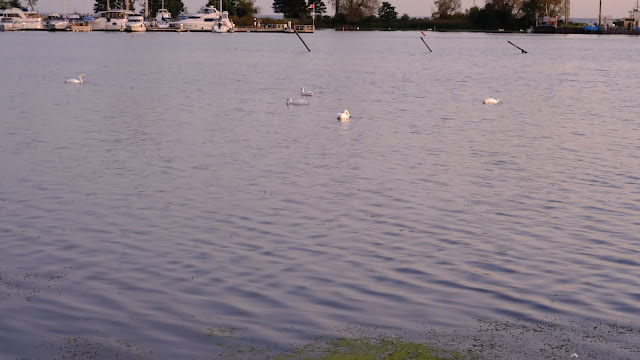
A sunset with swans on Frenchman's Bay.

Fuji XS-10 with 16-80  mm. F4, F8 @ 43 mm., 1/340 sec., ISO 400, Velvia film simulation


Saturday, October 23, 2021

A New Live Version of A Love Supreme

Today we have a wonderful and unexpected treat – a hitherto unknown live recording of the full "A Love Supreme" suite with Pharoah Sanders playing with Coltrane. Rolling Stone has a review.

It’s telling that some of the most memorable moments on the new John Coltrane archival release, A Love Supreme: Live in Seattle, don’t actually include John Coltrane. The original Love Supreme, the saxophonist’s legendary album-length suite of divine praise, featured his rightfully named classic quartet, with pianist McCoy Tyner, bassist Jimmy Garrison, and drummer Elvin Jones; this version, recorded onstage 10 months later, in October 1965, and previously unknown even to hardcore fans, augments that band with three additional players: saxophonists Pharoah Sanders and Carlos Ward, both of whom double on percussion, and second bassist Donald Rafael Garrett. The studio version will always be definitive, but there’s something magical and almost transgressive about hearing a loose and rowdy septet power through the four movements of this now-canonical work.

The recording isn't perfect - the drums are too loud (RS describes them as thunderous), but the playing is spectacular. If you just want to get a taste of it, listen to "Part IV, Psalm". The beauty will make you weep.

YouTube Music has the whole album

Friday, October 22, 2021

Android 12 First Impressions

One of the best things about Google's Pixel phones is getting prompt updates. Today was the official release of Android 12 (and new Pixel phones), and I updated my phone to the new version of Android this evening. 

The update took a bit more than half an hour and proceeded with no issues. When the phone rebooted I had my familiar home screen layout with only a couple of minor changes. I did have to wait a bit for my weather channel and Google Fit widgets to come back to life but they eventually did. 

Google has been hyping the new "Material You" design. My reaction is generally "meh". There's a new theming engine that picks up the colours from your wallpaper and new icon designs for things like the Phone and Contacts apps. I use a pure black background as my wallpaper so Google picked light grey accent colour on darker gray for its colours, which was kind of ugly and hard to read. I changed the accent colour to light green instead. I'd prefer a wider choice of colours but I can live with it.

Initially, the biggest change I noticed was with the Quick Settings screen. Rather than icons, the new design uses oval buttons with small icons and text. I prefer the old layout as it gets more on-screen in a smaller space. The addition of device controls to Quick Settings is a nice change. To go along with that, long-pressing the power off button brings up a panel with just four choices: Emergency, Lockdownm, Power Off, and Restart. 

There are some major changes to how notifications are handled. I haven't looked at them in detail yet, but what I've seen so far seems logical. 

It's hard to be sure but performance seems to be a little zippier and my battery life may be somewhat better. Also, I seem to have a few GB more of storage than I did before the update. 

I'm not going to go into more detail on new features. There are many easy-to-find articles on the web for that. Also, some of the new features are only available on the new Pixel 6 phones.

So to wrap up, I'm happy with the upgrade, but it's not life-changing. 


Thursday, October 21, 2021

I Won't Be Buying a Canon Printer

Our 10-year-old Epson Artisan inkjet printer has finally reached the end of its life, at least as a printer. I had the printer cleaned at a local shop a few months ago, but a few weeks after that, the printing went wonky again. Fortunately, I have a Brother laser printer, which keeps trundling on and on, but I can no longer print in colour.

The scanner still works fine. It's a good thing I don't have a recent Canon printer though, as newer Canon inkjet printers won't work, even as a scanner, if the ink runs out. Canon is now being sued over this reprehensible behaviour.  

 Canon, best known for manufacturing camera equipment and printers for business and home users, is being sued for not allowing customers to use the scan or fax functions in multi-function devices if the ink runs out on numerous printer models. David Leacraft filed a class action lawsuit against Canon USA, alleging the company engaged in deceptive marketing and unjust enrichment practices.

Leacraft decided to file the lawsuit upon discovering a Pixma MG2522 printer he purchased, advertised as an "all-in-one" machine, would not function as a scanner when ink cartridges are either low or empty. Moreover, faxing capabilities would not work when certain printers ran out of ink as well.

Of course, ink is not required to perform scanning or faxing documents, so the complaint stresses these features should function regardless of ink levels. As such, the lawsuit, which involves more than 100 class members, seeks at least $5,000,000 in awards.

I had considered buying a Canon all-in-one printer/scanner to replace the Epson, but now I'm certainly glad I didn't. 

If you have any recommendations for an inkjet all-in-one unit, please leave a comment. My needs are fairly basic. I want to be able to print colour photos up to 8x10 size and to be able scan and copy. If it can scan 35 mm slides, that would be a bonus. Cost needs to be under $400 CDN. 

Wednesday, October 20, 2021

Formatting Lists in Microsoft Word

Formatting numbered and bulleted lists in Microsoft Word can be a minefield for the unwary. Word makes it easy to use them by just clicking on one of the buttons in the formatting toolbar, but making any changes to Word's default format can produce unexpected results that are hard to correct. 

It is possible to create lists that are stable and have a format other than Word's default (for example, that aren't indented from the text margin) by using the multilevel list feature. The Office Watch website has recently published an article that explains how to do this. This is the technique that I used at the TSX. It does work and is reasonably stable, as long as you follow a few simple rules.

  • Never use the buttons in the ribbon to format your lists. Instead, use the paragraph styles defined in your template. (If you aren't using a template, see this post). 
  • Always paste text from another document as plain text. This is especially important if the text is part of a list. 
If you are still having problems with your list formatting, you can create numbered lists by using sequence fields. This technique requires more care when updating documents, but it is dead stable; in many years of using Word, I have never had a instance of document corruption using sequence fields. 


Tuesday, October 19, 2021

2021 Aurora Awards

The 2021 Aurora Awards for the best science fiction and fantasy of 2020 by a Canadian were announced at Can Con in Ottawa over the weekend. The awards are voted on by members of the Canadian Science Fiction and Fantasy Association, which basically means any Canadian SF&F fan who wnats to pay the small membership fee.

These are the fiction awards.

  • Best Novel: Mexican Gothic, Silvia Moreno-Garcia, Random House Publishing Group
  • Best Young Adult Novel: Flights of Marigold, Susan Forest, Laksa Media Groups Inc.
  • Best Novelette/Novella: “Tool Use by the Humans of Danzhai County“, Derek Künsken, Asimov’s Science Fiction Magazine, July/Aug
  • Best Short Story: “All Cats Go to Valhalla“, Chadwick Ginther, Swashbuckling Cats: Nine Lives on the Seven Seas, Tyche Books
  • Best Graphic Novel/Comic: It Never Rains, Kari Maaren, webcomic
I didn't vote this year as I haven't read any of the nominated works. 

Monday, October 18, 2021

Featured Links - October 18, 2021

Links to things I found interesting but didn't want to do a full blog post about.

Sunday, October 17, 2021

Saturday, October 16, 2021

Be Afraid, Be Very Afraid

If you read science fiction or watch SF movies, you'll no doubt have come across killer robots. Well, they're not science fiction ay more.  


The image above shows a quadrupedal robot — a Vision 60 unit built by US firm Ghost Robotics — that’s been equipped with a custom gun by small-arms specialists Sword International. It seems the gun itself (dubbed the SPUR or “special purpose unmanned rifle”) is designed to be fitted onto a variety of robotic platforms. It has a 30x optical zoom, thermal camera for targeting in the dark, and an effective range of 1,200 meters.

What’s not clear is whether or not Sword International or Ghost Robotics are currently selling this combination of gun and robot. But if they’re not, it seems they will be soon. As the marketing copy on Sword’s website boasts: “The SWORD Defense Systems SPUR is the future of unmanned weapon systems, and that future is now.”


Friday, October 15, 2021

Typos Can Cost You

Punctuation matters. An Australian man is being sued by his former employer over a Facebook post which read "employees" instead of "employee's". The distinction is that, as published, the implication is that the employer didn't pay any his employees' required pension contributions. The man claims it was a typo and he meant to type "employee's", referring to himself.

The New York Times (paywalled) has more details as well as a discussion of Australia's notorious defamation laws.

Less than 12 hours after the post was published on Oct. 22, Mr. Zadravic, who is based on the Central Coast in New South Wales, deleted it. But it was too late. Mr. Gan became aware of the message and filed a defamation claim against Mr. Zadravic.

On Thursday, a judge in New South Wales ruled that the lack of an apostrophe on the word “employees” could be read to suggest a “systematic pattern of conduct” by Mr. Gan’s agency rather than an accusation involving one employee. So she allowed the case to proceed.

 It could cost him 180,000 Australian dollars.


Thursday, October 14, 2021

Electric Vehicles Must Get Lighter

Here's something I didn't know until I read this article in Nature: electric vehicles are heavier than their equivalent fossil-fuel-powered model. For example, Ford's electric F-150 will be 700 kg heavier than the gasoline version. This is not a good thing, for several reasons. 

Electrifying vehicles adds yet more weight. Combustible, energy-dense petroleum is replaced by bulky batteries. And the rest of the vehicle must get heavier to provide the necessary structural support1. The electric F-150 weighs 700 kg more than its petrol-powered predecessor. Smaller electric cars are heavier than their petrol equivalents, too (see ‘Heavier electric fleet’).

Why does this matter? First and foremost is safety. The likelihood of passengers being killed in a collision with another vehicle increases by 12% for every 500-kg difference between vehicles2. This added risk wouldn’t apply if everyone drove cars of similar heft. But until they do, the number of casualties in crashes is likely to increase as heavy electric vehicles join lighter existing fleets. Pedestrians will also be at risk. If US residents who switched to SUVs over the past 20 years had stuck with smaller cars, more than 1,000 pedestrian deaths might have been averted, according to one study3.

Heavier vehicles also generate more particulate pollution from tyre wear. They require more materials and energy to build and propel them, adding to emissions and energy use.

How big a problem is this extra weight? A rough comparison between mortality costs and climate benefits shows that it is significant. Under the energy systems operating in most countries today, the cost of extra lives lost from a 700-kg increase in the weight of an electrified truck rivals the climate benefits of avoided greenhouse-gas emissions. 

I would still buy an electric vehicle, assuming the cost came down to the point where I could afford it, but I would factor weight into my consideration when looking for one.

Tuesday, October 12, 2021

Featured Links - October 12, 2021

Links to things I found interesting but didn't want to do a full blog post about.

Friday, October 08, 2021

Off For the Thanksgiving Weekend

Monday is Thanksgiving up here in the Great (soon to be) White North, so I'm taking the weekend off to relax and consume turkey with family. 

I'll be back on Tuesday. 

In the meantime, enjoy this picture of our cat, CJ, just chilling in the laundry basket.


Some Photography Links - October 8, 2021

Here are some about cameras and photography.

Thursday, October 07, 2021

A Good New Space Site

I've come across a good site if you are interested in space exploration. Space Explored has sections covering all of the major space exploration agencies, companies, and programs. There's also a handy launch schedule, which I expect to be referring to often.  

If you want to keep up with news about space exploration, this is one of the best sites you could use. 

Wednesday, October 06, 2021

The Aging Protocol That Keeps Breaking the Internet

Monday's Facebook outage was just the latest in a series of major outages going back years. Although Facebook hasn't given out any technical details, other than saying that the outage was caused by an internal network configuration error, it's likely that it was caused by something called the Border Gateway Protocol (BGP). This is a networking protocol that tells routers where to route the data going into or coming out of a network. It's been around since 1989 and has been the source of many outages, including an infamous one that took YouTube off of the internet for a few hours.

This article goes into the history of BGP, which is sometimes called the "three napkin protocol" because of the way it was developed, and explains some of the reasons why it is so fragile. 

At its most basic level, BGP helps routers decide how to send giant flows of data across the vast mesh of connections that make up the internet. With infinite numbers of possible paths - some slow and meandering, others quick and direct - BGP gives routers the information they need to pick one, even though there is no overall map of the internet and no authority charged with directing its traffic.

The creation of BGP, which relies on individual networks continuously sharing information about available data links, helped the internet continue its growth into a worldwide network. But BGP also allows huge swaths of data to be "hijacked" by almost anyone with the necessary skills and access.

The main reason is that BGP, like many key systems on the internet, is built to automatically trust users - something that may work on smaller networks but leaves a global one ripe for attack.

I had to learn a little bit about BGP while I was working at the TSX, and I'm very glad that it's not something that I have to worry about in my home network.  

Update: Here's an article from Gizmodo that goes into a little more detail about what happened at Facebook and how a BGP misconfiguration caused the problem. 

Tuesday, October 05, 2021

Stopping Image Fraud in Scientific Papers

I've posted a fair bit here about the problem of disinformation in several areas, including scientific papers. Now a group of publishers has announced standards for images in scientific papers. 

Studies suggest that up to one-fifth of published life-sciences papers contain at least one digitally altered image. Researchers might make adjustments for relatively harmless reasons — by increasing the contrast or colour balance to show a key point more clearly, for example. But they can also use image-editing tools to create completely fake results. A photograph of an electrophoresis gel or western blot can be altered by cropping and pasting the bands into different positions, or a microscope image could be photoshopped to remove a particular type of cell.

The Committee on Publication Ethics in Eastleigh, UK, a membership organization for academic publishing, has previously produced flowcharts showing steps that editors can take if a reader or reviewer raises issues with images or data in a manuscript. But now, a working group with representatives from eight publishers, including Elsevier, JAMA, Wiley and Springer Nature, as well as industry group STM, based in The Hague, the Netherlands, have come together to create a set of best-practice recommendations for editors. 

Needless to say, this is a good thing. Now if we could just get standards for use of images and videos in political ads.  

Monday, October 04, 2021

Featured Links - October 4, 2021

Links to things I found interesting but didn't want to do a full blog post about.

A grey bay
A grey morning on the bay

Sunday, October 03, 2021

Photo of the Week - October 3, 2021

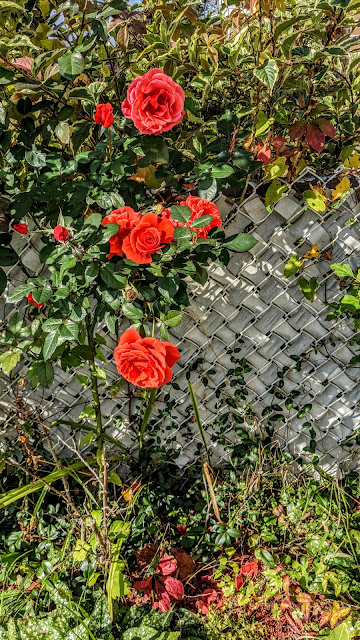
Here are a couple of fall flowers, a morning glory growing up through a dusty miller.


This was taken with my Pixel 4a.


Saturday, October 02, 2021

Libby Gets Better

Earlier this year, I posted about Overdrive's purchase of the library unit of RBdigital. This meant that the excellent RBdigital app that I used to borrow and read online magazines was replaced by Overdrive's Libby app. I found the Libby app vastly inferior and stopped using it, restricting most of my magazine reading to PressReader. I also contacted Overdrive's support about some specific issues I was having with their app.

I'm happy to report that the Libby app has been updated and some of my complaints have been addressed. 

I generally prefer to read magazines using text view with a black background and light text, since I find staring at a mostly white screen uncomfortable. They've added a navigation toolbar to the text mode screen, making it possible to move from article to article without having to go back to the PDF view. I would still like to be able to customize the text colour and brightness. 

They've also added an option to transfer your settings between different devices, and the app now syncs things like what's on your shelf and your position in magazines that you've read. This is a major improvement. 

When browsing through magazines, there is a summary screen for each issue that summarizes the contents in a little more detail than what you can glean from the cover image. 

There is now a Settings menu, which you can use to manage your notification settings and a few other aspects of the program. I don't remember what controls were there before, so I can't comment how much of this is new, but the notification options are extensive. For example, you can set up notifications to tell you when a new issue of a magazine has arrived or when your loan is about to expire, as well as setting the type of notification. 

My overall impression of the Libby app is now more positive, and I will be using it more. It's still a bit tricky to navigate in places, but that's probably more due to my lack of use rather than the design of the app itself. 

I should note that you can use the app to download ebooks and audiobooks, although I only use it for magazines. 


Friday, October 01, 2021

Movie and TV Reviews - September 2021

Here are some short reviews of things I watched in September. No movies this month - we've been watching a lot of baseball.

TV Shows

  • Nancy Drew: About the only thing that is common to the original YA series is the name. This is fully adult and has a strong supernatural element, without which it probably would have fallen flat. I enjoyed it but the season stretched out the central plot much too far. (Amazon Prime)
  • Jack Irish: This is a gritty, intense Australian detective drama worth watching for good writing and acting. The minor characters are especially well-drawn. It isn't all grim as there is a distinct funny side to some of the subplots, especially in season 2. If you liked Bosch, you might like this. (Acorn TV)
  • My Life Is Murder: This is a lighter Australian murder mystery, set in Melbourne, which is probably the best reason to watch it. (Acorn TV)
  • La Brea: So far, we've just watched one episode of this. It will be interesting to see where it goes, but I don't have high expectations, given that it's a network show. (CTV)