Friday, October 29, 2021

Some Photography Links - October 29, 2021

Here are some links about cameras and photography.

Sylvan Valley, taken with my Fujifilm X-S10 and processed in Photoshop Express


Thursday, October 28, 2021

Charles Stross, Rule 34, and AI

I'm currently plowing my way through Charles Stross' excellent Merchant Princes series in preparation for reading the sequel Empire Games trilogy. I'm about two-thirds of the way through and having trouble putting my Kindle down, despite the fact that I read the books when they came out almost a decade ago. Stross is good

I just came across an old (2013) post by author Randy Rucker about Stross' novel, Rule 34. It's a near-future police procedural set in Scotland and a sequel to Halting State. Among other things, there's quite a bit about AI, which was a theme in several of Stross' earlier books. 

Coming back to Stross’s Rule 34 , this book, like its loose prequel, Halting State , are quite close to the present-day world. It’s a world where some AI type behaviors have emerged among the applications that run on the Web. What do we mean by AI?

Stross observes, “If we understand how we do it, it isn’t artificial intelligence anymore. Playing chess, driving cars, generating conversational text… Perhaps we overestimate consciousness?”

He makes the point “We’re not very interested in reinventing human consciousness in a box. What gets the research grants flowing is applications.”

And, again: “general cognitive engines [are all] hardwired [to] project the seat of their identity onto you … what we really want is identity amplification.”

Rucker's comments about Stross are interesting and more relevant than ever, given the current focus on AI in everyday computing. His post is worth reading as are his and Stross' novels that deal with the subject.  

Wednesday, October 27, 2021

The Language of Climate Change According To the OED

The English language is constantly evolving, which keeps the dictionary of record, the Oxford English Dictionary (OED) scrambling to keep up. This year, they released an update covering one of the language's current hot topics, namely climate change. (I expect to see one covering words associated with the pandemic come out sometime in the near future).

A post on the OED's blog describes the update in some detail. 

Over the course of the last 30 years or so, the OED’s editors have researched and recorded many of the best-known terms related to climate change, such as global warming, microplastic, and emissions, as well as carbon and its associated compounds.

However, language is ever evolving, and earlier this year, the OED embarked on a project to broaden and review its coverage of vocabulary related to climate change and sustainability. With the increase in climate strikes and extreme weather in recent years, it is clear that this is a rapidly changing area of vocabulary, and one that our lexicographers have been carefully monitoring.

Below we explore some of the new and revised entries added in this update (shown in bold below), as ­well as looking at language related to climate change previously recorded in the OED, and terms that we are still monitoring. We reveal some of the spikes and dips in usage we are seeing, as well as changes in the way certain words related to climate change are now being used.

If you are interested in climate change or the English language, you'll find it a worthwhile read. 

Tuesday, October 26, 2021

A SETI False Alarm

A couple of years ago, the Parkes Murriyang radio telescope in Australia detected a signal that appeared to be coming from our nearest stellar neighbour, Proxima Centauri. Researchers have conducted an extensive investigation and now conclude that the signal originated on Earth.  

In November 2020, and in January and April of this year, the researchers pointed the Parkes telescope at Proxima Centauri to see if they could pick up the signal again. They could not.

Eventually, the team spotted other signals in the original data that looked a lot like the 982-megahertz signal but were at different frequencies. These signals had been tossed out by the team’s automated analysis as being earthly interference. Further analysis showed that BLC1 and these ‘lookalike’ signals were all interference from an unknown source. The signals had modulated and muddied one another, much as a guitar amplifier modulates and distorts a guitar note, which is what made it so difficult to identify BLC1 as interference.

I do hope that one of these days we'll find a clear, unambiguous alien signal. But this one wasn't it.  

More On Best By Dates For Food

I was brought up not to waste food. At the time I was growing up, we didn't have Best By dates on food packages, so judging whether something was unfit to eat was largely a matter of common sense and sometimes trial and error. Now that we have Best By dates, we have a different problem – throwing out food that's still quite edible because it's past the date on the packaging. 

The Healthy Gem website has published a guide to foods that are safe to eat past their Best By dates. It includes advices on pasta, eggs, dairy products, meat, spices and other foods that you likely have in your kitchen. 

Most people believe that the date printed on the package is the deadline to throw it out. But according to Paul VanLandingham, member of Food and Beverage Management of Johnson & Wales University, “best by” dates refer to food quality, not safety. So you can safely eat more foods beyond their expiration dates.

If the printed dates don’t determine food safety, how do you know when to clean out your fridge? Here, we’ll go over the real expiration dates for raw meat, spices, cooking oils, and dairy products based on information provided by food safety experts.

For information about more foods, you can look at the Eat By Date webiste, which I've posted about before

I would like to see food packaging show a second "Eat By" date, which would show a date by which food would be safe to eat, as well as the current Best By date.  

Monday, October 25, 2021

Featured Links - October 25, 2021

Links to things I found interesting but didn't want to do a full blog post about.

Sunday, October 24, 2021

Photo of the Week - October 24, 2021

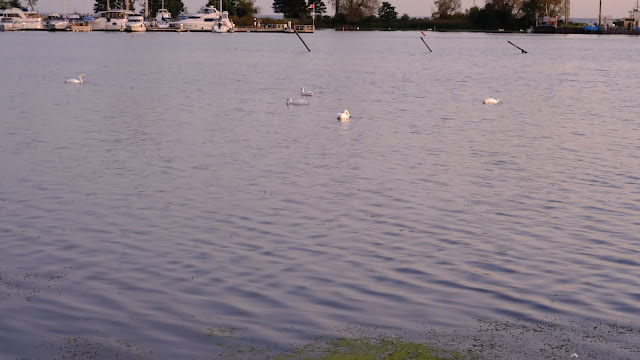
A sunset with swans on Frenchman's Bay.

Fuji XS-10 with 16-80  mm. F4, F8 @ 43 mm., 1/340 sec., ISO 400, Velvia film simulation


Saturday, October 23, 2021

A New Live Version of A Love Supreme

Today we have a wonderful and unexpected treat – a hitherto unknown live recording of the full "A Love Supreme" suite with Pharoah Sanders playing with Coltrane. Rolling Stone has a review.

It’s telling that some of the most memorable moments on the new John Coltrane archival release, A Love Supreme: Live in Seattle, don’t actually include John Coltrane. The original Love Supreme, the saxophonist’s legendary album-length suite of divine praise, featured his rightfully named classic quartet, with pianist McCoy Tyner, bassist Jimmy Garrison, and drummer Elvin Jones; this version, recorded onstage 10 months later, in October 1965, and previously unknown even to hardcore fans, augments that band with three additional players: saxophonists Pharoah Sanders and Carlos Ward, both of whom double on percussion, and second bassist Donald Rafael Garrett. The studio version will always be definitive, but there’s something magical and almost transgressive about hearing a loose and rowdy septet power through the four movements of this now-canonical work.

The recording isn't perfect - the drums are too loud (RS describes them as thunderous), but the playing is spectacular. If you just want to get a taste of it, listen to "Part IV, Psalm". The beauty will make you weep.

YouTube Music has the whole album

Friday, October 22, 2021

Android 12 First Impressions

One of the best things about Google's Pixel phones is getting prompt updates. Today was the official release of Android 12 (and new Pixel phones), and I updated my phone to the new version of Android this evening. 

The update took a bit more than half an hour and proceeded with no issues. When the phone rebooted I had my familiar home screen layout with only a couple of minor changes. I did have to wait a bit for my weather channel and Google Fit widgets to come back to life but they eventually did. 

Google has been hyping the new "Material You" design. My reaction is generally "meh". There's a new theming engine that picks up the colours from your wallpaper and new icon designs for things like the Phone and Contacts apps. I use a pure black background as my wallpaper so Google picked light grey accent colour on darker gray for its colours, which was kind of ugly and hard to read. I changed the accent colour to light green instead. I'd prefer a wider choice of colours but I can live with it.

Initially, the biggest change I noticed was with the Quick Settings screen. Rather than icons, the new design uses oval buttons with small icons and text. I prefer the old layout as it gets more on-screen in a smaller space. The addition of device controls to Quick Settings is a nice change. To go along with that, long-pressing the power off button brings up a panel with just four choices: Emergency, Lockdownm, Power Off, and Restart. 

There are some major changes to how notifications are handled. I haven't looked at them in detail yet, but what I've seen so far seems logical. 

It's hard to be sure but performance seems to be a little zippier and my battery life may be somewhat better. Also, I seem to have a few GB more of storage than I did before the update. 

I'm not going to go into more detail on new features. There are many easy-to-find articles on the web for that. Also, some of the new features are only available on the new Pixel 6 phones.

So to wrap up, I'm happy with the upgrade, but it's not life-changing. 


Thursday, October 21, 2021

I Won't Be Buying a Canon Printer

Our 10-year-old Epson Artisan inkjet printer has finally reached the end of its life, at least as a printer. I had the printer cleaned at a local shop a few months ago, but a few weeks after that, the printing went wonky again. Fortunately, I have a Brother laser printer, which keeps trundling on and on, but I can no longer print in colour.

The scanner still works fine. It's a good thing I don't have a recent Canon printer though, as newer Canon inkjet printers won't work, even as a scanner, if the ink runs out. Canon is now being sued over this reprehensible behaviour.  

 Canon, best known for manufacturing camera equipment and printers for business and home users, is being sued for not allowing customers to use the scan or fax functions in multi-function devices if the ink runs out on numerous printer models. David Leacraft filed a class action lawsuit against Canon USA, alleging the company engaged in deceptive marketing and unjust enrichment practices.

Leacraft decided to file the lawsuit upon discovering a Pixma MG2522 printer he purchased, advertised as an "all-in-one" machine, would not function as a scanner when ink cartridges are either low or empty. Moreover, faxing capabilities would not work when certain printers ran out of ink as well.

Of course, ink is not required to perform scanning or faxing documents, so the complaint stresses these features should function regardless of ink levels. As such, the lawsuit, which involves more than 100 class members, seeks at least $5,000,000 in awards.

I had considered buying a Canon all-in-one printer/scanner to replace the Epson, but now I'm certainly glad I didn't. 

If you have any recommendations for an inkjet all-in-one unit, please leave a comment. My needs are fairly basic. I want to be able to print colour photos up to 8x10 size and to be able scan and copy. If it can scan 35 mm slides, that would be a bonus. Cost needs to be under $400 CDN. 

Wednesday, October 20, 2021

Formatting Lists in Microsoft Word

Formatting numbered and bulleted lists in Microsoft Word can be a minefield for the unwary. Word makes it easy to use them by just clicking on one of the buttons in the formatting toolbar, but making any changes to Word's default format can produce unexpected results that are hard to correct. 

It is possible to create lists that are stable and have a format other than Word's default (for example, that aren't indented from the text margin) by using the multilevel list feature. The Office Watch website has recently published an article that explains how to do this. This is the technique that I used at the TSX. It does work and is reasonably stable, as long as you follow a few simple rules.

  • Never use the buttons in the ribbon to format your lists. Instead, use the paragraph styles defined in your template. (If you aren't using a template, see this post). 
  • Always paste text from another document as plain text. This is especially important if the text is part of a list. 
If you are still having problems with your list formatting, you can create numbered lists by using sequence fields. This technique requires more care when updating documents, but it is dead stable; in many years of using Word, I have never had a instance of document corruption using sequence fields. 


Tuesday, October 19, 2021

2021 Aurora Awards

The 2021 Aurora Awards for the best science fiction and fantasy of 2020 by a Canadian were announced at Can Con in Ottawa over the weekend. The awards are voted on by members of the Canadian Science Fiction and Fantasy Association, which basically means any Canadian SF&F fan who wnats to pay the small membership fee.

These are the fiction awards.

  • Best Novel: Mexican Gothic, Silvia Moreno-Garcia, Random House Publishing Group
  • Best Young Adult Novel: Flights of Marigold, Susan Forest, Laksa Media Groups Inc.
  • Best Novelette/Novella: “Tool Use by the Humans of Danzhai County“, Derek Künsken, Asimov’s Science Fiction Magazine, July/Aug
  • Best Short Story: “All Cats Go to Valhalla“, Chadwick Ginther, Swashbuckling Cats: Nine Lives on the Seven Seas, Tyche Books
  • Best Graphic Novel/Comic: It Never Rains, Kari Maaren, webcomic
I didn't vote this year as I haven't read any of the nominated works. 

Monday, October 18, 2021

Featured Links - October 18, 2021

Links to things I found interesting but didn't want to do a full blog post about.

Sunday, October 17, 2021

Saturday, October 16, 2021

Be Afraid, Be Very Afraid

If you read science fiction or watch SF movies, you'll no doubt have come across killer robots. Well, they're not science fiction ay more.  


The image above shows a quadrupedal robot — a Vision 60 unit built by US firm Ghost Robotics — that’s been equipped with a custom gun by small-arms specialists Sword International. It seems the gun itself (dubbed the SPUR or “special purpose unmanned rifle”) is designed to be fitted onto a variety of robotic platforms. It has a 30x optical zoom, thermal camera for targeting in the dark, and an effective range of 1,200 meters.

What’s not clear is whether or not Sword International or Ghost Robotics are currently selling this combination of gun and robot. But if they’re not, it seems they will be soon. As the marketing copy on Sword’s website boasts: “The SWORD Defense Systems SPUR is the future of unmanned weapon systems, and that future is now.”


Friday, October 15, 2021

Typos Can Cost You

Punctuation matters. An Australian man is being sued by his former employer over a Facebook post which read "employees" instead of "employee's". The distinction is that, as published, the implication is that the employer didn't pay any his employees' required pension contributions. The man claims it was a typo and he meant to type "employee's", referring to himself.

The New York Times (paywalled) has more details as well as a discussion of Australia's notorious defamation laws.

Less than 12 hours after the post was published on Oct. 22, Mr. Zadravic, who is based on the Central Coast in New South Wales, deleted it. But it was too late. Mr. Gan became aware of the message and filed a defamation claim against Mr. Zadravic.

On Thursday, a judge in New South Wales ruled that the lack of an apostrophe on the word “employees” could be read to suggest a “systematic pattern of conduct” by Mr. Gan’s agency rather than an accusation involving one employee. So she allowed the case to proceed.

 It could cost him 180,000 Australian dollars.


Thursday, October 14, 2021

Electric Vehicles Must Get Lighter

Here's something I didn't know until I read this article in Nature: electric vehicles are heavier than their equivalent fossil-fuel-powered model. For example, Ford's electric F-150 will be 700 kg heavier than the gasoline version. This is not a good thing, for several reasons. 

Electrifying vehicles adds yet more weight. Combustible, energy-dense petroleum is replaced by bulky batteries. And the rest of the vehicle must get heavier to provide the necessary structural support1. The electric F-150 weighs 700 kg more than its petrol-powered predecessor. Smaller electric cars are heavier than their petrol equivalents, too (see ‘Heavier electric fleet’).

Why does this matter? First and foremost is safety. The likelihood of passengers being killed in a collision with another vehicle increases by 12% for every 500-kg difference between vehicles2. This added risk wouldn’t apply if everyone drove cars of similar heft. But until they do, the number of casualties in crashes is likely to increase as heavy electric vehicles join lighter existing fleets. Pedestrians will also be at risk. If US residents who switched to SUVs over the past 20 years had stuck with smaller cars, more than 1,000 pedestrian deaths might have been averted, according to one study3.

Heavier vehicles also generate more particulate pollution from tyre wear. They require more materials and energy to build and propel them, adding to emissions and energy use.

How big a problem is this extra weight? A rough comparison between mortality costs and climate benefits shows that it is significant. Under the energy systems operating in most countries today, the cost of extra lives lost from a 700-kg increase in the weight of an electrified truck rivals the climate benefits of avoided greenhouse-gas emissions. 

I would still buy an electric vehicle, assuming the cost came down to the point where I could afford it, but I would factor weight into my consideration when looking for one.

Tuesday, October 12, 2021

Featured Links - October 12, 2021

Links to things I found interesting but didn't want to do a full blog post about.

Friday, October 08, 2021

Off For the Thanksgiving Weekend

Monday is Thanksgiving up here in the Great (soon to be) White North, so I'm taking the weekend off to relax and consume turkey with family. 

I'll be back on Tuesday. 

In the meantime, enjoy this picture of our cat, CJ, just chilling in the laundry basket.


Some Photography Links - October 8, 2021

Here are some about cameras and photography.

Thursday, October 07, 2021

A Good New Space Site

I've come across a good site if you are interested in space exploration. Space Explored has sections covering all of the major space exploration agencies, companies, and programs. There's also a handy launch schedule, which I expect to be referring to often.  

If you want to keep up with news about space exploration, this is one of the best sites you could use. 

Wednesday, October 06, 2021

The Aging Protocol That Keeps Breaking the Internet

Monday's Facebook outage was just the latest in a series of major outages going back years. Although Facebook hasn't given out any technical details, other than saying that the outage was caused by an internal network configuration error, it's likely that it was caused by something called the Border Gateway Protocol (BGP). This is a networking protocol that tells routers where to route the data going into or coming out of a network. It's been around since 1989 and has been the source of many outages, including an infamous one that took YouTube off of the internet for a few hours.

This article goes into the history of BGP, which is sometimes called the "three napkin protocol" because of the way it was developed, and explains some of the reasons why it is so fragile. 

At its most basic level, BGP helps routers decide how to send giant flows of data across the vast mesh of connections that make up the internet. With infinite numbers of possible paths - some slow and meandering, others quick and direct - BGP gives routers the information they need to pick one, even though there is no overall map of the internet and no authority charged with directing its traffic.

The creation of BGP, which relies on individual networks continuously sharing information about available data links, helped the internet continue its growth into a worldwide network. But BGP also allows huge swaths of data to be "hijacked" by almost anyone with the necessary skills and access.

The main reason is that BGP, like many key systems on the internet, is built to automatically trust users - something that may work on smaller networks but leaves a global one ripe for attack.

I had to learn a little bit about BGP while I was working at the TSX, and I'm very glad that it's not something that I have to worry about in my home network.  

Update: Here's an article from Gizmodo that goes into a little more detail about what happened at Facebook and how a BGP misconfiguration caused the problem. 

Tuesday, October 05, 2021

Stopping Image Fraud in Scientific Papers

I've posted a fair bit here about the problem of disinformation in several areas, including scientific papers. Now a group of publishers has announced standards for images in scientific papers. 

Studies suggest that up to one-fifth of published life-sciences papers contain at least one digitally altered image. Researchers might make adjustments for relatively harmless reasons — by increasing the contrast or colour balance to show a key point more clearly, for example. But they can also use image-editing tools to create completely fake results. A photograph of an electrophoresis gel or western blot can be altered by cropping and pasting the bands into different positions, or a microscope image could be photoshopped to remove a particular type of cell.

The Committee on Publication Ethics in Eastleigh, UK, a membership organization for academic publishing, has previously produced flowcharts showing steps that editors can take if a reader or reviewer raises issues with images or data in a manuscript. But now, a working group with representatives from eight publishers, including Elsevier, JAMA, Wiley and Springer Nature, as well as industry group STM, based in The Hague, the Netherlands, have come together to create a set of best-practice recommendations for editors. 

Needless to say, this is a good thing. Now if we could just get standards for use of images and videos in political ads.  

Monday, October 04, 2021

Featured Links - October 4, 2021

Links to things I found interesting but didn't want to do a full blog post about.

A grey bay
A grey morning on the bay

Sunday, October 03, 2021

Photo of the Week - October 3, 2021

Here are a couple of fall flowers, a morning glory growing up through a dusty miller.


This was taken with my Pixel 4a.


Saturday, October 02, 2021

Libby Gets Better

Earlier this year, I posted about Overdrive's purchase of the library unit of RBdigital. This meant that the excellent RBdigital app that I used to borrow and read online magazines was replaced by Overdrive's Libby app. I found the Libby app vastly inferior and stopped using it, restricting most of my magazine reading to PressReader. I also contacted Overdrive's support about some specific issues I was having with their app.

I'm happy to report that the Libby app has been updated and some of my complaints have been addressed. 

I generally prefer to read magazines using text view with a black background and light text, since I find staring at a mostly white screen uncomfortable. They've added a navigation toolbar to the text mode screen, making it possible to move from article to article without having to go back to the PDF view. I would still like to be able to customize the text colour and brightness. 

They've also added an option to transfer your settings between different devices, and the app now syncs things like what's on your shelf and your position in magazines that you've read. This is a major improvement. 

When browsing through magazines, there is a summary screen for each issue that summarizes the contents in a little more detail than what you can glean from the cover image. 

There is now a Settings menu, which you can use to manage your notification settings and a few other aspects of the program. I don't remember what controls were there before, so I can't comment how much of this is new, but the notification options are extensive. For example, you can set up notifications to tell you when a new issue of a magazine has arrived or when your loan is about to expire, as well as setting the type of notification. 

My overall impression of the Libby app is now more positive, and I will be using it more. It's still a bit tricky to navigate in places, but that's probably more due to my lack of use rather than the design of the app itself. 

I should note that you can use the app to download ebooks and audiobooks, although I only use it for magazines. 


Friday, October 01, 2021

Movie and TV Reviews - September 2021

Here are some short reviews of things I watched in September. No movies this month - we've been watching a lot of baseball.

TV Shows

  • Nancy Drew: About the only thing that is common to the original YA series is the name. This is fully adult and has a strong supernatural element, without which it probably would have fallen flat. I enjoyed it but the season stretched out the central plot much too far. (Amazon Prime)
  • Jack Irish: This is a gritty, intense Australian detective drama worth watching for good writing and acting. The minor characters are especially well-drawn. It isn't all grim as there is a distinct funny side to some of the subplots, especially in season 2. If you liked Bosch, you might like this. (Acorn TV)
  • My Life Is Murder: This is a lighter Australian murder mystery, set in Melbourne, which is probably the best reason to watch it. (Acorn TV)
  • La Brea: So far, we've just watched one episode of this. It will be interesting to see where it goes, but I don't have high expectations, given that it's a network show. (CTV)

Thursday, September 30, 2021

Book Cover Gallery

Thanks are due to the excellent Recomendo newsletter for pointing out this photo gallery of old book covers spanning the early part of the 20th century. 

Collection of U.S. dust jacket cover art starting from the 1920's and paperback & digest cover art from the U.S., UK, Canada and Australia starting from the end of the 1930's - organized in chronological Albums per publisher / series

I love looking at the covers of old pulp novels, so this could be a serious time sink for me. 

Flickr won't let me copy a URL so I can't post a picture, but trust me, it's worth the time to browse.

Wednesday, September 29, 2021

Babylon 5 Is Getting a Reboot

Like many other people, I was both surprised and excited to hear the news Monday that Babylon 5, the classic SF TV show from the 1990s, will be getting a reboot. Even better, the original author and director of the show, J. Michael Straczynski, will be in charge of the project. 

I've made no secret of how much I like Babylon 5; I still think that it's the best science fiction TV show yet, although The Expanse is giving it a run for that title. The news that Straczynski will be at the helm of a new version is incredibly exciting. 

He spent quite a bit of time on Twitter Monday adding details that weren't ion the Variety article and reassuring fans. Gizmodo has a longer article with some of his comments. 

“Heraclitus wrote ‘You cannot step in the same river twice, for the river has changed, and you have changed.’ In the years since B5, I’ve done a ton of other TV shows and movies, adding an equal number of tools to my toolbox, all of which I can bring to bear on one singular question,” Stracynzski tweeted. “If I were creating Babylon 5 today, for the first time, knowing what I now know as a writer, what would it look like? How would it use all the storytelling tools and technological resources available in 2021 that were not on hand then?”

I will certainly be watching it when it airs, probably in a couple of years. Until then, if you want more news about it, you can follow Staczynski on Twitter, where he is a regular poster, or subscribe to his Patreon account. 

Tuesday, September 28, 2021

Progressive Prepping

I'm not a prepper, but I do find the movement interesting. We have a stash of food and water in the basement cupboard, but that's more for dealing with something like the ice storm we had a few years ago, or supply chain problems that were occurring during the early part of the pandemic. But if there's a total social collapse, we're probably toast.

So I found Rolling Stone's article, Journal of a Progressive Prepper, quite interesting. It did change my somewhat jaundiced view of the prepping movement, though not enough for me to run out and start buying a stash of supplies. 

When I ask if Teri’s worried about the coronavirus, she swipes her hand, calls it “a big damn hoax.” But her focus on the EBT consumer speaks to two more fault lines in modern prepperdom: the first is the distinction that it’s not “the end of the world” we’re prepping for; it’s The End of the World As We Know It, abbreviated as TEOTWAWKI. If the globe explodes in one cataclysmic burst, no amount of MREs is going to do anyone any good. TEOTWAWKI is about adapting to a seismic shift in human existence (but a survivable one), perhaps globally but certainly on a local scale. In this sense, many communities around the world have already experienced, or are actively experiencing, an apocalypse. From Damascus to coal country, The World As They’ve Known It has already ceased to exist. People are not preparing for what might occur. They are Accepting Reality.

Because a second fault line of preparedness is that most apocalypses are slow and subtle. We’re trained by movies and TV to envision TEOTWAWKI as a sudden catastrophe — a meteor or nuclear bomb or snap of Thanos’ fingers upending our world in one brutal instant. Preppers refer to this as the moment when the Shit Hits The Fan (SHTF; we love acronyms). The more likely and typical scenario is a gradual erosion of systems and norms over the course of months or years or decades. Zoom out to the millennial timeline and it appears sudden. But living through it is closer to the frog-in-a-boiling-pot experience. Storefronts and factories slowly close. Corruption or disease seeps in. Thermometers tick upwards in imperceptible hundredths of degrees.

What I found most interesting was the part at the end of the article where the author talks about organizing neighbours into small, unofficial support groups. It's an idea that makes a lot of sense. 

 Preparations for a short-term disaster have transitioned to longer-term focus on adaptation. A month from now, Charlottesville gas pumps will run dry after the cyberhacking of the Colonial Pipeline, the latest reminder of our vulnerable energy infrastructure and our complete dependence on it. It will also be the latest reminder of apocalyptic hoarding — the selfish pricks have no problem filling two dozen spare gas tanks despite a 30-car line behind them. If the last year is any indication of what could happen, we all need to become more self-reliant while also capable of helping others.

This works better if everyone is doing it. Much like vaccinations, we’re a safer neighborhood and community if everyone has taken steps to be prepared for emergencies. If all your neighbors have a stash of emergency food, there’s less chance for scarcity and panic when the SHTF. We already have a great community of skilled friends here in Charlottesville and on the internet teaching us things we don’t yet know how to do, and the goal is to share this knowledge with friends, family, and neighbors. Without its former stigma and mandate for ultra-secrecy, prepping becomes a joint effort — a more collaborative approach to TEOTWAKI.


Monday, September 27, 2021

Featured Links - September 27, 2021

Links to things I found interesting but didn't want to do a full blog post about.

Old cemetary


Sunday, September 26, 2021

Photo of the Week - September 26, 2021

This is one of the newer homes with a nice view of Frenchman's Bay. It is totally at odds with the other homes in the area but some people like this kind of building, although I can't imagine why. 


Fujifilm X-S10 with 16-80 mm. F4, F5.6 @ 21 mm., 1/850 sec., ISO 160, Kodachrome 64 film simulation.

Saturday, September 25, 2021

An Interview With James S. A. Corey

Andrew Liptak has published a long interview with Daniel Abraham and Ty Frank, aka James S. A. Corey, the authors of the excellent science fiction series, The Expanse. 

A decade ago, I picked up a chunky, promising new science fiction novel, Leviathan Wakes, and found that something in the world really stuck with me: it was both a grounded and ambitious imagination of where we might be a couple of centuries from now.

There aren't many stories that stick with you beyond a reading or two, but over the years, I've found myself returning to The Expanse — in part because there's been a series of regular new installments — but because each time I've returned to it, I've found some interesting new insight into the world.

With that first installment turning a full decade this year (its birthday was back in June), with Amazon's television series coming to a close later this year, and with the final installment of the series, Leviathan Falls, hitting bookstores in November, it's a series that I've been thinking back on for a while.

A couple of weeks ago, I spoke with Daniel Abraham and Ty Franck about that anniversary and what their thoughts are on the legacy of the series, ten years in.

It's a good interview and full of interesting information about how the two authors managed the transition between print and screen for the Sy Fy/Amazon series that is based on the first six books. (AFAIK, the series won't cover the last three, although it wouldn't surprise me if they added some foreshadowing, just in case).  

Friday, September 24, 2021

A Detailed History of mRNA Vaccines

One of the arguments used by vaccine deniers is that the Pfizer/BionTech and Moderna mRNA vaccines is that they are a new technology that is untested. 

Nature has just published a long article detailing the history of the mRNA technology used in these vaccines, and t goes back quite bit a further than you might think. back to the 1960s. I knew that people had been researching mRNA at least since the original SARS outbreak in 2003, but I didn't know about the previous research.

In late 1987, Robert Malone performed a landmark experiment. He mixed strands of messenger RNA with droplets of fat, to create a kind of molecular stew. Human cells bathed in this genetic gumbo absorbed the mRNA, and began producing proteins from it1.

Realizing that this discovery might have far-reaching potential in medicine, Malone, a graduate student at the Salk Institute for Biological Studies in La Jolla, California, later jotted down some notes, which he signed and dated. If cells could create proteins from mRNA delivered into them, he wrote on 11 January 1988, it might be possible to “treat RNA as a drug”. Another member of the Salk lab signed the notes, too, for posterity. Later that year, Malone’s experiments showed that frog embryos absorbed such mRNA2. It was the first time anyone had used fatty droplets to ease mRNA’s passage into a living organism.

Those experiments were a stepping stone towards two of the most important and profitable vaccines in history: the mRNA-based COVID-19 vaccines given to hundreds of millions of people around the world. Global sales of these are expected to top US$50 billion in 2021 alone.

But the path to success was not direct. For many years after Malone’s experiments, which themselves had drawn on the work of other researchers, mRNA was seen as too unstable and expensive to be used as a drug or a vaccine. Dozens of academic labs and companies worked on the idea, struggling with finding the right formula of fats and nucleic acids — the building blocks of mRNA vaccines.

It's an interesting article that is well worth reading, both for getting a better understanding of what we've been putting into our bodies, but also for insights into the complexity of modern medical and scientific research. 

Thursday, September 23, 2021

Convert PDF Scientific Papers to HTML

Most scientific papers these days get posted on the internet as PDFs. That's OK if you're reading on a desktop computer but may not be ideal otherwise. Paper To HTML Converter is an online tool that converts PDFs of scientific papers into a more easily viewable HTML format.  

This is an experimental prototype that aims to render scientific papers in HTML so they can be more easily read by screen readers or on mobile devices. Because of our reliance on statistical machine learning techniques, some errors are inevitable. We are continuing to improve upon our models. To use, upload a scientific paper below, or view a gallery of example papers.

Tuesday, September 21, 2021

Some Simple Design Tips for Word Documents

As a former technical writer, I have a lot of experience with Microsoft Word. (I've been using Word in one form or another since version 1.0 for DOS). So using Word is pretty much an automatic process for me. But that isn't true for most people, especially those who are using Word for the first time in a professional environment. 

Word is a complex program and it can turn around and bite you at a moment's notice. You can make your life a lot easier by following some basic rules, starting with the ones outlined in this article

I could add a few more, but the article does a good job of covering the basics. For more tips on Word, take a look at the Microsoft Word topic on this blog, where I've posted several articles written during my tenure at the TSX to help people there cope with Word's idiosyncracies. 

Going beyond the tips in the article, I would add these two as the most important:

  • Learn how to use paragraph and character styles for formatting instead of the buttons in the ribbon.
  • Always, always, always paste text from another document as unformatted text. 
The first of those tips will save you vast amounts of time in the long run. The second will keep Word from messing up your formatting in unpredictable ways that are hard to correct. 

Monday, September 20, 2021

Featured Links - September 20, 2021

Links to things I found interesting but didn't want to do a full blog post about.


Sunday, September 19, 2021

Photo of the Week - September 19, 2021

This week's photo is a picture of our cat, McGee. He's a rescue from a warehouse, where they were going to kill him. Fortunately, someone called our local rescue society, and then McGee chose us, for which we are very grateful. 

Fujifilm X-S10 with 16-80 mm. F4, F8 at 47 mm., 1/140 sec., ISO 4000, Tri-X 400 film simulation. 


Saturday, September 18, 2021

Some Good Grateful Dead

Here's an excellent show by the Grateful Dead from Oakland, CA on February 17, 1979. It was the final show with keyboard player, Keith Godchaux, and his wife, Donna. I don't think it's had an official release. The audio is from a good-quality soundboard. 

1979 isn't generally regarded as one of their better years, but this show is hot. Jerry is on fire and Bobby is full of energy and emotion.

This post from Dead of the Day has a short article about the show and links to individual songs if you want to pick and choose. I've listened to about half of it so far and it's all good.

Thursday, September 16, 2021

Custom Film Simulations on Fujifilm Cameras

One of the main reasons I decided to buy a Fujifilm camera (in my case, the X-S10) earlier this year was the film simulation modes that Fujifilm includes in its cameras. These simulate the look of several of Fujifilm's film stocks and are simple to use - just turn a dial and select which one you want. 

Here are two examples from our cluttered and somewhat neglected back yard. The first is Velvia, which has vivid, saturated colours and high contrast, which makes it ideal for landscapes. The second is Provia, which is the default simulation on Fujifilm cameras.


On my camera, there are 18 choices, covering a wide range of film types, including black and white and ones that are more suited for video.

You might think that 18 choices are enough, but the built-in simulations are designed to emulate only Fujifilm's products. What if you want to emulate a Kodak film like Kodachrorme or Tri-X? 

Fujifilm's cameras let you save custom settings and there are a lot to modify. People have been creating "film recipes" that you can input and save into your camera's custom settings (on my camera, there are four) to emulate other films. I started by saving two: Kodachrome 64 and Tri-X 400, which here two films that I shot a lot of back in the day when I was using film cameras.

Here are examples of the Kodachrome 64 and Tri-X 400 custom simulations.


I will have to try the Kodachrome 64 more but on first glance I like the openness and warmth of the picture. The Tri-X simulation captures the grittiness and graininess of the original film and I will probably use it as my standard black-and-white simulation. 

The Fuji X Weekly website contains film recipes for more than 100 film simulations. There's also an app for mobile devices, although it just contains the recipes and examples; it doesn't load them onto your phone (as far as I know, there's no way of doing that). 

This article contains instructions on how to enter and save custom settings as well as some other useful links. If you want, detailed information about Fuji's film simulations, this article will tell you pretty much everything about them, and it also explains why it's difficult to simulate them in programs like Lightroom (although you can come pretty close). 

Wednesday, September 15, 2021

Something Pretty For Today

I haven't been listening to a lot of Dead and Company recently, but after watching the video below, I may have to change that. It's Bird Song from Saratoga Springs on August 27. I've found their music sometimes aimless, especially in the jams, but this performance is mostly pretty focused and often quite pretty. Enjoy. 

Tuesday, September 14, 2021

Flash Is Dead and So Are a Lot of News Archives

Adobe Flash was notorious for being insecure and a vector for malware and Adobe finally killed it off in December of last year. I don't miss it at all. (One of my least favourite jobs as a technical writer was updating a user guide that the previous writer had written in Flash). 

The last weekend, with reruns of news clips from 2001, has revealed a side-effect of killing off Flash. A lot of web sites from that era used Flash, and now their content in inaccessible. That includes quite a bit of news footage, as this article from CNN points out. 

Adobe ending support for Flash — its once ubiquitous multimedia content player — last year meant that some of the news coverage of the September 11th attacks and other major events from the early days of online journalism are no longer accessible. For example, The Washington Post and ABC News both have broken experiences within their September 11th coverage, viewable in the Internet Archive. CNN's online coverage of September 11th also has been impacted by the end of Flash.

That means what was once an interactive explainer of how the planes hit the World Trade Center or a visually-rich story on where some survivors of the attacks are now, at best, a non-functioning still image, or at worst, a gray box informing readers that "Adobe Flash player is no longer supported."

It's yet another example of how format creep is going to cause problems for archivists, librarians, and historians in future years.  


Monday, September 13, 2021

Featured Links - September 13, 2021

Links to things I found interesting but didn't want to do a full blog post about.

Sunday, September 12, 2021

Photo of the Week

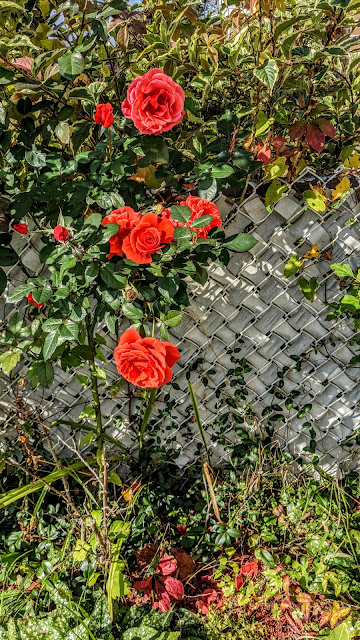
A late-blooming rose from our front yard.


Fuji X-S10 with 16-80 mm. F4, F16 @ 80 mm., 1/240 sec. at ISO 1250, Velvia film simulation, post-processing in Windows Photo.


Friday, September 10, 2021

The Bizarre Bone Asteroid

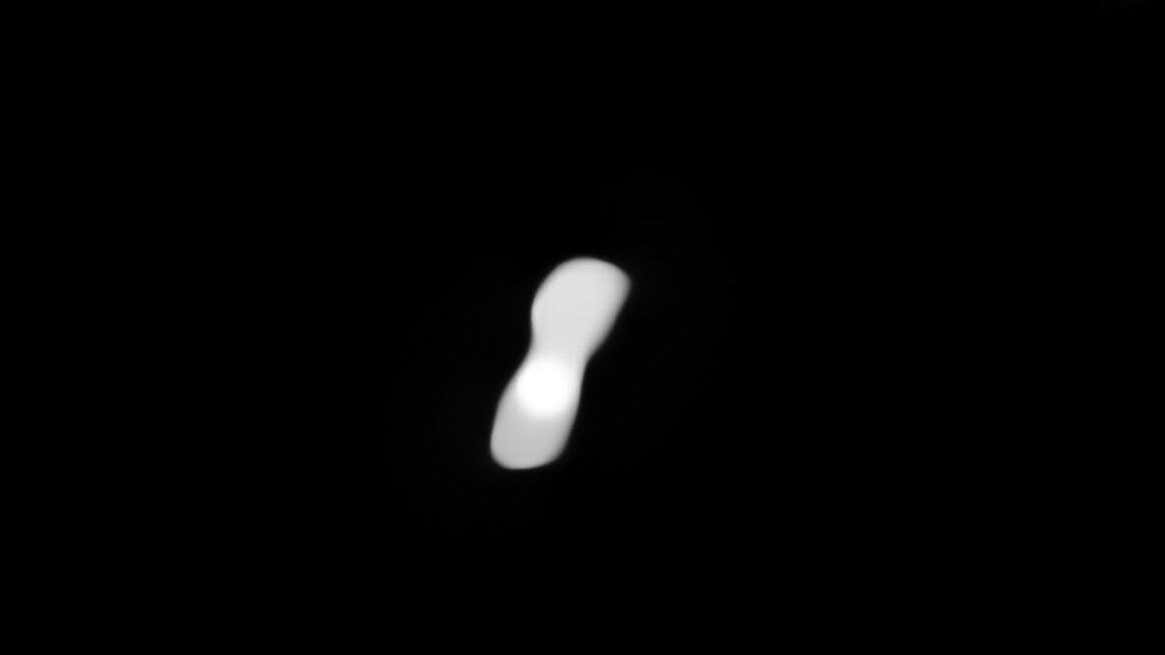
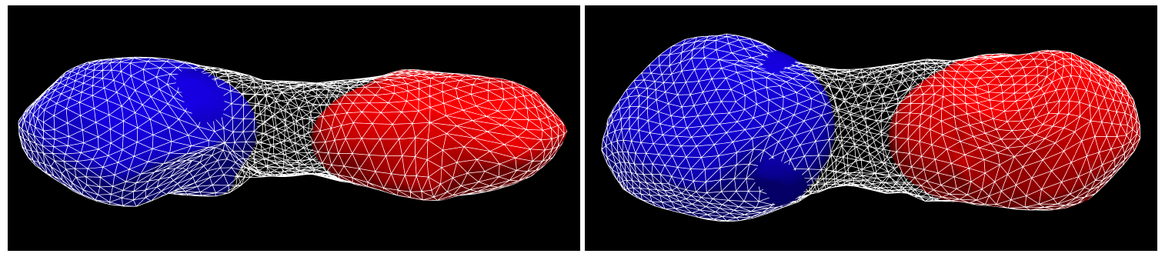
Every once in a while, I come across a science story that is just so strange  or so revealing that I can't resist posting about it. In this case, we have the asteroid, Cleo, also known as the 'bone' asteroid because of it's shape and apparent low density. 

Recent observations have provided detailed images and a lot more information about the asteroid. 

“The SPHERE instrument is one of these next-generation adaptive optics systems which is now capable of working in visible light,” said Marchis. “Consequently, it provides images in optical light—in this case in red—with the full resolution of the 8m-telescope, like if the VLT were in space.” To which he added: “Thanks to this amazing image quality, we can now see details about the shape of the asteroid, see the two lobes and the bridge connecting them.”
The asteroid is remarkable and odd. But what I find remarkable is the quality of the imaging and the amount of information about it that astronomers have been able to glean. 


I have a math and physics minor from university and I've always had a strong interest in astronomy.  When I think back about what was known when I was in school and what we know now, I am truly amazed. The advances in astronomy are at least comparable (and are due in part) to the advances in computing over the last few decades. As Paul Simon said: "These are the days of miracles and wonders". 


Thursday, September 09, 2021

Fall SF&F Movies

The fall is a big time for movie releases and this year will be no exception, even with the pandemic. io9 has assembled a list of science fiction, fantasy, horror, and thriller films to look forward to in the next few months, and it's quite a list. Most of the films include trailers so you can get an idea of what they're about.

Given the new realities of the movie business, it probably won't be long before most show up on one of the streaming services if you're still leery about visiting a cinema in person.

As for myself, there are only a couple of movies that I'm likely to venture out for: Dune and No Time To Die.


Wednesday, September 08, 2021

What I've Been Reading

I finally finished Kim Stanley Robinson's cli-fi epic, The Ministry for the Future. It's a brilliant and important book in many ways, but not a great novel. Parts of the story are chilling and compelling, but other parts are more like a treatise on non-capitalist economic policy - an important subject, but not one that makes for easy reading. I found myself skimming a lot. I did find the last third of the novel quite engaging and liked that he ended on an optimistic note, an optimism that I do not share.
I am now re-reading Charlie Stross' The Merchant Princes series, in the new omnibus editions, starting with The Bloodline Feud. I have been looking forward to the sequel series for some years, and the third book will be published later this month (I have it on pre-order with Amazon). Re-reading the first series was not an easy decision, given the number of books in my to-be-read collection, but I thought that it would help with reading the new series. So far, I've read about 15 percent of the book, and I am hooked. Stross is eminently readable, and I'm looking forward to revisiting his multiverse and picking up some details I missed the first time.

As an aside, I've decided that I have to cut back on my online browsing, especially Twitter. I have many fascinating people on my Twitter feed, and it's possible to spend an hour reading posts and checking out links that people post. But Twitter is like a river, it keeps flowing, and trying to read everything just takes too much time. I'm going to restrict myself to just browsing the last hour or two of tweets and leaving it at that. When I have spare time, I will read my book instead. The Kindle and my phone synchronize position so I can jump from one device to another without losing my place.

Tuesday, September 07, 2021

Featured Links - September 7, 2021

Links to things I found interesting but didn't want to do a full blog post about.

The west shore of Frenchman's Bay

Friday, September 03, 2021

Off for the Weekend

It's another long weekend here in the Great White North (which probably will be white in a couple of months). It's technically Labour Day weekend if you're keeping track, and I'm taking the weekend off so I don't have to labour over this blog.

Links, rants, and raves will resume next week.

In the meantime, enjoy these flowers from my front yard. I do.


Dune "Sets a New Standard"

Gizmodo has the first review I've seen of Villeneuve's Dune and ... yes, it sounds like it is as good as we all hoped.

What could happen in the future isn’t something you can think about when critiquing a movie though. There’s this movie, this story, and if it doesn’t work on its own, that would problem. It’s not a problem here. This Dune, by itself, even if we never get another movie, sets a new standard for modern sci-fi epics. Villeneuve’s attention to detail in design, combined with his expansive vision of multiple worlds, conveys a reverence and respect for the material that makes the film feel even more majestic than it already is (and it’s pretty damn majestic). It would be a travesty if we never got to see the second part of this story, but Part One has satisfying narrative threads with a logical endgame that leaves you wanting more. The set pieces, while sporadic, are exciting and the movie presents such a fantastic, robust sci-fi world, you could watch it a million times and find something new with each viewing. And yet, that dense, complex world exists solely to enhance a personal, relatable, emotional story. A story of a world where a boy grows to be a man with all sorts of unfathomable expectations—expectations this movie probably has on it too. But don’t worry, Dune is awesome in every sense of the word, and it’ll be a movie fans cherish for years to come.

The review is spoiler-free - not that it matters with this one - I can't imagine any reader of this blog hasn't read the book or seen the other adaptations.

I have been wishing for a very long time for a movie adaptation of one of the SF classics that lived up to the full potential of both the original work and modern film technology. Probably the best example in film so far is the Lord of the Rings trilogy (with The Expanse for a long series adaptation). Perhaps Dune will become the new standard.

September Science Fiction and Fantasy Books

Fall is traditionally a big time for publishers, and this year is no exception, despite the pandemic. Here's a list of 63 science fiction and fantasy books being published this month. There are quite a few that look interesting. Here are a few that I might look at.

  • The All-Consuming World by Cassandra Khaw
  • The Best Science Fiction of the Year edited by Neil Clarke
  • AI 2041 by Chen Qiufan
  • The Body Scout by Lincoln Michel
  • Dune: The Lady of Caladan by Brian Herbert and Kevin J. Anderson
  • Invisible Sun by Charles Stross (I am pre-ordering this one). 
  • The Year's Best Science Fiction editing by Jonathan Strahan
As I've noted before, my taste runs to science fiction. If you prefer fantasy, do take a look at the list as there are many more fantasy titles than SF. 


Thursday, September 02, 2021

If You Use Google Messages, You NEED To Read This

Sorry for the click-bait title, but it's true.

As many people found out during Hurricane Ida, Google Messages doesn't work well during a disaster, when there is no or limited cell network service. That's because of the base RCS protocol that it uses, instead of the older and data-thriftier SMS protocol.  

In the US in 2021, there’s no single agreed-upon way to keep in touch with people unless everyone you know has an iPhone. Some friends prefer Discord, others Facebook Messenger, and I can reach a select few with RCS — an up-and-coming replacement to SMS messaging being championed by Google. On Sunday, with Hurricane Ida only just having made landfall, I was using three different apps to check in on friends and family.

Come Monday morning, the storm having ravaged Louisiana overnight, the situation had changed. All across the state, cell towers were damaged, taking out some carrier networks and making an internet connection essentially impossible in most areas. Worse, there was no way to really know any of that until local news outlets reported it hours after the fact, leaving us worrying all morning about those who stayed behind.

Thankfully, we found that, in some cases, a simple text message could get through, assuming the cell towers functioned at all. Now, what does any of this have to do with RCS?

In trying to reach out to my dad, I opened Google Messages and tried to send him a quick text to make sure everyone was okay. A few minutes later, I realized that it was trying to send via RCS. Google’s current RCS system is built on the assumption that the internet will always be accessible, but thanks to the destruction caused by Ida, I knew internet access would be essentially non-existent.

Knowing my way around Google Messages, I was able to use the per-contact toggle to “Only send SMS and MMS messages” and try to send my message again.

As the article later points out, Google needs to update Messages to provide a general option to use SMS or to fall back to SMS if RCS messages can't be delivered. 

Wednesday, September 01, 2021

Movie and TV Reviews - August 2021

Here are some short reviews of things I watched in August.

Movies

  • Jungle Cruise: This turned out to be better than I expected for a movie based on a theme park ride. It had some good moments but never quite came together. (Disney+)
  • Godzilla vs Kong: Meh. (Apple TV)
  • Lake Placid versus Anaconda: Lots of screaming. (Netflix)
  • The Suicide Squad: Much better than the first movie but still not great. 
  • The Last Mercenary: Jean-Claude Van Damme is having something of a career renaissance these days. This was much better than I expected and quite a lot of fun. (Netflix)
  • Beckett: OK action flick with lots of implausible action and not much else. (Netflix)
  • Mortdecai: Not Johnny Depps best. It wasn't quite quirky enough to be good. (Neflix)
  • Sweet Girl: Another movie ruined by a non-linear plot. (Netflix)

TV Shows

  • The Heart Guy (Season 5): The final season of this Australian drama got more soapy and less medical. (Acorn TV) 
  • Thorne: Older gritty and intense British police drama. Good but a bit grim. (Acorn TV)
  • Monty Don's Paradise Gardens: If you like gardens you will enjoy this. (Acorn TV)